SHANGHAI -- China's commercial banks are facing a high risk of increased bad loans, partly due to a lending spree to support massive economic stimulus three years ago.
That risk might worsen as local governments have attempted to unleash a new round of stimulus packages amid the current economic downturn, market analysts have warned.
Seven out of the 16 Chinese listed banks reported a rise in their Non-Performing Loan ratios in the first half of 2012, according to their interim reports.
Though many managed to keep the ratio below 1 percent, bad loans in some particular sectors and regions were more significant.
China Everbright Bank, for example, said the NPL ratio for its loans extended to small and medium-sized businesses reached 1.63 percent.
Loans extended to businesses in Wenzhou, a city in east China known for its entrepreneurship, went bad most notably for Ping An Bank and Bank of Communications. About 27.6 percent of Ping An's outstanding bad loans originated from Wenzhou, according to the bank's interim report.
Qian Wenhui, vice president of Bank of Communications, said 90 percent of the bank's 887 million yuan new default loans in the first half of this year were from Wenzhou.
Since late last year, Wenzhou had been embroiled in a debt crisis caused by unregulated private lending that boomed with stimulus following the 2008-2009 global financial crisis. As weakened overseas demand continued to dampen demand for exports, many of Wenzhou's small and medium-sized businesses went bust, their loans to banks or private creditors invalidated.
Market analysts say, while Wenzhou is an extreme case, the credit surge to support the country's counter-crisis stimulus measures did spawn risks for the banks.
"Past experience has taught us that a bad loan crisis usually came three years after a period of abnormal credit surge," said Wei Guoxiong, chief risk management official with the Industrial and Commercial Bank of China. "There will be a notable rise in bad loans in the banking sector this year."
According to the interim reports, Shanghai Pudong Development Bank, Minsheng Bank, and China Everbright Bak saw overdue loans grew by 81.6 percent, 63.2 percent, and 62 percent in the first half, respectively.
Some analysts believe that the sluggish real economy will erode the huge profits made by China's banks, once called the most lucrative sector in the world. The 16 listed banks still earned a profit of 545 billion yuan in the first half, nearly half of the net profits made by China's listed companies combined, the reports show.
But many are more worried about the impact on banks of local governments' latest efforts to stimulate the economy.
China's local governments usually rely on bank lending to finance development projects.
In July, Changsha, capital city of central Hunan Province, unveiled its ambitious investment plan, which features a total investment of 829.2 billion yuan in 195 projects ranging from constructing an airport and exhibition halls to renovating run-down towns.
Wuhan, capital of Hubei Province, announced 82 transport projects that involve 230 billion yuan investment. Southwest Guizhou Province, China's poorest province, said in a tourism development draft that it might need 3 trillion yuan for its 2,382 suggested tourism projects.
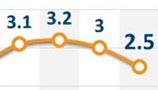
These came as Chinese economic growth dipped to a three-year low of 7.6 percent in the second quarter of 2012.
"We should be alert that these local governments' projects don't drag the banks into a bad loan crisis," said Fei Fangyu, a finance professor with Shanghai Jiaotong University.
Analysts say banks should learn from the experience that loans to solar panel manufacturing, ship-building and steel, which later suffered from over-capacity, notably went bad three years ago.
"The banking sector is extremely sensitive. We can't overlook the risks even though the overall NPL ratio remains low," said Zeng Gang, a researcher with the Chinese Academy of Social Sciences.
He said banks should ramp up measures -- including by slashing dividend payments -- to be better prepared for bad loan risks.

Copyright 1995 - . All rights reserved. The content (including but not limited to text, photo, multimedia information, etc) published in this site belongs to China Daily Information Co (CDIC). Without written authorization from CDIC, such content shall not be republished or used in any form. Note: Browsers with 1024*768 or higher resolution are suggested for this site.
License for publishing multimedia online 0108263 Registration Number: 130349