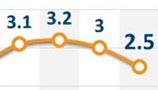
While China's economy continues to lose steam for the sixth quarter running, officials are starting to look at syndicated loans as a means of supporting large-scale construction projects to shore up the economy while fending off risk.
Syndicated loans refer to lending provided by a group of lenders which are arranged and administered by one or several banks, known as arrangers.
"At present the downside pressure on the economy is increasing. We need to support growth while checking financial risk, which requires better development of syndicated loan business," Du Jinfu, vice-chairman of the China Banking Regulatory Commission and a former deputy governor of the central bank, said at a conference.
The government has already started to clear the obstacles ahead of the more rapid growth of syndicated lending by exploring an information system for the online organization and registration of such loans, which would start in Jiangsu province in early September and be extended across the country in the fourth quarter.
Named "loanlink", the system is expected to realize the trade and transfer of such loans on a secondary market next year, to stimulate the development of the primary market, and help to set syndicated loans at reasonable prices.
Developing such lending is a sound solution to the dilemma of financing projects while preventing loans from getting too concentrated among certain clients or industries, Du said.
According to a report released by the China Banking Association on Tuesday, outstanding syndicated loans extended by lenders reached 3 trillion yuan ($470 billion) by the end of 2011, an increase of 22 percent year-on-year.
As of June, the figure may have already reached more than 3.4 trillion yuan, an increase of more than 14 percent year-on-year, said Zhong Gang, deputy director-general of the Market Development & Equity Investment Department of China Development Bank.
Syndicated lending has grown at an average rate of 41 percent over the past six years, according to Du.
"The proportion of syndicated loans to total corporate lending was nearly 9 percent by the end of 2011, which means there is still large development potential given the level of 20 percent in mature markets such as Europe and the United States," he said.
"Such lending was mainly developed by major State-owned banks and focused on financing infrastructure projects, which means it's still in its primary phase," said Zhong.
He forecast that, in the coming months, the growth of syndicated loans extended by banks will rise steadily as monetary policy continues to loosen, and construction projects are launched by local governments to stimulate the economy.
Some industry insiders are less optimistic compared with the officials in terms of the risks related to syndicated loans.
"It should be noted that such lending business only diversifies risks, instead of reducing risks. That means risks could still pile up and become a disaster one day if they are not handled properly," said Wang Shanying, assistant manager of the risk management department of The Export-Import Bank of China.
"Participants must make decisions based on their own preference in terms of risks and never follow the arrangers blindly. And they should get involved with risk management after lending by themselves, instead of relying on the arrangers."
Xiao Dongming, vice-governor of China Development Bank's Shanxi Branch, said banks would also tend to develop the business, because it could help generate deposits, collect fee income, expand off-balance sheet assets, and bypass some regulatory controls on lending quotas or curbs on the concentration of lending in certain areas.
China Construction Bank Corp, the nation's second-largest lender by assets, reported an 86.9 percent year-on-year increase in revenues collected through syndicated lending in its interim results on Sunday.
Despite the enthusiasm from both regulators and lenders, one barrier is obvious - when banks negotiate with clients, the application of a standard document is too limited, which is quite different from international markets and results in unnecessary costs for both sides, said Liu Dali, a partner at Jun He Law Offices.
But for lenders, the biggest headache is that the market is still dominated by buyers. "They tend to talk with banks one by one and agree a loan at the lowest price, instead of sitting down with all the participants," said Jin Qi, deputy manager of the Corporate Banking Department at Bank of Communications.
Capital controls and too much influence from macroeconomic regulation in the formation of interest rates has also restricted the development of the syndicated lending business by interfering in the pricing of such loans, the China Banking Association said in the report.
wangxiaotian@chinadaily.com.cn

Copyright 1995 - . All rights reserved. The content (including but not limited to text, photo, multimedia information, etc) published in this site belongs to China Daily Information Co (CDIC). Without written authorization from CDIC, such content shall not be republished or used in any form. Note: Browsers with 1024*768 or higher resolution are suggested for this site.
License for publishing multimedia online 0108263 Registration Number: 130349