Comments()
  Print
Print  Mail
Mail  Large Medium Small
Banks' total bad loans reached 456.4b yuan in the second quarter
Chinese businesses are holding more money in reserve to protect themselves against exposure to bad debt, suggesting that companies are becoming weaker and giving rise to worries about lenders' balance sheets.
|
 |
|
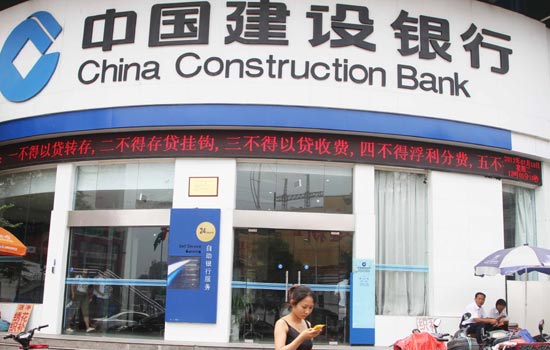
A China Construction Bank branch in Xuchang, Henan province. In the second quarter, Chinese banks held a larger amount of bad loans on their books for the third straight quarter in a row, according to the China Banking Regulatory Commission. [Photo/China Daily]? |
A report released on Wednesday by Wind Information Co Ltd, a financial information provider, showed that about 70 percent of the 516 public companies that had released their financial results for the first half of the year by Wednesday held more money in reserve during that period than theye had a year ago. Chinese accounting standards require companies to put money into reserve funds when they think they are in danger of not receiving payments owed them.
The China Banking Regulatory Commission said in a statement on Wednesday that Chinese banks, by the second quarter of 2012, had seen the amount of bad loans they held on their books increase for three quarters in a row. That was the first time that had happened in eight years, raising the total amount of bad debt by 18.2 billion yuan in the second quarter to a total of 456.4 billion yuan.
Non-performing loans became more prevalent at all types of banking institutions, including the largest State-owned lenders, rural banks and foreign banks, as China's GDP growth slowed to a three-year low of 7.6 percent. The increase in bad loans has weighed on banks' profits; the total net income of the 3,800 lenders in China increased at a rate of 23 percent in the second quarter of the year, down from 24 percent in the previous quarter.
Shanghai-traded Yangquan Coal Industry (Group) Co Ltd, a coal miner, put 128 million yuan ($20.1 million) in its reserve in the first half of the year. That was the largest amount set aside by any of the listed companies that had reported their first half earnings by Wednesday. Behind Yangquan Coal was China Vanke Co Ltd, a developer of residential properties, which added more than 100 million yuan to its reserve fund.
Companies that set aside money as a protection against bad debt are required to record "impairment losses", which directly affect their income statements and lower their earnings. And those that cannot collect payments that are owed them will find themselves starved of liquidity and threatened by bankruptcy.
At times, companies have also been known to hold more money than they need in reserve in a particular year and then reduce it in a subsequent year, seeing that as a way to ensure their profits increase in a smooth manner. The practice is most common among public companies, which use it to "squeeze out" profits and escape delisting, which becomes a risk to companies that report losses in three consecutive years.
It can also hurt banks.
"If a company cannot pay its suppliers, it's natural to think it would also have trouble paying interest owed on bank loans," said Wang Jianhui, chief economist with Southwest Securities Co Ltd. "And for a supplier, if it doesn't receive payments owed it by clients, it will have no money to pay banks."
China's economy is still facing big downward pressure and the foundation of a recovery is not yet solid, Premier Wen Jiabao said during a trip to the country's coastal Zhejiang province, China National Radio said on Wednesday.
Wen made the remarks when he met representatives of domestic and foreign companies during his two-day trip to assess the health of the world's second-biggest economy.
Wen added that economic difficulties may last for a while and that the government must focus on employment in the meantime.
The increasing prevalence of bad loans, or those that have been overdue for at least three months, is setting off alarm bells in a country where bank loans are the main source of corporate financing. A freeze in banking liquidity will cause havoc in the country's financial system.
In 1998, the government injected more than 270 billion yuan into the "Big Four" State-owned banks — Industrial and Commercial Bank of China Ltd, China Construction Bank Corp, Bank of China Ltd and Agricultural Bank of China Ltd — to protect them against the bad loans they held.
But economists believe that bad loans are still relatively rare in the Chinese economy and won't endanger the banking industry. They also think the bad loan ratio will decrease in the second half of the year, when economic growth rebounds.
By the end of June, bad loans made up 0.9 percent of banks' total loans, a proportion unchanged from March, according to the regulator.
Cao Yuanzheng, chief economist with BOC International Holdings Ltd, an investment bank, believes lenders will remain safe even if their bad loan ratio rises to 1.2 percent. Spain's ratio was 8.95 percent by the end of May.
Even so, Chinese lenders have become more hesitant to issue new loans. July saw the issuance of nearly 540.1 billion yuan worth of yuan-denominated loans. That amount fell below the 700 billion in such loans many economists had expected to see and was the lowest monthly amount recorded since October.
Jin Lin, chief banking industry analyst with Orient Securities Co Ltd, believes that the bad loan ratio is likely to show a sudden increase in the near future.
"A lot of loans were set to go bad but were not yet overdue," he said. "And lenders, to cover up their troubles, avoided marking them as bad loans. A time will come when these issues can no longer be covered up."
Contact the writer at gaochangxin@chinadaily.com.cn
Copyright 1995 - 2010 . All rights reserved. The content (including but not limited to text, photo, multimedia information, etc) published in this site belongs to China Daily Information Co (CDIC). Without written authorization from CDIC, such content shall not be republished or used in any form. Note: Browsers with 1024*768 or higher resolution are suggested for this site.
License for publishing multimedia online 0108263 Registration Number: 20100000002731