Comments()
  Print
Print  Mail
Mail  Large Medium Small
|
 |
|
China has become the biggest victim of malicious smartphone applications. The number of infected phones in the country is more than a quarter of the world's total. Smartphones running the Android operating system are the biggest target. [Photo/China Daily]? |
China is world's biggest victim with 18.23m malicious software attacks
For many people, it's hard to imagine life without a mobile phone. We spend unprecedented amounts of time playing with the little gadgets, whether it's at the breakfast table, under the office desk or beside the pillow.
We spend more time with our loyal digital assistants than we do with colleagues or family members. But have you ever thought that one day your mobile phone may turn against you and work for someone else behind your back?
A recent mobile security report found that, due to the popularity of smartphones, an increasing number of mobile phones have been hacked by malicious applications. Some of the "bad apps" were even preinstalled on the phones before purchase.
China has become the biggest victim of malicious apps. The number of infected smartphones in the country is more than a quarter of the world's total.
A total of 18.23 million smartphones were installed with apps designed to hack users' mobile accounts, up 42 percent compared with the second half of 2011, said the report released by NQ Mobile Inc, the nation's largest mobile security provider by users.
"The number of infections surged because some apps are able to copy and spread themselves to other phones," said the report.
The past two months saw an explosion in the number of malicious applications.
More than 10,000 new malicious apps were detected in May and June, while less than 2,000 similar apps were found in April.
Smartphones running the Android operating system were the biggest target. A total of 3 million Android phones were attacked in June, according to the report. The infection rate of smartphones running the world's most used open-source OS was 78 percent in June. The figure was 40 percent at the end of last year.
Android phones had about 67 percent of the market share in the first quarter of the year, and the proportion will increase by 10 percent each quarter, Beijing-based IT analysis company Analysys International said last month.
The Symbian system, which recently has fallen out of favor, is the second-biggest target for malicious software, with fewer than 500,000 new infections each month.
And malicious apps are smarter than most people realize.
A number of apps are capable of recognizing the location of the mobile phone. If the SIM card belongs to a region with tight controls over mobile phone crime, the malware applications will automatically cease attack.
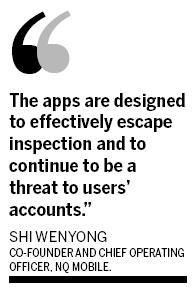
"The apps are designed to effectively escape inspection and to continue to be a threat to users' accounts," said Shi Wenyong, co-founder and chief operating officer at NQ Mobile.
One of the most common attacks is telephone fee deduction, according to security experts. More than 23 percent of the malicious apps were developed to secretly transfer pre-charged mobile phone fees to the hackers' accounts.
"The apps usually don't hit accounts with pre-charged values lower than 50 yuan ($7.85) because it's easier for those users to notice the losses in their accounts," Shi said.
Malicious app developers usually set the deduction amount at 1 yuan at a time, and they will not do more than three transfers per user in the same month.
"Users aren't likely to detect the 2-3 yuan change in their monthly phone bill," said Shi.
But the long-term effect is tremendous if we take the nation's significant smartphone user numbers into account.
The number of China's mobile phone users was 1 billion in March, nearly triple the figure in North America, data from the Ministry of Industry and Information Technology showed. And the figure is set to increase in the coming years.
Developers and spreaders of fee deduction malware applications receive nearly 4 million yuan every day, NQ Mobile's report showed.
Meanwhile, developers of malicious advertising apps — a type of malware that automatically pushes unwanted ads to mobile phone users and receives fees from advertisers — get more than 9 million yuan on a daily basis.
In addition, China's massive smuggled smartphone market provides another unique breeding ground for malicious apps, experts said.
Some smuggled phones may have preinstalled malicious apps, and buyers may suffer hefty economic losses on the first day they use the devices, according to Shi.
The country's large number of third-party online app stores is also an easy channel for malware apps.
The best way to get rid of malicious apps is to install anti-virus software. And more and more users are doing just that.
More than 260 million smartphone users in China installed at least one security software app in the second quarter of the year, an increase of 18.5 percent quarter-on- quarter, data from Analysys International showed.
"Smartphone users increasingly rely on security software.The function of anti-virus apps is expected to expand to fit all kinds of demand," said Liu Peng, an analyst at Analysys International.
"The wide spread of malicious software is forcing more smartphone owners to download security software. The move is set to increase competition among security software providers," Liu said.
gaoyuan@chinadaily.com.cn


 Michelle Obama addresses at Democratic National Convention
 Slides of Yanbian: place, people and prosperity
 Washington to remain focused on Asia-Pacific
 RQFII target blue chips amid bear market
 Australian recall for top two exporters
 China fears new car restrictions
Copyright 1995 - 2010 . All rights reserved. The content (including but not limited to text, photo, multimedia information, etc) published in this site belongs to China Daily Information Co (CDIC). Without written authorization from CDIC, such content shall not be republished or used in any form. Note: Browsers with 1024*768 or higher resolution are suggested for this site.
License for publishing multimedia online 0108263 Registration Number: 20100000002731