To help Chinese businesses that have fallen on hard times, the government may let them delay payments they are required to make into the country's social insurance funds or pay reduced amounts, a senior official said.
At a news conference on Wednesday, Yin Chengji, a spokesman for the Ministry of Human Resources and Social Security, said his ministry is aware that some small and medium-sized enterprises in eastern regions are struggling as the country's economic growth continues to slow.
"We will keep an eye on the business situations of SMEs," he said. "If a lot of them find it difficult to sustain their growth or keep operating, we will introduce a policy to help ease their burdens, one that is similar to one we had in 2008 and 2009, when the global financial crisis was hitting hard."
The country's social insurance system is divided into pension, unemployment, basic medical, workman's compensation and maternity funds.
By the end of 2008, the ministry had decided to allow businesses to apply for permission to delay the payments they are required to make into the country's social insurance funds, allowing them to postpone those for six months at the most.
The ministry would also let selected businesses reduce the premiums they have to pay into every social insurance fund except the pension fund for up to a year.
To obtain those benefits, businesses had to explain their difficulties to local social security authorities and then submit applications.
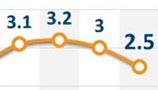
Dragged down by weak external demand and government policies aimed at controlling the property industry, the country's GDP growth slowed to a three-year low of 7.6 percent in the second quarter of this year.
"We are not talking about profits this year, but merely coming through this intact," said Yang Hua, general manager of Bestwish Home Textile in Nantong, Jiangsu province.
"A large number of companies in this industry, whether they are export-oriented companies or those that concentrate on the domestic market, are struggling in the hope they won't be shut down this year."
"Our previous customers are running away from us and turning to new partners in Vietnam, Cambodia and in some African countries, where they only pay workers a monthly salary equivalent to $60 to $70," Yang said.
Yang showed little enthusiasm for the government's current proposal to modify social insurance policies.
"Senior workers in our company, most of whom are from rural areas, actually don't want to pay social insurance and almost always prefer to use cash," he said.
Yang said his company does not pay social insurance premiums for everyone employed there.
In China, employers and employees each pay part of the pension, medical and unemployment insurance premiums that are owed to the government. Employers, though, are solely responsible for paying workman's compensation and maternity insurance premiums.
Lu Xuejing, a social security expert at Capital University of Economics and Business in Beijing, said the decision to delay and reduce premium payments proved to be wise in 2008 and 2009.
"Payments into the five types of social insurance are equal to about 30 percent of what employees are paid," she said. "It would give businesses a lot of relief if the payment of these premiums could be delayed or reduced."
Lu said small and medium-sized enterprises employ more than 80 percent of the country's labor force.
Compared with the pension premiums owed in other countries, the pension payments Chinese businesses must make are high, Lu said.
Every month, workers pay 8 percent of their wages into the fund and employers match that with an amount that is equal to 20 percent of the monthly wages they pay employees.
Shi Jing in Shanghai contributed to this story.
chenxin1@chinadaily.com.cn

Copyright 1995 - . All rights reserved. The content (including but not limited to text, photo, multimedia information, etc) published in this site belongs to China Daily Information Co (CDIC). Without written authorization from CDIC, such content shall not be republished or used in any form. Note: Browsers with 1024*768 or higher resolution are suggested for this site.
License for publishing multimedia online 0108263 Registration Number: 130349