|
 |
|
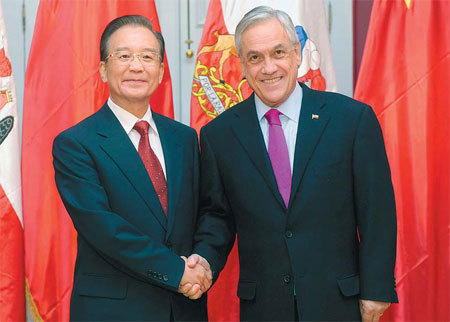
Premier Wen Jiabao meets Chilean President Sebastian Pinera during a banquet at La Moneda, the presidential palace, in Santiago on Monday. [Jose Manuel De La Maza / Presidencia De Chile Via Agence France-Presse] |
|
 |
|
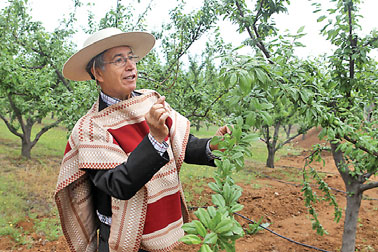
Alamiro Morales Mil, a Chilean agronomist, works in an apricot field in Jixian county, Tianjin. [Photo/China Daily] |
Andes Resort International sounds like the kind of place where Premier Wen Jiabao would be staying on his current trip to South America. But the property is a mere hour's drive from central Beijing, and there are more surprises when you get there.
The nation of Chile makes most people think of mines and wines - industries that represent the bulk its business with China and other countries. But on this suburban site in Jixian county, Tianjin, 23 hectares devoted to growing grapes and fruit trees present a fresh opportunity for trade.
Chile is a major producer of fruits and vegetables, and the demonstration farm on the resort grounds is a showcase for Chile's produce.
Thanks to a free trade agreement negotiated in 2006, Chilean fruit sales are expanding rapidly in China, says Nicolas Serrano Rolin, director of the Trade Commission Office of Chile in Guangzhou, Guangdong province.
The largest fresh fruit exporter in the Southern Hemisphere, Chile ranks behind only Thailand in fruit exports to China and No 1 in grapes, cherries, plums and apples, Rolin said. Total fruit sales surged 80 percent year-on-year to $441 million last year.
Most imported Chilean fruits are distributed from the Guangzhou Jiangnan Fruits and Vegetables Wholesale Market to major cities, including Beijing, Shanghai, Tianjin and Dalian, said Lin Yetao, a public relations manager of the market. Lin said Chilean fruit accounts for about 20 percent of the imported fruit his company handles.
Lin credits the growth to the free trade agreement - which cut duties on Chilean imports and made the country's fruits more cost-effective - and to the ever-increasing purchasing power of Chinese consumers. Plus, he notes, Chile is in the Southern Hemisphere, so it's harvesting and shipping fruits when they are not in season in China.
The demonstration farm, meanwhile, adds another dimension to the relationship, proving a chance to share Chile's fruit-farming expertise with China as the demand for fresh and safe food rises.
"The farming cultures are very different," said Alamiro Morales Mil, a Chilean agronomist who was recently in the apricot fields thinning the young fruits. Since there were a lot of visitors on this day, Morales was working in traditional costume: a flat-brim hat, colorful vest and ornate boots. He was plucking two of every three small green fruits off the branch, rolling them off his palm into a trash bag - a practice that makes his local work crew wince.
"Farmers here have traditions that were born in hard times," he said. "For them, the more grapes on a vine, the more plums on a tree, the better. The idea that you can add value by thinning, so the fruits that remain get all of the tree's energy, is pretty new here."
It takes a while, he said, to convince people that having fewer fruits that are bigger, sweeter and better shaped adds value that newly affluent Chinese will pay for. "The market decides," he added. "When imported fruits command good prices here, the Chinese growers want to get a piece of that business. And they should."
The learning isn't all one-way.
"When we came here, our Chinese growers were surprised and amused when we had top of the line arbors shipped over here for trellising the grapes," said Luis Schmidt Montes, Chile's ambassador to China. "They asked us what we were going to do with those, and when we explained, they all said 'Bu hao!' (No good!) very loudly."
The site isn't too far from Shandong province, China's coastal agricultural zone that is temperate enough to expose grape vines to winter weather. But the northern part of Tianjin gets kissed with -20 C and chilly winds. Here, the vines must be planted at an angle so they can be covered with soil during the coldest months, the way they protect vines in the blustery climates of Gansu and Xinjiang.
"We still have those arbors," Schmidt said with a chuckle, "as a monument to our foolishness."
That miscalculation aside, the Chileans offer a lot of expertise. "Table grapes represent 42 percent of our agricultural exports," Schmidt said.
Schmidt himself has been ready since the 1990s, when he was president of Chile's top agribusiness group. A man who speaks with a lot of energy and passion, Schmidt couldn't generate the same level of enthusiasm from the agriculture ministries in Beijing or Santiago. Finally, he decided he needed some "show and tell", and he urged both countries to collaborate on a demonstration fruit farm that would show Chinese farmers how they could meet the country's growing demand as well as showcase Chile's best produce.
"My agriculture minister at the time just looked at me and shook his head," Schmidt said, shaking his own head with a grin.
"He said, 'We have $100 million in trade with China, and 99 percent of that is in copper, in mining. And you want to make a farm? You are foolish!'"
However, after the Jixian site on the edge of Tianjin was settled on, Schmidt's "crazy" idea began to blossom. Today there is a five-star hotel, conference center, golf course and an "ecology garden" on the site - not to mention a row of huge replicas of the famous stone heads of Easter Island. Schmidt also made a winning pitch to acquire Chile's pavilion from the Shanghai Expo 2010 site after that world fair was over.
The resulting complex represents both the changes in that coastal area - more tourism, less farming - and Chile's determination to get noticed. The hotel and meeting rooms are usually booked to capacity.
Schmidt loves to take groups out to see the project, boisterously testing the exercise equipment in the hotel's health club, pouring wine for guests and leading after-dinner songs. Fresh fruit may be good business, but under his wing it seems to be a lot of fun, too.
Li Wenfang and Shu Meng in Guangzhou contributed to this story.
michaelpeters@chinadaily.com.cn

Copyright 1995 - . All rights reserved. The content (including but not limited to text, photo, multimedia information, etc) published in this site belongs to China Daily Information Co (CDIC). Without written authorization from CDIC, such content shall not be republished or used in any form. Note: Browsers with 1024*768 or higher resolution are suggested for this site.
License for publishing multimedia online 0108263 Registration Number: 130349