|
|
The total number of bank cards in China reached about 2.8 billion in 2011, according to figures from the People's Bank of China. [Photo/China Daily] |
Chips instead of magnetic strips will offer much better security
The view that banks are reliable and take good care of people's deposits is no longer true, at least in Zhao Ren's eyes.
The Beijing white-collar worker received an early morning text message on April 14 informing her that she had spent 560 yuan ($88) on in a credit card transaction at 4:30 am when she was actually asleep in her Beijing apartment.
Zhao called China Merchants Bank, the issuer of her credit card, and asked what was up. Bank staff said they were also confused and would check.
After weeks of delay, Zhao was eventually told it was very possible that her credit card account information had been stolen. In other words, someone had copied the information stored on the magnetic strip on her card and used it to transfer money.
"The bank admitted such cases happen occasionally and promised to give me a new card," Zhao told China Daily.
The card is vitally important to the relationship between banks and their customers. When users have a payment card in their wallet, they've got a part of their bank with them - the only piece of its infrastructure that they always carry around.
"However, we found magnetic strip cards have by their very nature some security flaws. They are not totally trustworthy," a credit card manager from China Construction Bank, who declined to reveal his name, said.
"That's why many countries across the world have already adopted advanced alternatives - chip cards," he added.
Compared with the magnetic strip card, with its easy-to-steal information, the chip card is much safer and can perform multiple functions, said Tang Jiye, a manager in the marketing department of Shanghai Pudong Development Bank Co Ltd.
The chip card, also called a smart card or integrated circuit card, has a unique identifier and digital seal that cannot be copied and put on to another card.
"In China, although banks have gradually started to offer chip cards since 2009, few people really know what a chip card is," Tang said.
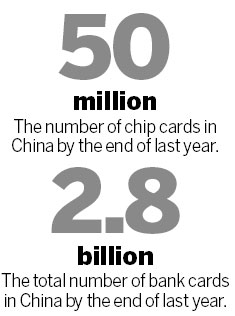
Suzanne Tong-Li, senior vice-president of the secure transactions business unit at Gemalto NV, the inventor of smart-card chips, estimated there were a mere 50 million chip cards in China by the end of last year. The total number of bank cards in China reached about 2.8 billion in 2011, according to figures from the People's Bank of China, the nation's central bank.
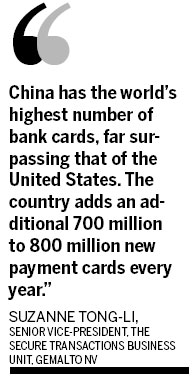
"China has the world's highest number of bank cards, far surpassing that of the United States. The country adds an additional 700 million to 800 million new payment cards every year," said Tong-Li. She pointed out that the small percentage of chip cards in China demonstrated a great threat to security.
Some neighboring countries of China, such as South Korea and Malaysia, have already migrated to chip cards, while Singapore, Japan and Australia are in the process of moving to the chip card phase, Tong-Li said.
Taiwan has stopped issuing magnetic strip cards and Hong Kong aims to turn to chip cards by 2014. For the Chinese mainland, the People's Bank of China issued guidance in March 2011 that specified the timetable for the adoption of chip cards.
It demands all national commercial banks begin issuing chip cards from Jan 1, 2013. Starting from Jan 1, 2015, all RMB account payment cards issued in China's economically developed regions should be chip cards.
"It is a challenging target for Chinese commercial banks," Tong-Li at Gemalto said. She expected the rate of chip cards out of the total number of bank cards could reach 80 percent in China by 2015.
The Amsterdam-based company already helped Industrial and Commercial Bank of China to launch the first batch of chip cards on the Chinese mainland in 2009. ICBC had issued more than 20 million chip cards in China by 2011, according to public figures.
However, one of the biggest barriers for Chinese banks adopting chip cards is cost. Each magnetic strip card costs about 1.2 yuan, and a chip card costs about 18 yuan, China Business News reported. That's why banks are reluctant to reduce profits and promote chip cards, the paper said.
shenjingting@chinadaily.com.cn

Copyright 1995 - . All rights reserved. The content (including but not limited to text, photo, multimedia information, etc) published in this site belongs to China Daily Information Co (CDIC). Without written authorization from CDIC, such content shall not be republished or used in any form. Note: Browsers with 1024*768 or higher resolution are suggested for this site.
License for publishing multimedia online 0108263 Registration Number: 130349