Comments()
  Print
Print  Mail
Mail  Large Medium Small
|
 |
|
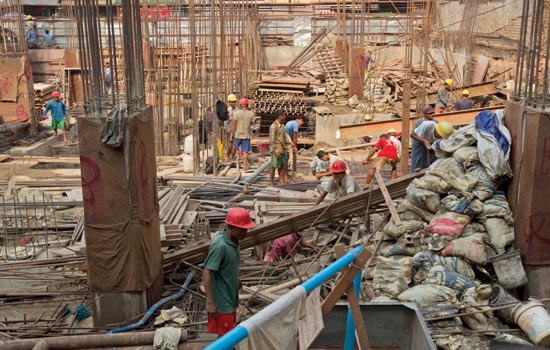
Workers on a construction site in Yangon, Myanmar. Last August, Myanmar President Thein Sein abruptly called off the construction of a Chinese mega-dam project in Myitsone, citing constant complaints from local residents and opposition forces. [Photo/Bloomberg] |
While all the signs point to the ushering in of an "economic spring" in Myanmar, as great opportunities attract foreign investors, there is unease among Chinese businessmen.
The latest sign of this "spring" is Myanmar's liberalization of its exchange rate.
On April 1, Myanmar introduced a managed float of its currency, the kyat, to help normalize and unify its exchange rates.
The same month witnessed Aung San Suu Kyi's opposition party, the National League for Democracy, achieve a landmark victory in parliamentary by-elections.
The Southeast Asian country, which had poor relations with the West for more than two decades, is also rolling out incentives to woo foreign investors.
The nation's law on foreign investment is expected to be amended soon, which will introduce tax exemptions for foreign investors
At a recent seminar in Beijing on investment in Myanmar, Soe Han, counsellor of Myanmar's embassy in China, explained the planned changes to the law.
He said customs duties for machinery and equipment during a new foreign project's construction period would be exempted, and income taxes would be waived for three consecutive years
Value-added taxes in Myanmar, once as high as 200 percent, were cut dramatically, with an upper limit of 5 percent.
And the situation for foreign investors will be even more attractive in Myanmar's special economic zones.
In its Special Economic Zones Law passed in January, foreign companies in the zones can enjoy tax holidays for the first five years, and 50 percent relief on income taxes for exported products. Myanmar now has three special economic zones: Kyauk Phyu on the west coast, and Thilawa and Dawei Seaport on the south coast.
"These policies are very favorable, much more favorable than China's policies," said Xu Ningning, executive secretary-general of China-ASEAN Business Council, who also attended the seminar.
Myanmar's economic liberalization has stirred enthusiasm for the impoverished but resourceful country among Western companies, which have been unable to do business with it due to long-standing sanctions.
In fact, Western companies are already moving into the country.
GE Healthcare, a unit of General Electric Co, said it was entering the Myanmar market with a local partner, while Standard Chartered Plc has said it is interested in re-entering the country.
US investor Jim Rogers said: "If I could put all my money into Myanmar, I would."
In contrast to Western companies' excitement, there are mixed feelings among Chinese entrepreneurs, who are concerned about the heated competition.
"Their entry is just a matter of time," Li Min, general manager of China Texmatech Co Ltd, told China Daily at the seminar. His company is helping build production facilities for Myanmar's state-owned textile producer.
He said the funding of Myanmar's state-owned enterprises was previously not a problem, but now the funding has to be approved by the nation's parliament.
"We used to compete mainly with Chinese companies. Now I'm afraid that we are going to compete with companies from the West, Japan and South Korea," Li said.
Chinese companies are also worried about the volatility of Myanmar's government.
Last August, Myanmar President Thein Sein abruptly called off the construction of a Chinese mega-dam project in Myitsone, citing constant complaints from local residents and opposition forces.
After the incident, leaders from both Myanmar and China tried to play down the issue. But it has undoubtedly cast a shadow over future investment from China.
"Of course we are concerned about the incident," said Ma Jun, a project manager of China Railway International Ltd, which has contracts for two road projects in Myanmar.
As a result, Chinese companies are increasingly aware of their projects' environmental and social consequences.
In his speech at the seminar, Li Zilin, vice-president of China National Petroleum Corp's Southeast Asia Pipeline Co Ltd, dealt mainly with his company's ethical approach and its work to help improve local people's lives.
CNPC's most important project in the country is a 2,000-kilometer gas pipeline that runs through the heart of Myanmar and ends at Kunming in southwestern China's Yunnan province.
CNPC holds a 50.9 percent stake in the project, while the remainder is held by Myanmar Oil and Gas Enterprise, the country's oil and gas industry monopoly.
"Until now, there has not been a single environmental inquiry from a third party," Li said, adding the construction is proceeding smoothly and is expected to be completed in July next year.
But Xu Ningning said Chinese companies should be confident about their strengths, given their large and long business presence in the country, geographical and cultural proximity, and the close relationship between the two countries' governments.
The Chinese mainland is currently the largest investor in Myanmar, having dedicated $13.95 billion by April, according to the Myanmar embassy.
The power industry is the area in which Chinese businesses are most active, accounting for 63 percent of Chinese investment. This is followed by oil and gas with 25 percent, and mining with 11 percent. These lucrative sectors are off limits to 100 percent foreign owned companies, according to Myanmar's Foreign Investment Law. Foreign companies are allowed a stake of no more than 35 percent when forming joint ventures with domestic enterprises.
Xu suggested Chinese investors should be particularly alert to Myanmar's policy changes. "Actually, more players in the country could bring prosperity to this country, thus creating more opportunities for our investors," Xu said.
zhengyangpeng@chinadaily.com.cn
| ?
 |
Copyright 1995 - 2010 . All rights reserved. The content (including but not limited to text, photo, multimedia information, etc) published in this site belongs to China Daily Information Co (CDIC). Without written authorization from CDIC, such content shall not be republished or used in any form. Note: Browsers with 1024*768 or higher resolution are suggested for this site.
License for publishing multimedia online 0108263 Registration Number: 20100000002731