China is adopting a series of policies meant to stimulate purchases of energy-saving products and stoke domestic demand.
The Ministry of Finance, the National Development and Reform Commission and the Ministry of Industry and Information Technology issued rules on Monday to encourage purchases of energy-saving flat-screen televisions and air conditioners.
|
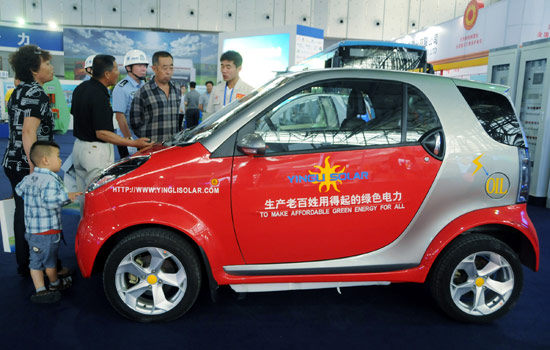 |
| A photovoltaic car attracts visitors at the New Energy Equipment Exhibition in Langfang, Hebei province, on May 18. China is adopting policies to stimulate purchases of energy-saving products and stoke domestic demand. [Photo / Xinhua] |
The release came after the State Council announced on May 16 that 26.5 billion yuan ($4.2 billion) in subsidies will be used to stimulate purchases of energy-saving products - mainly automobiles and household appliances.
The rules state that two energy-saving projects will officially begin on June 1 and will operate for a year.
The subsidies used to encourage purchases of flat-screen TVs will range from 100 yuan to 400 yuan, and those for plasma TVs will range from 250 yuan to 400 yuan.
For fixed-speed air conditioners, the subsidies will range from 180 yuan to 330 yuan, and for speed-controllable air conditioners, from 240 yuan to 400 yuan.
Makers of flat-screen televisions that seek to benefit from the policies should be able to sell no fewer than 500,000 TV sets in a year and makers of air conditioners that want to do likewise should be capable of selling no fewer than 100,000 units annually.
The subsidy plan comes as the successor to previous policies used to encourage purchases of various types of home appliances, said Bill Fan, an analyst with the financial services company Guosen Securities Co Ltd.
"Previous policies of this type have gradually ended in most of the provinces," he said. "The subsidy plan this time is aimed at boosting consumption amid a bad economy."
In line with the previous policies, sales of home appliances are subsidized in the countryside from December 2007 to January 2013. Meanwhile, rural residents also received subsidies if they chose to replace certain old home appliances with new ones between June 1, 2009 and May 31, 2010.
According to the Ministry of Finance's website, Vice-Minister Zhang Shaochun said the central government will provide as much as 2 billion yuan in subsidies annually starting this year to support the manufacture of new-energy vehicles, as well as to encourage research and development related to energy-saving vehicles.
He said the first step in that direction will come in promoting the use of hybrid buses in big and medium-size cities throughout the country. Meanwhile, the government will further encourage the use of alternative-energy vehicles in public transport in 25 selected cities, especially for official purposes and in the car-leasing industry.
The government is also expected to adopt other stimulus measures such as subsidies for automobile purchases, which the government adopted in 2009 in the hope of stoking domestic sales of automobiles.
"Favorable policies in rural regions are necessary," said Cui Dongshu, deputy secretary-general of the China Passenger Car Association.
"We also hope the government will introduce policies to reduce the purchase and consumption taxes imposed on vehicles to help promote sales in China's slowing automotive market."
The measures helped the country's demand for vehicles increase greatly in 2009 and 2010, when China surpassed the United States to become the largest market for automobiles in the world.
In 2009, the central government cut in half the sales taxes charged on vehicles with engine capacities of 1.6 liters or less. The authorities also provided 5 billion yuan in cash to help consumers replace their old vehicles.
The policy helped drive sales of smaller vehicles up by 71 percent year-on-year in 2009.
To maintain the growth, the government extended its stimulus measures for another year in 2010.
In part as a result of those policies, automobile sales in China increased by 46 percent in 2009 and by 32 percent in 2010.
But, the country's vehicle industry slowed greatly in 2011, when it did not enjoy such support, showing only 2.45 percent in year-on-year growth. That was the lowest rate it had recorded in 13 years.
In the first four months of this year, the automobile industry has seen its slow times continue. In the period, it sold 6.42 million vehicles, a drop of 1.3 percent year-on-year.
Contact the writers at lifangfang@chinadaily.com.cn and chenlimin@chinadaily.com.cn

Copyright 1995 - . All rights reserved. The content (including but not limited to text, photo, multimedia information, etc) published in this site belongs to China Daily Information Co (CDIC). Without written authorization from CDIC, such content shall not be republished or used in any form. Note: Browsers with 1024*768 or higher resolution are suggested for this site.
License for publishing multimedia online 0108263 Registration Number: 130349