Acquistions and mergers now expected within the industry
Ru'ao town, in Xinchang county, Zhejiang province, suddenly became famous in April - not for its beautiful scenery or outstanding economic growth but for a pharmaceutical safety scandal.
The town, with a population of fewer than 30,000 and an area of 100 square kilometers, produces 80 billion pills of capsules every year, accounting for more than 30 percent of China's total production.
 |
|
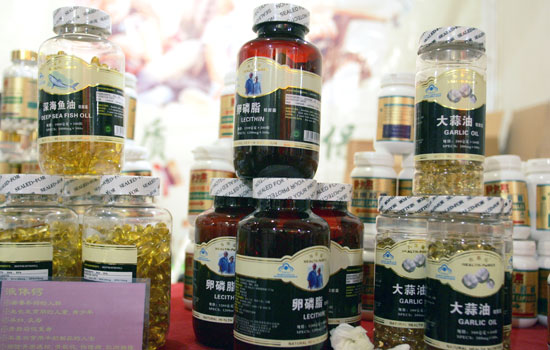
Bottles of capsule-packed deep sea fish oil, lecithin and garlic oil at a store in Beijing. Many healthcare drugs and foods sold in the Chinese market are foreign brands. According to the International Food Packaging Association, the price of industrial gelatin is 10,000 yuan a ton in the world market, compared with 30,000 yuan for edible gelatin and 50,000 yuan for pharmaceutical gelatin.?[Photo/China Daily] |
The scandal was exposed by the media on April 15. A total of 13 commonly used drugs made by nine big Chinese pharmaceutical companies were packed into capsules made from industrial gelatin, which contains a much higher degree of chromium and is priced much lower than edible gelatin. Eight of Ru'ao's total 34 capsule producers were involved. Their output makes up one-fifth of the town's production as a whole. They used gelatin made from waste leather scraps to process drug capsules. Chromium can be toxic and carcinogenic if ingested in large quantities.
The town has attracted food and drug administration and supervision officials, inspection and quarantine experts, industry association staff and the media. "The situation in Ru'ao might be regarded as a snapshot of China's capsule industry," said Zhang Shide, vice-chairman of the China National Pharmaceutical Packaging Association. "Low standards in the industry and ever-increasing demand led to decentralization and a boom in small-sized companies. The boom resulted in over-production, serious competition and price wars that, combined with a lack of self-discipline, created disordered and malicious competition within the industry."
Industry consolidation
Statistics from the association show that there are 117 companies with drug capsule production certificates in China. Most are located in Xinchang county in Zhejiang province, Huangshan city in Anhui province and Qingdao city in Shandong province and are small in size. Their combined annual production capacity is 200 billion pills. Meanwhile, 32 companies are members of the association, whose production accounts for 70 percent of the industry.
The relatively large producers include Anhui Huangshan Capsule Co, Jiujiang Ang Tai Group Co, Yili Capsule Co and Zhejiang Huaguang Capsule Co.
By the end of last month, products from 15 capsule producers, all small ones, were found to contain excessive levels of chromium. The State Food and Drug Administration imposed an immediate product recall and called for the destruction of the chromium-tainted products. Tests conducted by the Chinese Academy of Inspection and Quarantine found that sample capsules from pharmaceutical companies contained chromium in excess of 2 milligrams a kilogram - the maximum permitted under a Chinese Pharmacopoeia 2010 regulation - and one even contained 90 times the permitted level.
"The scandal will force the industry to consolidate in a relatively short period of time. Meanwhile, the price of capsules will increase by 20 to 30 percent soon," said Wang Weiliang, chairman of Xinchang Capsule Industry Association and also general manager of local company Xinchang Tianlong Capsule Co.
Edible gelatin is manufactured from animal bones and skins and is widely used in the food and drug industries, while industrial gelatin is usually made from waste, such as discarded leather. To further strengthen the regulation of capsule makers, the drug administration, the nation's top drug authority, has ordered them to draft specific standards on raw materials, mainly animal skins, bones and tendons. It also said that all producers of capsules have to be equipped with testing facilities and staffed with professional testing workers.
"Few companies have the capability in terms of finance and technology to meet the testing requirements," Wang said.
Currently, to produce 10,000 drug capsules in China, the high-quality edible gelatin needed costs around 150 yuan ($24). The same amount of industrial gelatin costs 60 yuan. In the international market, the price of industrial gelatin is 10,000 yuan a ton, compared with 30,000 yuan for edible gelatin and 50,000 yuan for pharmaceutical gelatin, according to the International Food Packaging Association.
Wang said that the average profit margin of China's medical capsule sector is between 3 and 5 percent, which is "rather low".
"Standardization in the industry and low profit margins are likely to squeeze workshop-styled companies, which lack funding capability and technology strength, out of the business," Wang added.
Zhang said the government should encourage relatively larger producers to conduct mergers and acquisitions. His association is also willing to coordinate work to support the consolidation.
"Many Chinese pharmaceutical companies have set the prices of capsule at an unreasonably low level. Some small capsule makers started using industrial gelatin made from discarded leather products to reduce costs. They should think twice. Which is most important - safety or business profit? How should they maintain a balance between price and quality?" Zhang Shide said.
The drug administration also has ordered pharmaceutical companies to beef up their quality control and testing procedures. Since May 1, pharmaceutical firms have been required to test every batch and category of capsules they purchase before producing drugs and local drug watchdogs must verify the test results released by these companies to ensure authenticity.
Given the limited resources of raw materials and an increase in operational costs, the price of capsules in the domestic market is expected to increase by double digits in the latter half of this year, according to Jin Shaohua, an analyst from domestic brokerage Guolian Securities Co.
Price hike
The price of edible gelatin rose by 30 percent year-on-year in 2011 because of a shortage of materials, including pigskin and animal bone. The cost of quality management and supervision is rising. Moreover, the closure of some factories will lead to a decrease in supply. Market demand is rising because of the fast development of China's pharmaceutical industry. "All in all, we believe the price will rise along with an increase in quality," Jin said.
He also said that imports would increase to a small extent and will to a degree further stimulate price rises. "But I don't think imports will jump noticeably because capsules are a product with low technological content and supervision of the industry is not difficult. So long as the government and the public attach great attention to the safety of the industry, improvements will soon be seen," he said.
A group of lawyers have united to take legal action against pharmaceutical companies that have misused industrial gelatin. Geng Shuang, a lawyer and leader of the team, said that "punitive damages" or "exemplary damages" should be demanded from irresponsible pharmaceutical companies and capsule makers.
Sina Weibo.com, a popular Twitter-like microblogging service in China, was flooded with comments, mostly condemnations, about the capsule scandal. Meanwhile, many netizens were critical that related government departments had failed to do their jobs of administration and supervision and were negligent in their duties. They said they should also be punished.
According to Zhang from the China National Pharmaceutical Packaging Association, many of China's capsule producers, especially comparatively big ones, are good at ensuring quality and supervise themselves well. But he added: "A few bad apples spoil the whole bunch. That's a lesson to us. Rebuilding public trust and confidence in the industry needs time."
Chinese scientists are carrying out active research and development into plant-based capsules. They are trying to use seaweed or other plant resources to replace animal materials.
The Institute of Oceanology under the Chinese Academy of Sciences is cooperating with Beijing Huangdao Ocean Biotechnology Co to develop seaweed capsule products, the price of which will be higher than products made by edible gelatin from animals.
According to Chen Junshi, a food safety expert at the Chinese Academy of Engineering, plant capsules are expected to be a new trend within the industry. They are also more environmentally friendly.
liujie@chinadaily.com.cn
  |

Copyright 1995 - . All rights reserved. The content (including but not limited to text, photo, multimedia information, etc) published in this site belongs to China Daily Information Co (CDIC). Without written authorization from CDIC, such content shall not be republished or used in any form. Note: Browsers with 1024*768 or higher resolution are suggested for this site.
License for publishing multimedia online 0108263 Registration Number: 130349