China's less-developed western provinces have become new champions of GDP growth, as the more advanced coastal areas experience setbacks in their export business.
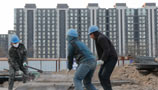
Wang Jian, a leading researcher with China Macro Economics Institute, noted that "a large-scale process is taking place in which industrial capacity from China's coastal provinces is being transferred to the poorer interior and western regions".
China's GDP growth will remain low over the next three months, said Wang.
With the exception of Gansu and Heilongjiang, the 29 provinces, municipalities and autonomous regions on the mainland released their GDP growth reports for the first quarter of the year.
China's overall GDP growth rate was 8.1 percent year-on-year in the first quarter, according to the National Bureau of Statistics, compared with 8.9 percent in the fourth quarter and 9.1 percent in the third quarter of last year.
Of the 29 provincial-level entities, only five, namely Jiangsu and Henan provinces, and the Guangxi Zhuang, Inner Mongolia and Ningxia Hui autonomous regions, reported higher growth rates than the rates they reported in the same period last year. And the other 24 all saw a slowdown.
Among the provinces with higher growth rates, only one, Jiangsu, was from the east coast.
But where are the familiar names that led the country's economic growth in the past decade, such as Guangdong and Shanghai?
In fact, nearly all of the members of the former leading pack are now trailing behind. In year-on-year terms, both Shanghai and Beijing grew merely 7 percent in GDP. Zhejiang, which is home to the nation's largest cluster of private enterprises, grew 7.1 percent. Guangdong, the largest province in foreign trade, grew only 7.2 percent.
The sagging momentum is due to sluggish demand from overseas and a tight domestic money supply, said Ba Shusong, a renowned economist with the State Council Development Research Center. But different regions are exposed to the impact of these negative factors in different ways, he said.
The worst hit area was Guangdong, which is much more heavily dependent on exports than any other province on the mainland.
In contrast, Jiangsu, the second-largest province in China in terms of GDP, could still obtain 9.8 percent growth in the first quarter while its foreign trade registered no progress from the same period last year.
Guangdong's problem is seen more vividly in some of its cities. Shenzhen, which used to grow much more rapidly than the rest of Guangdong, saw growth of 5.8 percent, the lowest in 32 years.
And Dongguan, an export-oriented manufacturing hub that was dubbed the "factory of the world," saw growth of 1.3 percent, its worst result since early 2009. The city is now in a "truly gloomy situation," said Lin Jiang, a professor of financial economics at Sun Yat-sen University in Guangzhou. "One sees no sign of its economy's early recovery."
Guangdong's export-led, labor-intensive industries explain its vulnerability to external market turbulence, said Cheng Jiansan, a professor with the Guangdong Academy of Social Sciences.
Although Guangdong remains the largest provincial economy in China, Cheng said Jiangsu has built a superior industrial structure and is capable of working much more flexibly with neighboring regions. "No one should be surprised that Jiangsu can keep growing faster nowadays."
Guangdong is undergoing "temporary growth pains", said an editorial in Nanfang Daily. But the temporary pains may be beneficial because they may result in changes to the province's economic structure, the newspaper said.
With heavy machinery and high-tech industries accounting for a larger share of its economy, Jiangsu can afford to rely less on exports than Guangdong. Jiangsu's technology sector contributed more than 35 percent to its total industrial output in the first quarter.
See a similar economic pattern in Zhejiang. Chen Jianjun, a professor of regional economics at Zhejiang University, noted that following the outbreak of the global economic crisis in 2008, Zhejiang and Guangdong could immediately pick up thanks to the financial stimulus program from the government, without having to change their business model.
But as soon as the stimulus program had done its work, these two provincial economies began to slump - showing the results of their slow adjustment, he said.
However, the growth pattern of all the faster-growing provinces is not without questions. They may not depend so much on exports, but they continue to depend on huge injections of government-sponsored investment in industrial and public facilities.
In the first quarter, Jiangsu's fixed-asset investment, the bulk of which is government-sponsored, grew 22 percent year-on-year, much faster than local consumer spending. Real-estate projects took up one-fifth of its fixed-asset investment.

Copyright 1995 - . All rights reserved. The content (including but not limited to text, photo, multimedia information, etc) published in this site belongs to China Daily Information Co (CDIC). Without written authorization from CDIC, such content shall not be republished or used in any form. Note: Browsers with 1024*768 or higher resolution are suggested for this site.
License for publishing multimedia online 0108263 Registration Number: 130349