|
 |
|
Cabbages on display at a fruit and vegetable market in Beijing. The price of farm produce has risen because of shortages following a long winter and poor cultivation policies by farmers.?[Photo / China Daily]? |
In a bid to find a cabbage to satisfy the pensioner's needs, the saleswoman showed him all the available produce and Zhang finally chose one weighing 1.5 kg. He was still reluctant to pay, however, and murmured: "If I bought a larger one, the extra money I spent would be enough to buy half a kilo of pork. Last autumn cabbage was only about 0.3 yuan per kg." The saleswoman has become familiar with this reaction to the soaring price of vegetables, where even young people, with little experience of inflation, have been raising an eyebrow.
In May, the weather begins to get warmer and it's harvest time for most farmers. The increased supply generally results in prices declining daily. However this year, May was different, because the prices of a whole range of common vegetables have risen markedly.
Pensioners such as Zhang, and those on low incomes, aren't the only ones affected by the rise. Many people have complained that they can no longer afford to buy large quantities of vegetables.
Statistics from Xinhua News Agency, which monitors national vegetable prices, show that on May 2, the price of cabbage had risen by 96.6 percent from the same month a year earlier. The price of radishes increased by 75.7 percent over the same period, while tomatoes registered an increase of 49.2 percent, a record high in recent years.
Meanwhile, data from the Beijing-based www.xinfadi.com.cn, the capital's largest wholesaler of agricultural products, show that on May 8 the wholesale price of cabbage was 2.3 yuan per kg, twice the asking price in April.
The situation has become a national phenomenon. According to statistics provided by the agricultural information platform 21food.cn, the wholesale price of cabbage over the past week has been 2 to 3 yuan per kg. In some cities in Zhejiang province, the price is more than 4 yuan, a massive rise from six months ago, when it was just 0.6 to 0.8 yuan per kg.
Substantial losses
"Oversupply meant that the price of cabbage was extremely low during the winter and some rotted in the fields because no one wanted to buy them. Many farmers suffered substantial losses, so they lost confidence in cabbage and began to grow other vegetables, which has resulted in severe shortages this year," said Zhang Yumei, a researcher at the Chinese Academy of Agricultural Sciences.
"Last year, after we conducted research in the regions where cabbage sales were most sluggish, we suggested that the related (government) departments and vegetable sellers should store cabbages over the winter months to avoid sharp price rises this year, but sadly, no one took up our suggestion," said Zhang.
Meanwhile, a long winter, low temperatures in the main vegetable-producing areas in March and April, and crop diseases and insect damage have exacerbated the shortfall.
Qin Peipei, director of the business department at the Shouguang Shangqing Agricultural Specialized Cooperative said the low temperatures resulted in poor crop yields. Moreover, the prices charged by the producers have also increased. Cabbage, for example, has risen to 1.4 yuan or 1.5 yuan per kg, twice the price of the same period last year.
And it's not only cabbage, other vegetables have also been affected.
"Usually by May, eggplants, cultivated in plastic shelters, are already ripe. But this year, only a small proportion have ripened, and they're small," according to Zhang Xueshan, a farmer from Cangshan county in Shandong province.
The increasing cost of labor has also been one of the main factors pushing up prices, he said. "The labor shortage has become a serious problem and affects many industries."
|
 |
|
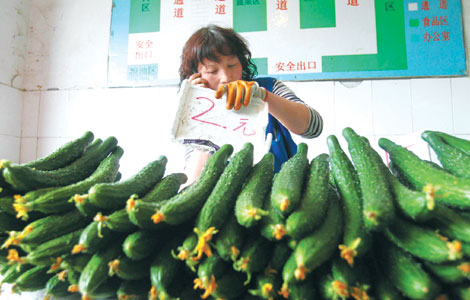
A stallholder holds a sign showing the price of cucumbers. [Photo / China Daily] |
Petrol price hikes
Ma Wenfeng, an agricultural analyst from Beijing China Agro Consulting Co, said that two recent hikes in the price of petrol have to be taken into account when considering the soaring cost of vegetables."The petrol price increases have also pushed up vegetable prices. There's a correlation between the two: generally every time the price of petrol rises by 4 percent, vegetable prices increase by 3 percent," said Ma.
Recent research conducted by the price bureau of Hainan province supported Ma's theory. The cost of transporting 1 kg of vegetables from the province's main supply bases in Kunming, the capital of Yunnan province and Nanning, the capital of the Guangxi Zhuang autonomous region, rose by 0.50 yuan to 0.54 yuan after the petrol price hikes.
The high fees charged by logistics services are another important reason for the price surge. Statistics from the China Logistics Association show that total logistics costs accounted for 18 percent of China's GDP in 2011. Although the figure has declined slightly from the 21 percent recorded in 2009, compared with the 10 percent level seen in many developed economies, the figure is still high. Generally, logistics account for 50 to 70 percent of the price of vegetables.
"To say that the high cost of logistics could become an obstacle to China's economic development is no exaggeration. The high fees charged by logistics services are one of the main reasons that vegetable prices are soaring," said Xu Guangjian, deputy director of the School of Public Administration and Policy at Renmin University of China in Beijing.
"One possible way to lower logistical costs would be to reduce the current highway charging criteria, and strengthen the management of road tolls to deter illegal charges, fines and the setting up of illicit toll gates. We should also reduce the number of intermediate links," he said.
Professor Zhang said a uniform charge for logistics services is also essential. The industry is poorly organized as a whole, because most operators are small or medium-sized companies with insufficient economies of scale.
"The more intermediate links involved, such as wholesalers and retailers, the higher the vegetable price. The best way to reduce prices would be to establish special logistics companies to deliver vegetables directly to the community markets in cities. Some districts in Beijing have organized direct vegetable transportation, which is a good way of reducing prices and should be promoted," she said.
"Blind" cultivation
"Because of their limited education, most farmers still find it difficult to make full use of information shared through the Internet. Their cultivation plans are mainly based on the experience of the previous year and suggestions from other farmers, which often lack any sort of market research," said Li Yu'e, a researcher at the Chinese Academy of Agricultural Sciences.
"These growing plans are often "blind" because most of the dealers in agricultural produce haven't signed production contracts with farmers.
Sluggish sales of some vegetables or fruits, a common phenomenon in recent years, for example potatoes in Shaanxi province and bananas in Hainan, have dampened farmers' enthusiasm to grow those crops," she said.
Li said that a national agricultural information service platform should be established, through which real time information on supply and demand could be sent to farmers' mobile phones. That could help to avoid wide price fluctuations and would also alleviate the situation whereby some farmers suffer diminishing returns and earn less even as their output increases.
"Local agricultural departments may also set up special units or assign special staff, preferably at least one in each county, to help farmers decide which plants to grow," she said.
Professor Zhang suggested that one way to minimize price fluctuations would be to store vegetables within easy reach of cities, but she admitted that more flexible solutions must be found.
"To stabilize vegetable prices, the ministry of agriculture should formulate a long-term plan to establish production bases near the cities they supply, to help reduce the number of intermediate links and logistics costs," she said.
Jin Zhu contributed to this story.
Contact the reporters at hena@chinadaily.com.cn or yangwanli@chinadaily.com.cn

Copyright 1995 - . All rights reserved. The content (including but not limited to text, photo, multimedia information, etc) published in this site belongs to China Daily Information Co (CDIC). Without written authorization from CDIC, such content shall not be republished or used in any form. Note: Browsers with 1024*768 or higher resolution are suggested for this site.
License for publishing multimedia online 0108263 Registration Number: 130349