A structural problem
"China's labor shortage is not a lack of labor in the general sense. In fact, it is a structural problem - and refers to a labor shortage in some professions, industries and regions," said Zhou Tianyong, an economics professor at the Party School of the Central Committee of Communist Party of China in Beijing.
|
 |
Moreover, this year's employment outlook for graduates is tougher than ever, because 2012 will see 200,000 more graduates than last year.
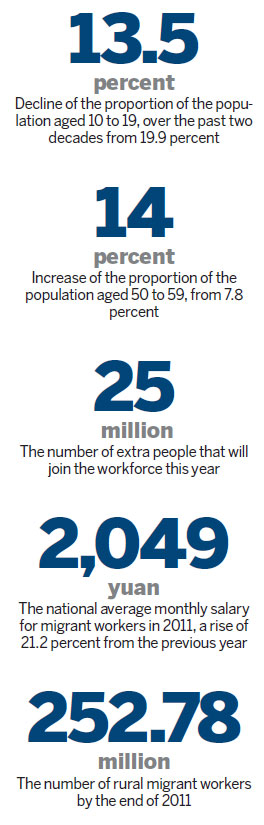
"Cities and towns will see 25 million extra people joining the workforce this year, more than half of whom will be university and college graduates, while another 9 to 10 million will be surplus rural laborers," said Yin Weimin, minister of human resources and social security, at a news conference in March.
Graduates are finding it difficult to get jobs and many enterprises are facing problems in recruiting workers and technicians, revealing structural problems in the employment market, said Yin.
According to Rong Lanxiang, president of Shandong Lanxiang Vocational School, the country's higher education system needs to be adjusted. "What students learn in college should be in line with social demand. Moreover, providing training in job skills would help to address the employment difficulties faced by college graduates, while at the same time addressing the shortage of skilled professionals," said Rong.
The pressure eases
Because of the slowdowns in both the global and Chinese economies, the shortage of laborers has eased slightly, especially for export-oriented companies. "Although it is still not easy to recruit suitable workers, the situation now is much better than it was at the start of last year," said Zhang Kuifeng, general manager of a Hangzhou-based clothing company.
"Last year, I had to ask a colleague in the human resources department to display a billboard at the employment office. But this year, workers have approached us or have been introduced by their fellow villagers," Zhang said.
Fang Qi, general manager of Ningbo Shentong Electrical Co, has had a similar experience. "It is still hard to recruit skilled, experienced workers and to keep them, we have to offer higher wages and better fringe benefits," she said, adding that the average monthly salary for an unskilled worker currently stands at 2,000 to 2,200 yuan, while the pay for skilled employees is more than 2,500 yuan, plus better fringe benefits (such as insurance and pensions).
"Even then, it is still not easy to attract experienced, skilled workers. So, we have now signed an agreement with some technical training schools so that we get first choice of the best students to become interns in our company. We hope that cooperation such as this will help to develop a talent pool for us," she added.
According to analysts, the easing of the labor shortage in Zhejiang province, where Ningbo Shentong is based, is the result of a combination of large increases in wages and a reduction in orders because of weakening external demand.
According to Zhou Dewen, chairman of the Wenzhou small and medium-sized enterprises development association, the average monthly salary for workers in Wenzhou rose by 15 percent to 25 percent last year, with the lowest wages averaging more than 2,000 yuan.
Meanwhile, some businesses have lowered their manufacturing capacities or even suspended production temporarily, in the face of growing economic uncertainty. That has led to reduced demand for laborers. "So far, around 20 percent of Wenzhou's enterprises have stopped or slashed production," said Zhou.
Economic restructuring
In February, the Ministry of Human Resources and Social Security said that the average monthly salary for migrant workers reached 2,049 yuan nationally in 2011, a rise of 21.2 percent from the previous year. That increase accompanied a year-on-year rise of 4.4 percent in the number of rural migrant workers, with the number hitting 252.78 million at the end of 2011, said Yang Zhiming, deputy minister of human resources and social security.
The rapid rise in wages for migrant workers has weighed heavily on enterprises and prompted them to move up the value chain. Fang said her company's profit margin narrowed by more than 10 percent last year because of rising labor costs and declining sales. "We are now developing new products to attract customers in emerging markets as demand from Europe and the United States continues to fall," Fang said. "But the rising costs of labor and raw materials will remain a huge challenge for us in 2012."
As a medium-sized manufacturer of vacuum cleaners, Ningbo Shentong's labor costs have risen nearly 20 percent this year, Fang added. "This year, we've invested heavily in product innovation in the hope that high-end products will bring a wider profit margin to offset rising costs," she said.
Sun Chi, an economist at Normura Securities, said that rising wages will force companies to move up the value chain and boost total-factor productivity, a term economists use to describe the amount of total output that is not fully explained by the amount of input. The government has pushed for such a move for many years, but businesses had little incentive to do so while they could tap such a vast pool of cheap labor.
On the other hand, rising wages have also helped to stimulate consumption and fuel the transformation of the Chinese economy from one driven by exports to a model that's more reliant on increased internal consumption. According to a report by Normura, the decades-long decline of the household share of national income reflects China's traditional cheap-labor advantage. But if labor shortages now lead to rapid wage growth, especially among low-income groups, household consumption is likely to boom because low-income households have a greater propensity to spend.
China's labor shortage will be a long-term problem, rather than a short-term concern, according to some economists. Stephen Green, an economist at Standard Chartered Bank who specializes in China, said the growth rate of new jobs will exceed the increase in the number of workers and the situation will deteriorate during the coming decade. "We estimate that the growth rate of the labor population will be close to zero in the coming years, so improving efficiency is key to sustaining economic growth," said Green.
According to Nomura, the proportion of the population aged 10 to 19, the "pipeline workforce", has fallen steadily over the past two decades from 19.9 percent to 13.5 percent, while that of workers in the 50 to 59 age bracket (the official retirement age being 60 for men and 55 for women) has increased from 7.8 percent to 14 percent.
This development suggests that the proportion of the workforce to the population as a whole is close to peaking. "These labor market trends are intricately linked to China's ongoing economic restructuring and are helpful in sustaining growth," said Sun.
Contact the reporter at huyuanyuan@chinadaily.com.cn


Copyright 1995 - . All rights reserved. The content (including but not limited to text, photo, multimedia information, etc) published in this site belongs to China Daily Information Co (CDIC). Without written authorization from CDIC, such content shall not be republished or used in any form. Note: Browsers with 1024*768 or higher resolution are suggested for this site.
License for publishing multimedia online 0108263 Registration Number: 130349