Comments()
  Print
Print  Mail
Mail  Large Medium Small
|
 |
|
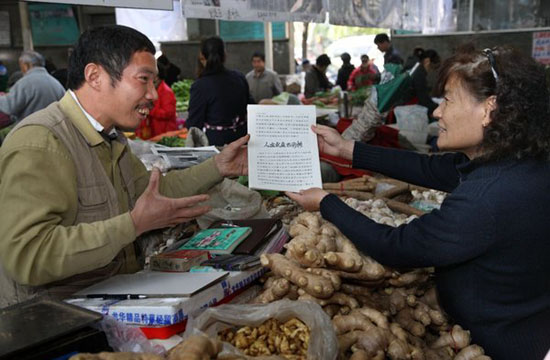
Doctors are offering voluntary medical checks in Yichang city, Hubei province. The increasing popularity of household medical devices has made self-check more convenient. [Photo / China Daily] |
"It was really magic," said Zheng, a 40-year-old Beijinger. "My father bought it on a business trip to Japan for my mother, who was suffering from high blood pressure."
"That Omron sphygmomanometer was our first household medical device. Now we have an electric thermometer, a blood glucose machine, a pedometer and fat-weight analyzer," she said.
Recently, Zheng bought an electric wheelchair made by Jiangsu Yuyue Medical Equipment and Supply Co Ltd for her mother, who is partially paralyzed after a stroke last year.
Zheng and her family are not alone. Home health devices are a significant growth industry in China, as the population ages and people's standard of living continues to improve.
In the past decade, a range of medical devices - from monitoring equipment to electric wheelchairs to massage chairs - has become common in urban households.
The market for these devices will continue to increase as Chinese consumers demand timely and effective treatment of a variety of health conditions, said Wu Guangming, vice-chairman of the China Association for Medical Devices Industry.
Sales of household medical equipment in China amounted to 14 billion yuan ($2.22 billion) in 2010, or 14 percent of the 100 billion yuan ($15.8 billion) the nation spent on all medical equipment. The ratio in developed countries is about 25 percent, according to the association.
Medical equipment sales are expected to reach 200 billion yuan by 2015, with an average annual growth rate of 25 percent, but "the home health device sector will develop faster", Wu said.
Per capita expenditure for home health devices in China was 7 yuan in 2009, compared with 90 yuan in the United States and 75 yuan in Japan.
"In developed markets, a sphygmomanometer is a must for people with cardiovascular diseases, and any diabetes patient should have a blood glucose monitor, which helps them keep track of their body's condition and get immediate treatment when symptoms emerge," said Wu.
Chinese consumers first encountered household medical devices from foreign manufacturers, such as Omron and Philips, but are now being courted by emerging Chinese makers, such as Jiangsu Yuyue and Tianjin-based Andon Health Co Ltd.
Domestic and foreign firms share the market about equally, according to Bai Yu, chairman and president of Beijing Rehabilitation Home Trading Co Ltd, China's largest household medical device chain retailer with more than 20 direct sales outlets around the nation.
"They are equal in the wheelchair sector. The foreigners are taking the upper hand in the electronic thermometer and blood glucose instrument area, while domestic household oxygen machines are dominant," Bai said.
Foreign brands have an edge in new technology, while domestic makers offer affordable prices and after-sales service, he added.
Omron Healthcare, the medical device arm of Japan-based Omron Corporation, was one of the pioneer home health equipment manufacturers in the Chinese market. It set up a joint venture in Dalian, Liaoning province, in 1991 and has since expanded its business from coastal cities to central China.
Between 2006 and 2010, Omron's annual sales growth reached 30 percent. Sales of the company's blood pressure monitor in China exceeded those in Japan and Europe in 2009. So far, Omron accounts for about 65 percent of China's electronic sphygmomanometer market, the company said.
Wang Ying, strategic development director of Omron Healthcare China, said that the company plans to add data storage, analysis and transfer functions to its products.
When Zheng Xinyi was looking for a wheelchair for her mother, she preferred Chinese brands, which are generally half the price of foreign models.
Zhou Rui, an analyst for China Investment Consulting Co Ltd, said in addition to competitive prices, Chinese companies offer designs tailored for Chinese consumers, whose physical conditions are somewhat different from Westerners', and convenient service, as the producers have established sales and service networks around the nation.
Although the market is promising, Wu said strict registration, approval and supervision mechanisms should be established as soon as possible.
liujie@chinadaily.com.cn
Copyright 1995 - 2010 . All rights reserved. The content (including but not limited to text, photo, multimedia information, etc) published in this site belongs to China Daily Information Co (CDIC). Without written authorization from CDIC, such content shall not be republished or used in any form. Note: Browsers with 1024*768 or higher resolution are suggested for this site.
License for publishing multimedia online 0108263 Registration Number: 20100000002731