|
|
|
 |
|
|
|||||||||
Looking back on his time as a migrant worker in Dongguan - a manufacturing hub in South China's Guangdong province - the chicken and pig farmer Nong Hongneng, 45, utters a deep sigh.
"When I worked in Dongguan, I was always being scolded by my boss, and I earned hardly any money," he said.
Nong was lured back to Shangguoling, a village in Napo county in South China's Guangxi Zhuang autonomous region, by the favorable policies of his hometown government to help returning migrant workers develop their own businesses.
|
 |
|
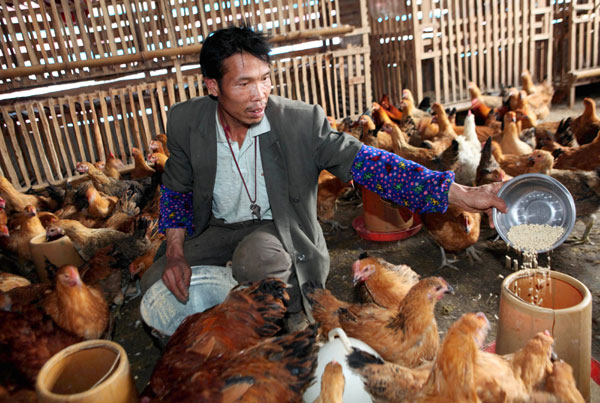
Nong Hongneng, a farmer in Shangguoling village of Napo county in the Guangxi Zhuang autonomous region, feeds chickens in his farm recently. He began raising chickens and pigs in 2008 with the help of the local government's supporting policies. [Photo/China Daily] |
Guangxi, a region with one of the nation's largest poor populations, was engaged in a decade-long poverty reduction campaign from 2000 to 2010.
Nong started his chicken and pig farm in 2008, and he was soon honored by the local government for his success and given more support by the government. Last year, his farm had 500,000 yuan ($79,000) in revenue.
Nong's ambition grew even stronger when he learned in February that Guangxi was reviving its poverty alleviation campaign.
Guangxi has selected 6,540 villages and 57 counties as the main targets of the campaign over the next 10 years, said Mo Yanshi, deputy director of the regional office of the poverty alleviation and development.
Guangxi's rural poor population reached 10.12 million, more than 20 percent out of its residents, when the nation reset the poverty level last year to 2,300 yuan in annual per capita net income. Previously, it had been 1,196 yuan.
During the 12th Five-Year Plan period (2011-15), the region will develop 3,000 impoverished villages to increase the per capita income to 5,000 yuan.
Over the next four years, a total of 150 billion yuan will be invested in fighting regional poverty, 80.2 billion yuan of which will come from the central government, said Mo.
Most of the funds will be used to help low-income residents create or develop their own businesses and ultimately have sustainable, stable and relatively high incomes, Mo said.
Nong, who is also expected to benefit from the campaign, built his second pig farm with the help of the local government, which gave him steel and cement for the construction.
For Ma Zhenlong, a tobacco planter in Dehe, a village in Napo county, the help with planting techniques is more important. Ma, 62, returned home in 2009 to plant tobacco and expanded his tobacco field to about one hectare with support from the government.
"Our village is one of the key targets of the poverty reduction campaign, and they have not only given us money and built a tobacco drying house for us, but have also sent experts to show us how to plant and bake tobacco," Ma said.
To alleviate the pressure of borrowing, the regional government will pay the interest on loans taken out by rural poor families. The interest subsidy policy started in the last poverty alleviation campaign. In 2009, Nong got subsidized government loans that helped him expand his farm.
"With government support, I have more confidence to develop my business," Nong said.
Meanwhile, the region is conducting a pilot program to set up mutual aid funds in some poor villages to ease the funding shortage. The funds will be from 150,000 to 300,000 yuan, depending on the village population, and will be managed by associations of local farmers.
To channel the poverty alleviation fund to the right people, Guangxi will conduct a census of the poor in the next three months.
The region plans to help the rural poor increase their annual incomes by 12 percent by 2015.
"I hope to earn enough money to build a new house to replace my current old tile-roofed one," said Ma.
Contact the writers at Gaoqihui@chinadaily.com.cn
Huoyan@chinadaily.com.cn and Huangfeifei@chinadaily.com.cn