|
|
|
 |
|
|
|||||||||
|
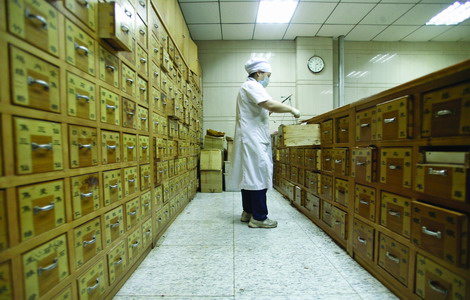
A pharmacy worker prepares packets of herbs used in traditional Chinese medicine at the Beijing Traditional Chinese Medicine Hospital. Overseas demand for not only the herbs but also herb extracts has risen in recent years. [Photo / Provided to China Daily] |
For China's TCM exporters, the main challenges are technical standards, which are especially stringent for formulary TCMs, and registration in developed markets.
In terms of raw materials, sliced medicinal herbs and plant extracts, each product has its own individual characteristic, and so the task of formulating technical standards and obtaining market registration isn't too difficult.
However, the formulas for TCMs are complex, usually involving several or possibly dozens of ingredients, each with its own individual characteristic. That means that drawing up a unified industrywide code of standards and establishing a standard for each medicine is virtually impossible.
Because of their limited knowledge of TCMs, many overseas authorities apply the standards relating to synthetic medicines to TCMs, thus necessitating chemical indexing and data garnered from clinical trials. However, scientific research into TCMs, especially into compound formulary medicines, only started in the mid-1980s and so no long-running databases are available.
"In addition to using modern technologies to carry out pharmaceutical studies into raw materials and formulary TCMs to provide the data required by foreign medical authorities, we also have to combine the popularization of TCM culture with product promotion," said Tongrentang's Mei, adding that helping to improve foreign consumers' knowledge of TCMs will be a crucial requirement in the internationalization of the medicines.
In addition to the technical problems, new rules concerning market registration are also hindering Chinese companies' attempts to enter some overseas markets. In May 1994, the European Union imposed new registration rules for TCMs, which required a registration period of seven years. During that probationary period, the health department tests and retests the effectiveness of formulary TCMs. However, the strict data requirements and high registration fee - nearly $1.3 million for a formulary TCM containing only a small number of ingredients - mean that few Chinese companies have bothered to register.
"I don't think the EU is setting barriers and intending to make TCMs withdraw from its market," said Guo Fanli, a pharmaceutical analyst at China Investment Consulting Co Ltd. "The EU government is aiming to standardize the market to meet the increasing demands of European consumers in terms of both health and safety, and Chinese companies should actively adapt to the mechanism."
A number of Chinese government departments, including the Ministry of Commerce, the Ministry of Health and the State Food and Drug Administration, have been in negotiations with EU health authorities. They have selected 10 medicines made by three large TCM companies in an attempt to secure registration. In this way, they hope to explore a practical and efficient way for TCM products to re-enter the EU market.
Liu from the import-export chamber said that TCM manufacturers are making strenuous efforts to upgrade their technologies, optimize their export structures and establish brands that will support expansion over the long term.
Technological upgrading
Located in the Chengdu High-Tech Zone, Sichuan Neautus Traditional Chinese Medicine Co Ltd is virtually indistinguishable from every other high-tech company in the district: the only difference is the bittersweet herbal smell emanating from its premises.
Founded in 2001, this well-known processor of medicinal herbs moved from a small factory in rural Chengdu, where production was undertaken mainly by hand, to modern buildings in 2009. In the new complex, there are not only machine-dominated workshops, but also labs for research and development and quality supervision.
The company's annual production of medicinal sliced herbs was 400 tons six years ago. During the past two years, the annual output exceeded 5,000 tons. Now, the capacity is 8,000 tons and the facility can produce more than 1,000 varieties of sliced herbs.
"We pay great attention to maintaining, but also innovating, traditional processing techniques, while promoting standardization. We have employed a number of sophisticated, experienced pharmacists to conduct research into the production process and to study the international standards," said Jiang Yun, chairman of the company, which has become one of China's top 10 exporters of medicinal sliced herbs.
As the traditional importers of sliced herbs, such as South Korea and Japan, have raised their quality thresholds, many small businesses have quit the market. In response, Neautus has initiated an alliance with some smaller producers of sliced herbs.
"We help them increase their technological capability and raise quality to meet the new standards overseas, and they help us meet the orders. It's mutually beneficial," said Jiang.
The company declined to disclose any financial details because it's in the process of applying for an IPO on the Chinext, China's Nasdaq-style second board, but insisted that its export growth is stable.
Guo of China International Consulting said that combining with other companies to raise quality and realize industry upgrades is one way that Chinese producers of sliced herbs can maintain their businesses in the international marketplace.
The pace of growth of exports of medicinal sliced herbs and other raw materials with lower added value, is slowing. According to Liu of the import-export chamber, China exported $767 million of raw materials and sliced herbs in 2011, a year-on-year increase of 17.7 percent. During the first nine months of 2010, the export volume of these products amounted to $509 million, a rise of 25.93 percent from a year earlier.
"Chinese companies are seeking more added-value products, such as plant extracts. This type of product is easier to transport and widely used in the whole healthcare industry, involving "energy" products, such as the drink Red Bull, nutritional supplements, pharmaceuticals and cosmetics," said Liu, who forecast that the sector will see annual growth of around 20 percent during the next decade.