|
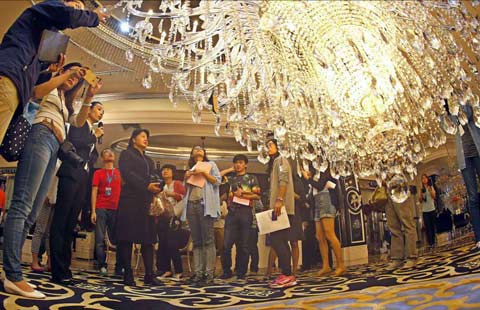
Although Women's Day is not a big day, many female white collar workers use it as an excuse to reward themselves through buying high-end goods such as Bottega Veneta or Louis Vuitton handbags. But for the rest of the year, their credit card bill may be their biggest headache. [Fu Yexing / for China Daily] |
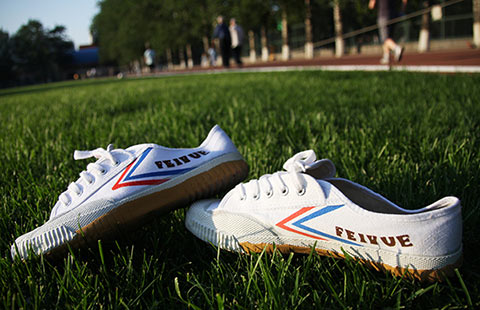
BEIJING - Xiao Le, a 25-year-old administrative assistant at an advertising agency, spent 430 yuan ($68.25) on 10 items of clothing at a wholesale market in Beijing. She says she enjoys finding the "occasional pearl among a seabed of oysters".
"Look at this navy stripe T-shirt - 100 percent cotton. Guess what? Only 35 yuan," said Xiao. She then picked up a pair of skinny blue jeans from her bed. "This pair - only 65 yuan."
Xiao said she got up very early to go to the market in order to find the "pearls". In addition to going to flea markets, Xiao likes online shopping. She said she surfed the Internet shopping portal Taobao.com a lot because it has everything she wants at affordable prices.
"I only buy things that I can afford. I cannot imagine spending 10,000 yuan, which is nearly three months' salary for me, merely on a bag or a pair of shoes," she sighed.
Xie Wei, a college student, has her own way of saving money - she exchanges clothes with her best friend and roommate.
"We are the same size and have almost the same taste in clothes so it's good that we can share garments and spend less of our parents' money," said Xie.
While Xiao and Xie are happy about the bargains they have ferreted out, on the other side of the city chic white collar worker Wang Si is planning to buy herself a gift for Women's Day. She has chosen a Tiffany ring featuring a tiny diamond.
"I reward myself with beautiful gifts on special days," said the 35-year-old senior auditor. "Although Women's Day is not a big day, I just want to find a way to relieve work stress and make myself happy."
Wang is by no means alone in buying high-end goods. Li Li, a 29-year-old fashion editor, is also planning some conspicuous shopping on the Women's Day holiday.
She plans to buy two of the latest Bottega Veneta handbags. "I love those two bags - the style, the color. I need to buy them. I have been longing to do so for months," said Li. "But for the rest of the year, my credit card bill will be my biggest headache."
Zhang Yansheng, director of the Institute for International Economics Research under the National Development and Reform Commission, China's top economic planning body, said that when a country's annual per capita gross domestic product reached the threshold of $4,000, its consumption structure will change from survival mode to one of enjoyment. Last year, per capita GDP in more than 10 municipalities, provinces and autonomous regions surpassed that figure.
According to the World Luxury Association, the number of Chinese people who bought luxury products has reached about 200 million and showed a growth rate of 25 percent year-on-year.
The association said combined personal luxury spending on the Chinese mainland, in Hong Kong and in Macao has reached more than 150 billion yuan a year. China is expected to replace Japan as the world's top consumer of luxury goods this year because of growing demand in the nation and declining consumption in Japan, according to the association.
A report by the association showed that during the Spring Festival holiday, which fell in January this year, purchases of luxury products outside the country by Chinese nationals totaled $7.2 billion, a year-on-year increase of 28.6 percent. It was mainly spent on watches, leather goods and clothing.
Driven by the surging demand, giant shopping malls have been springing up in Chinese metropolises such as Beijing, Shanghai and Shenzhen. Luxury goods makers are rushing to open outlets in second- and third-tier cities to seek faster growth.
The British bespoke tailoring company Gieves & Hawkes entered the Chinese market in 1995 when it opened its first store at the Beijing Peninsula Palace Hotel. The company has just exceeded the 100 shop mark across the Chinese mainland, Hong Kong and Macao and it wants to be in almost every province.
French luxury goods producer Louis Vuitton, which is the most recognized brand, has established stores in second- and third-tier cites, including Dalian and Hangzhou. Burberry plans to expand from 57 to 100 stores within five years. Herms has even launched its own China-specific sub-brand, Shang Xia.
The global business research and consulting firm Frost & Sullivan said there will be 160 million Chinese willing to spend money on luxury goods in the next five years, mainly in second- and third-tier cities, which will be the main battlefields and driving engines for luxury labels in the future.
A survey by the Taiwan External Trade Development Council shows that the number of Chinese individuals with assets totaling more than 10 million yuan has passed 1 million and estimates that high-end consumption in the country will pass 70 billion yuan a year in a few years.
The survey shows the number of people with investable assets - excluding houses owned for their private use - of more than 10 million yuan is more than 500,000. If private homes are taken into account, the number of people meeting the level comes to 1.1 million.
The latest Hurun wealth report reveals there are 960,000 yuan millionaires in China. The growing number of super-rich are seeking ways to show off their social status, including purchasing luxury sports cars, yachts and private jets.
An increasing number of middle class are also buying high-end goods.
According to management consultancy McKinsey & Co Inc, as these middle-class consumers acquire the designer habit, China is becoming the world's largest luxury market, worth $27 billion a year, up from $10 billion in 2009.
"I purchase luxury bags or perfume in the Sanya duty free shop because I get the opportunity to fly there twice a year for business," said Chen Ping, a sales in Beijing. "I know the price there is not as cheap as in Hong Kong, but it is better than in Beijing."
Chen said he was willing to spend a month's salary on a Swiss watch because he feels the need to wear at least one expensive item to show off his taste.


Copyright 1995 - . All rights reserved. The content (including but not limited to text, photo, multimedia information, etc) published in this site belongs to China Daily Information Co (CDIC). Without written authorization from CDIC, such content shall not be republished or used in any form. Note: Browsers with 1024*768 or higher resolution are suggested for this site.
License for publishing multimedia online 0108263 Registration Number: 130349