Need for managing inflation
Updated: 2012-02-22 11:06
By Syetarn Hansakul (China Daily)
|
|||||||||


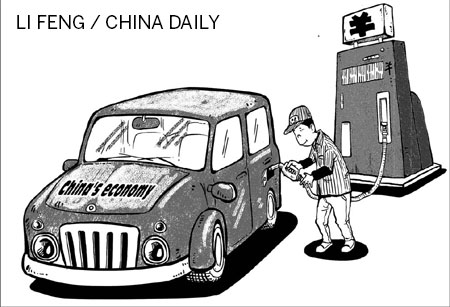
Over the weekend, China's central bank announced it would lower the reserve requirement ratio by half a percentage point to 20.5 percent for larger financial institutions in an effort at "fine tuning" as Premier Wen Jiabao said a week ago.
It's a move intended to maintain economic growth by pumping up substantial amount of liquidity into the financial system while keeping inflation in check.
Managing inflation expectations in China is not an easy task. In a country with a population of more than 1.3 billion people, the key economic objective is to deliver economic growth and jobs. In recent years, the emphasis has been shifted to not only the level of growth alone, but also the quality of growth and sustainability. Keeping price pressures within reasonable limits and managing inflation expectations remain significant.
A look at the past few decades shows that the country has fared well in regards to inflation management. The double-digit inflation days of the 1980s and mid-1990s appear to be over. In the past decade, inflation was contained at below 6 percent on an annual average basis, despite consistently strong economic growth. Nonetheless, the road ahead will not be easy.
It's not always convenient to blame domestic inflation on food prices. With several ongoing structural changes, price pressures look set to intensify. The structural changes include the rise of large emerging market economies, which include China that would imply a persistent surge in demand for the world's scarce commodities such as oil, minerals, and food.
The pressure for higher wages is here to stay. One only needs to look at recent labor discontent in the southern provinces to see the picture. Plans to provide for better welfare for workers along with their pension plans are positive steps that will raise the cost of hiring workers.
Additionally, the green tax, which is necessary for long-term sustainable growth, will raise production costs and the prices of products. Higher commodity prices and wages seem inevitable as the nation matures into a new stage of development. Although it is mainly food price inflation that has driven the Consumer Price Index (CPI) higher in recent years, there is no mistaking the trend that core CPI has been raising steadily. The consistent increase in core CPI reflects the impact of structural changes on the national economy.
Chinese authorities have been using several monetary policy levers, besides adjusting interest rates; the People's Bank of China (PBOC) establishes targets for money and loan growth. The task is complicated by the existence of a sizeable informal lending sector. The current reminbi regime adds complexity to monetary management. Years of strong accumulation of foreign reserves have increased the money supply, inflationary pressures, and subsequent sterilizing operations that bear fiscal costs.
China must contend with the management of domestic liquidity and inflation expectations. In the current cycle, authorities have signalled they are expecting a downturn in economic growth. The inflation-fighting objective of 2011 is giving way to concerns over downside risks. The reserve requirement ratio for banks has already been cut, which means the tightening monetary cycle has passed.
It would be wise for the country to tread carefully with monetary easing in this current cycle. The population faces many unfulfilled basic demands such as housing. Demand-pushed inflationary pressures are much stronger than in mature economies. To inject liquidity into the system beyond a certain point could create future asset bubbles and raise risks of boom-bust economic cycles. Addressing supply and supply-side constraints would be another way to manage inflationary pressures. It is encouraging to see the promotion of more efficient farming methods as well as efforts to increase housing supply for lower-income groups.
Overall, it is unlikely the PBOC will engage in aggressive monetary easing this year. Monetary policy for most of 2012 could best be characterized as "neutral with an easing bias". The recent rebound in the Purchasing Manager Index is encouraging but there is no guarantee that global headwinds as seen in the fourth quarter of 2011 will not recur. Flexibility not only in monetary policy but also in the use of other policy tools will be the way to go. We had already seen a selective easing on curbs in the property sector in some cities.
In the medium- to longer-term future structural changes can improve the efficiency of monetary policy and manage inflation expectations. Other than relieving the bottleneck on the supply side, a gradual transition to a more market-based interest rate and credit allocation system as well as efforts to bring the informal banking sector under the purview of regulators should be the main tasks at hand.
The author is a senior economist at Deutsche Bank.
Related Stories
Expert: Inflation unlikely in China 2004-12-07 11:34
China's inflation controlled 2011-12-09 06:30
China should be cautious of inflation 2011-01-16 07:28
Is China exporting inflation to the world? 2011-03-04 08:48
- Anxin wood flooring pulled off shelves
- China invests big in nuclear research
- Apple moves to defend rights on iconic iPad
- Overseas contract values rise
- Tianmao to push ahead with online sales of drugs
- Film agreement offers reel opportunities
- Online sales smart move for Jingdong, Mercedes
- Alibaba profit misses estimates