Crops in cyberspace
Updated: 2012-02-20 09:53
By Du Juan (China Daily)
|
|||||||||


Modern marketing
"The boom in electronic commerce will change the marketing mode for agricultural products and accelerate the development of the sector," said Liu.
|
 |
|
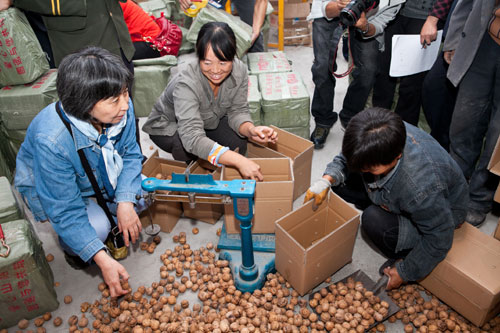
Farmers in Nanjiushui village in Hebei province packaging walnuts for online orders. Economists, such as Professor Liu Shuwei (on the left), have called for more innovative marketing and improved logistics to help China's farmers sell their products.[Photo/China Daily] |
In 2010, the prices of garlic, ginger, cotton and potatoes reached record highs. However, in the following year, many agricultural products such as Chinese cabbages in the provinces of Shandong and Zhejiang, carrots in Jiangsu, bananas in Hainan and potatoes in the Inner Mongolia autonomous region all faced a poor market.
The record high prices were caused by manipulation of the market. The following year's poor market was caused by "blind planting": when farmers get a good return from a certain plant one year, many will plant it again the following year, leading to oversupply in the market and a loss of earnings.
The price of Chinese cabbage in Shandong dropped as low as 0.2 yuan per kilogram, according to market statistics.
The slack market for agricultural produce was not purely result of oversupply, according to Liu's analysis.
"Traditional small-scale farming by individual owners cannot meet the needs of a modern society. That has led to an imbalance in the demand and supply of agricultural products."
Traditionally, the market process for agricultural product sales in China is very simple: family-based production units sell the produce to wholesalers and the wholesalers sell them on to retailers.
The farmers' choice of crops is largely dependent on the previous year's prices of agricultural products, which adds the aforementioned "blindness" to the choice of crops sown.
Moreover, the quality of the products is not directly related to the reputation of specific farmers, because consumers buy them from the retailers instead of individual growers. In other words, the quality of the products in one year will not affect profits the next, a state of affairs that fails to motivate farmers to produce better goods.
"The use of online marketing means customers have access to information and the photos on the micro blog about the produce they have ordered. That helps to build trust between farmers and the buyers," Liu said. "It also avoids price manipulation by traders, because farmers and customers are directly linked. They can communicate online."
"We have sold fewer walnuts than last year and selling them online is a little troublesome, but we make more money by doing this than by selling them to the traders as before," said Li Quan, 65, one of the village heads of Nanjiushui, and the father of Li Hejun.
He said his son endured many sleepless nights because of wet weather during the October harvest period.
Usually, the walnuts need to be put under the blazing sun for two to three days immediately after they are harvested to accentuate the flavor. However, people in Nanjiushui didn't have good luck because of the inclement weather in 2011.
They had planned to sell 15,000 kilograms of walnuts, but eventually only managed to pick 5,000 kilograms of produce that was of sufficiently good quality. "During that period, I prayed every night that the next day would be sunny," said Li. "Because I am the person operating the micro blog, I have a responsibility to ensure the quality of the produce."
Many micro-bloggers told Li that they didn't care about the quality of the walnuts because they saw their purchases as a charitable move to help the villagers build the much-needed road. However, Li refused their offers and refunded two-thirds of the orders.
Li said the reputation of Nanjiushui's agricultural produce will not be affected by these events.
"In the future, we are going to sell dried persimmons and chestnuts through the micro blog," he said. "We should provide customers with the best-quality food."
According to Liu's research, when the reputations of farmers influence their future profits, they will have stronger motivation to provide better-quality goods.
Modern agricultural production methods will be fully embraced when groups such as the Nanjiushui farmers can develop their own brands and continue to prosper.