Use of fossil fuels to decline
Updated: 2012-02-10 09:09
By Lan Lan (China Daily)
|
|||||||||


China aiming to raise output of clean energy, such as biomass, wind and solar
BEIJING - China's consumption of fossil fuels declined slightly in 2011, but the world's largest energy consumer still faces great challenges in optimizing its energy structure, said analysts.
|
 |
|
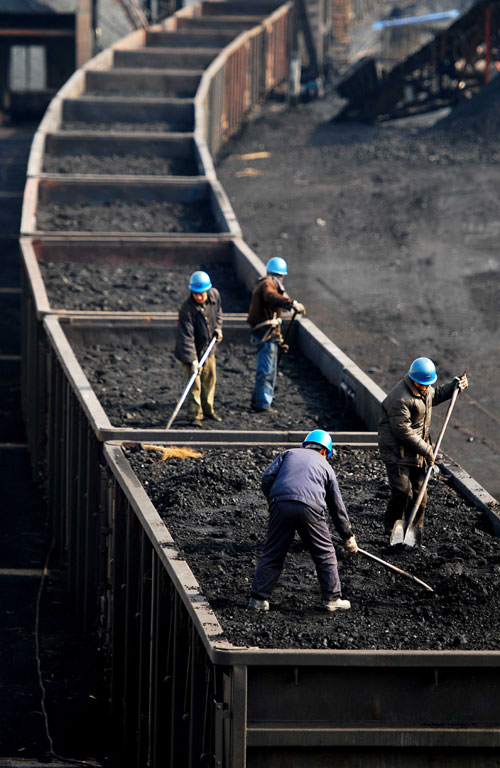
Workers load coal at a railway station in Jiujiang, Jiangxi province. China's consumption of fossil fuels such as coal and oil dropped slightly last year, while its production of clean energy increased.[Photo/China Daily] |
Non-fossil fuels accounted for 9.4 percent of China's overall primary energy consumption in 2011, compared with 8.7 percent in 2010, said Li Junfeng, deputy director of the Energy Research Institute of the National Development and Reform Commission.
The figure means the country needs to increase the proportion of non-fossil fuels in the mix by 0.5 percent annually in the coming four years to realize a government target of 11.4 percent by 2015, he said.
"The country is facing great pressure to reach the target because the efforts to build the nation's nuclear capacity have slowed," said Li.
The 21st Century Business Herald, a Chinese publication, reported recently that the proportion of China's non-fossil fuel in the overall energy mix declined to about 8 percent in 2011. However, Li said these data were inaccurate.
But he admitted that the pace of energy use restructuring has been sluggish,as the use of coal-dominated fossil fuels continues to increase.
The newly added capacity for coal output reached 95 million tons in 2011, and the country plans to add another 200 million tons in 2012, according to the National Energy Conference in January.
The country is caught between the urgent need to save energy and reduce greenhouse gas emissions and the desire to increase energy generation to sustain economic development.
Reducing dependency on coal by promoting the use of cleaner energy sources, including wind, solar and biomass, is one of the most feasible ways of solving the problems faced by the country, according to experts.
China plans to add 20 gigawatts of installed hydropower capacity in 2012, while prioritizing ecological protection and the relocation of residents in areas designated for major hydropower projects.
China's hydroelectric energy generation decreased by 3.5 percent year-on-year in 2011, which resulted in a great increase in the use of coal, said the China Electricity Council on Friday.
Nuclear power output increased by 16.9 percent and wind power increased by 48.2 percent year-on-year. Meanwhile thermal power production increased by 14.1 percent over the same year, it said.
Ren Dongming, deputy director of the Center for Renewable Energy Development at the National Development and Reform Commission, said the country will adopt more policies aimed at stimulating the development of renewable energy.
The government is also expected to launch the Renewable Portfolio Standard, a scheme that will require electricity suppliers to provide a minimum level of electricity generated from renewable sources.
The mechanism, which is still at the design stage but is expected to be unveiled soon, will focus on energy generated from sources such as wind, solar and biomass, said Ren.
China aims to cut the amount of energy consumed for every unit of GDP by 16 percent between 2011 and the end of 2015.
However, the country may have missed the target of a 3.3-percent reduction in energy consumption per unit of GDP in 2011, said Xie Zhenhua, deputy minister of the National Development and Reform Commission last week, although the data have yet to be released
China's energy consumption totaled 3.25 billion tons of coal equivalent in 2011.
Related Stories
Non-fossil fuels to take up 11.4% of China's energy use 2011-03-04 13:47
Demonstrators ask people to use less fossile fuels 2010-12-10 02:43
Fossil specimen exhibition held in Hangzhou 2011-02-14 09:35
Where dinosaurs once roamed 2011-10-13 11:04
- New Year inflation jumps higher than estimated
- Chery exports up 21% in Jan
- Yuan rises to new high against the US dollar
- Exports drop first time in 2 years
- China to lure private capital in mining sector
- Govt gets tough on food safety, quality
- TCM exports set to rise at a healthy clip
- Ties to cover more sectors