Lack of supplies drives transport operators to frustration, Tang Yue reports from Hunan province.
Hu Libing, 40, normally brings in 500 yuan ($79) for a 12-hour day driving a taxi in Changsha from 6 am. But winter can be a chilly time of year, both in terms of temperature and income.
His revenue may drop, some days, to "a little more than 200 yuan". That doesn't even cover his costs as he must pay 220 yuan daily to the taxi company.
A diesel shortage is the reason Hu loses money on those days.
|
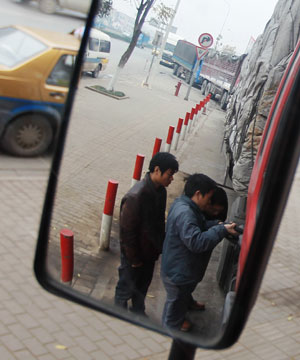 Drivers line up to fill their tanks in Changsha, Hunan province, last month. The province has had to grapple with a shortage of diesel this winter. Cui Meng / China Daily |
"I have to wait for two hours and even longer at the gas station to get refueled. And you are only allowed to buy 50 yuan worth of diesel. So I have to come back for another two hours in the afternoon," he said. "In the worst scenario, I tried 10 filling stations and couldn't get a single drop of diesel and was afraid of running out of fuel."
The shortages are nothing new to Changsha nor confined to Hunan province. They first occurred in the winter of 2003 in the Yangtze River Delta and became widespread in the past few years in central, eastern, southern and southwestern China during the peak season for diesel.
According to C1 Energy, an online information provider for the petrochemical industry, nearly half of the privately held filling stations and a quarter of the State-owned stations nationwide couldn't ensure ample supplies last month.
As a result, more than 20 buses in Changsha shut down for a couple of days in mid-December. Local media even reported that a funeral home in Chongqing lacked sufficient diesel supply to meet the demands of cremation during the pinch period last year.
Bigger fuel tanks
While taxi drivers struggle in the provincial capital, long-haul truck drivers are desperate on the freeway.
China Daily visited the Pingjiang gas station run by China Petrochemical Corp (Sinopec) along the Beijing-Hong Kong-Macao Expressway on the evening of Dec 22. Thanks to a bailout by Sinopec, the situation had eased a little in Changsha and the Pingjiang station was providing diesel without limit.
Zheng Yonggang was thrilled to learn the news from his "old friends" on the road and had skipped several stations with long lines to get to this one.
"It is not easy to find a filling station that doesn't limit supply now. It seems I have to wait for two hours, but it is worth it," Zheng said before excusing himself so he could call his boss to report the glad tidings.
Zheng, 39, was in the middle of a 4,000-km journey from Guangxi Zhuang autonomous region in South China to the Heilongjiang province in the Northeast. He was transporting bananas.
He originally planned to leave Nanning on Dec 20, but he couldn't find enough diesel. "I had to fill the fuel tank before starting out. I can't afford several days' delay with the cargo. What I am carrying is fruit, not commodities," he said.
After "taking full advantage of the local connections", Zheng knew that one filling station could work out. He got up at 3 am the next day and waited for two hours before getting the diesel.
"I could finally take the load off my mind for the time being and dared to load the bananas," Zheng said.
 |
|
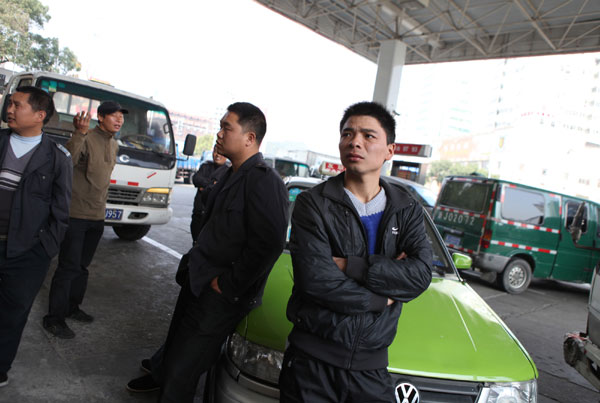
Shortages of diesel fuel have become a chronic winter annoyance that now hit China's center, east, south and southwest. These drivers were waiting for diesel at a filling station in Taizhou, Zhejiang province, one day last month. Provided to China Daily |
Blame-worthy reasons
Several factors contribute to the struggles of truckers and taxi drivers:
The spokesman at Sinopec's Hunan office has said this year's low water level in the Xiangjiang River contributed to difficulty in transporting diesel to the region.
Last winter, electricity supplies were restricted in a bid to meet energy-intensity goals at the end of the 11th Five-Year Plan (2006-10). As a result, many high-polluting and energy-intensive industries switched to diesel-powered generators to keep their businesses going.
Companies that supply diesel admit they limit availability early to ensure they have enough diesel during Spring Festival, when transportation peaks in China.
But leading experts place most of the blame for the chronic problem on the government-advised pricing system for oil products and on the industry's dominance by the top State-owned oil companies.
Intentions vs market
In China, the retail price of oil products is set by the National Development and Reform Commission, the country's top economic planner. According to the "Methods for Oil Price Regulation" it issued in 2009, the commission adjusts the retail price when fluctuation in the average international price of crude oil within 22 consecutive business days exceeds 4 percent.
On Oct 8, the commission announced it would cut retail prices for gasoline and diesel by 300 yuan a ton. It was the first price revision in 16 months.
Lin Boqiang, director of the China Center for Energy Economics Research at Xiamen University, said the policy shows the government's "good intention" but goes against market rules.
"It will affect the profit margins of the major refiners and has decreased their motivation to refine oil and offer diesel to the domestic market, especially when the international price of crude oil has remained at a high level," Lin said.
"To maximize their profit, the fuel dealers tend to hold back sales when they expect the government is about to raise fuel prices soon."
'Every single penny'
In Hunan, the retail price was required to fall from 8,600 yuan a ton to 8,300 yuan. Since the regulation also says the highest wholesale price should be at least 300 yuan less than the highest retail price per ton, the wholesale price should be 8,000 yuan.
But the market didn't buy it.
Xiao Xi is the sales manager of Hunan Heshun Petroleum & Chemical, a private enterprise that owns six filling stations in the province.
According to Xiao, the company paid the refinery at least 8,300 yuan a ton. Its actual cost would be as much as 8,500 yuan when taking personnel, transportation and waste into account.
"So we are actually losing money by selling diesel at the moment. We can only ensure the supply for the customers who had contracts with us in advance and those we are very familiar with," Xiao said
Others might encounter a "sold out" sign.
"The State-owned giants can receive subsidies for their loss but for us, the private companies, we have to undertake the loss of every single penny by ourselves," Xiao said. He noted that the company can make up for the deficit only with the profit on gasoline.
Out of reach
Most gas stations in the city strictly obey the price regulation, but not so in remote areas where the watchdogs don't reach. Zheng, the trucker heading for Heilongjiang, knew that well.
The set price, 8,300 yuan a ton, translates to 7.09 yuan a liter. However, before arriving at the Pingjiang gas station near Changsha, he paid 7.8 yuan at a local filling station in Qiyang county in southern Hunan.
"Not only the privately owned stations are selling at a higher price," Zheng said. "Sinopec and PetroChina are doing the same." (PetroChina is the China National Petroleum Corp.)
"We even have to bribe the staff at the station to lift the upper limit. Sometimes it was 50 yuan but it could be even more when the situation is really bad," added Wu Languo, who was taking driving shifts with Zheng.
The problem resulted from the failure of the pricing system to reflect changes in the market in time, said Lin, the professor from Xiamen University.
"In the short term, the government should shorten the 22-day period and lower the 4 percent criteria," he said. "In the long term, marketization, instead of the administrative fiats, should always be the direction."
Gigantic influence
 |
|
Some stations in Changsha fill extra barrels with diesel when it's available so they can keep serving their customers. Cui Meng / China Daily |
There are about 50,000 private-sector gas stations in China, 46 percent of the total, according to the China Chamber of Commerce for the Petroleum Industry.
But the country's three biggest State-owned oil companies dominate more than 95 percent of China's crude oil imports. As a result, local refiners and filling stations suffer a shortage of raw oil and thus a higher cost by using residual oil.
"It is hard for the private refineries to get the crude oil from the giants," Ma Li, the chamber's secretary-general, said. "They can only use secondhand oil. The processing cost is more than 1,000 yuan higher than that of the raw oil."
According to the chamber, the proportion of local gas stations has dropped from 60 to 46 percent in recent years since State-owned giants tightened their control of raw oil amid aggressive mergers and acquisitions of local refineries and filling stations.
The dominance by conglomerates inevitably gives a distorted picture of the real market situation and thus contributes to the diesel crisis, said Han Xiaoping, an analyst from information provider China Energy Resources Website.
"China needs to introduce more competition to the market. The problem could only be solved when the local companies could be involved in the upstream oil exploration and oil import," he said.
Winter's woes
Zheng, the trucker, said it is beyond his ability to figure out "what was really behind the diesel shortage". He decided to put the hassle aside for the time being.
The 300 liters of diesel he got at the Pingjiang station ensured he could drive straight to Henan, where it is easier to fill up. Then, within 30 hours, he would be at home in Harbin. This was his last drive from Guangxi to Heilongjiang for the winter.
"Let's just leave the vexation of next year until it comes," an upbeat Zheng said.
Meanwhile, Hu, the taxi driver, was caught in a dilemma. "It seems that when the price goes down, it is harder to find diesel. Of course we want cheaper fuel, but I can't afford to lose money due to insufficient supply," he said.
"I really don't want another winter like this."
Write the reporter at tangyue@chinadaily.com.cn.

Copyright 1995 - . All rights reserved. The content (including but not limited to text, photo, multimedia information, etc) published in this site belongs to China Daily Information Co (CDIC). Without written authorization from CDIC, such content shall not be republished or used in any form. Note: Browsers with 1024*768 or higher resolution are suggested for this site.
License for publishing multimedia online 0108263 Registration Number: 130349