Magazine industry soars
Updated: 2011-12-17 11:09
By Lu Chang (China Daily)
|
|||||||||||


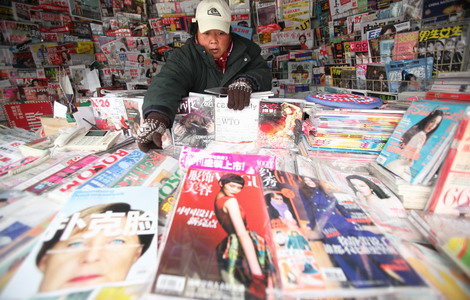
A newsstand carrying a variety of magazines in Beijing. A total of 9,884 titles were published in China last year, according to the General Administration of Press and Publication. [Photo / China Daily]
The nation remains a bright spot for publishers as circulations rise and advertisers pour in
BEIJING - While the magazine industry struggles in most nations, in China the sector is soaring and a number of well-known magazines and publishing houses are looking to expand or make their first forays into the world's second-largest economy.
In November, Bloomberg Businessweek was relaunched in China and the magazine flew off the racks to the tune of 350,000 copies. Meanwhile, RCS MediaGroup, the Italian publishing company formerly known as Rizzoli, also said it may launch a new magazine in the near future.
Profits in the magazine publishing industry in China exploded by 50 percent to 1.9 billion yuan ($298.7 million) last year from 2009, according to the General Administration of Press and Publication (GAPP). Sales climbed 4.1 percent to 15.7 billion yuan.
The relaunch of the Chinese edition of Bloomberg Businessweek on Nov 11 was a testament to the confidence that several foreign publishers have in the nation's media market.
The magazine has a licensing agreement with Modern Media Group, one of China's biggest print media players that also publishes the lifestyle magazine Eleven.
"We have a long-term commitment to doing business in China. We believe that success in any market depends upon the quality, indispensability and globalism of the magazine you are publishing," said Paul Bascobert, president of Bloomberg Businessweek.
While it is still too early to tell if the Chinese edition will flourish, the partnership with Modern Media has allowed the publication to reap success in a market where advertising has been expanding at a feverish pace.
One of the main factors behind the decline of the magazine industries in countries such as the United States has been the lack of advertising. That's definitely not the case in China. Thomas Gorman, chairman and editor-in-chief of Fortune China, said that, in sharp contrast to many other markets, print advertising is not in a crisis in China.
The total spend on advertising in China is expected to rise 15.2 percent to $54.8 billion in 2011 from last year, but it's not known how much of that advertising is attracted by foreign magazines.
In the first three quarters of this year, revenue for magazines grew by 15 percent to $2.04 billion, according to the Beijing-based CTR media market research, a joint venture between China International Television Corporation and Taylor Nelson Sofres PLC.
"I'm optimistic about continued robust growth prospects for strong brands which implement effectively across print and the other platforms," Gorman said. "In the business segment, consumer demand for quality information will remain strong, as will marketers' demands for effective channels to reach an upscale audience."
He said circulation at Fortune China has grown to 182,000, a considerable jump from the figure of 50,000 when the magazine was first launched in 1996. Published 19 times a year, Fortune China's core mission is centered around its best known brand: the Fortune Global 500.
Gorman noted that when Fortune China was launched in 1996, there were almost no business magazines in the country. Today, there are 150.
"Sustainable success comes to those with a very clear sense of brand value and editorial mission, who are able to differentiate themselves from competitors in print, online and the other channels," he says.
A total of 9,884 magazine titles were published in China last year, according to GAPP. The number of magazines by foreign publishers accounted for less than 10 percent of the total, according to Li Wenbin, senior analyst at the research company Century Chinese International Media Consultation Inc (CCIMC).
Therein lies one specific problem: Foreign publishers cannot operate in China independently and are required to secure copyright cooperation with a local partner. And a number of local publishers believe that the many cultural differences and distribution challenges are major hurdles to foreign magazines.
China's magazine industry may be booming, but it by no means equates to a huge success in the market. So, while the market remains highly appealing to international players, it is also highly complicated and challenging. Not every foreign magazine has fared well.
"Most foreign magazines struggle for a while when they come to China and the major of challenges come from regulatory, operational, distribution and network restrictions.
"Take distribution for instance, whether it is through the postal service, airports, newsstands or subscriptions, every channel is different (in each nation) and the situation becomes even more complicated in different cities."
One example of a failed venture came in the early 1990s when Lisa, a women's magazine published by Germany's Hubert Burda Media, ceased publication after years of struggling to make a profit. Elle also failed to reap a profit until six years after its mid-1990s launch because of what were described as unexpected costs in distribution and operations.
Sun Qun, who publishes magazines produced by Italy's RCS MediaGroup, said that it's not easy for a foreign company, whether in TV, print or film, to make money in China until it achieves a certain level of success in its home country.
"The costs of printing, operations and distribution are likely to be much more expensive for a foreign company than a local publisher, who already has several publications," Sun said..
Sun, who founded a joint venture with RCS MediaGroup and published the Chinese editions of the RCS home-decoration magazines Casa Design and Abitare, says that his magazines didn't turn a profit until this year, several years after their initial launch.
"We spent quite a long time cultivating the market, and educating people about how we operate and what we can offer. This year we organized International Design Week in Beijing and invited the deputy mayor of Milan, and many international companies, experts and designers to participate in the event," Sun said.
"This is good not only for our branding and marketing but also for the development of the whole industry, which in return will offer many opportunities," he added.
The company is mulling the launch of a new interior-design magazine and other new-media portals in the coming years, Sun said, without providing more details.
Another challenge faced by all magazines is that posed by the Internet. In many Western countries, online advertising has been sluggish for magazines and newspapers, but in China online advertising has really taken off.
Online advertising revenues are forecast to reach $6.95 billion by 2012 and become the second-largest target for advertising in the country, according to the China Internet Network Information Center.
"The online media has squeezed the living space of print media and forced foreign titles to update their quality of content, their services and their distribution capabilities in order to be more competitive," Li said.
Meanwhile, some foreign titles have been successful in China by finding a niche.
As an English-language publication in China, Time Out, based in the United Kingdom, has positioned itself as a city-central magazine for expatriates.
Under a license agreement with SEEC Media Group Ltd, a Hong Kong-listed publisher and distributor, Time Out is published in Shanghai and Beijing with a circulation of 130,000 and is distributed to spots popular with expats, such as diplomatic compounds, five-star hotels, bars, restaurants and airport lounges.
Kenneth Tan, editor-in-chief of Time Out China, said the publisher has doubled its revenue so far this year from the same period in 2010 thanks to its strong and attractive global brand.
"The great thing about Time Out is that it's an international brand. People know what the brand is. The strength of our magazine also lies in our strong editorial team, not just in China but an international community based on Time Out's global resources, so our clients value our expertise and how we do things. People take ads in Time Out and obviously they want return investment. We try to take care of that. We know what kind of ads they want, while certain companies don't have that knowledge," he says.
CCIMC's Li says that the addition of foreign magazines has not only helped the industry's bottom line, they have helped domestic magazines develop and grow.
"The boom in foreign media groups has helped the print media industry in China develop to a new level. People are not just aiming to gain more market share, but they are also working hard to develop resources in China," Li said.
Related Stories
Magazines seek new revenues 2011-05-16 08:01
Bookish magazine serves up spice of life 2011-01-28 08:05
Economic boom leads to cultural revival 2011-11-05 14:42
CPC guideline on cultural development published 2011-10-25 22:58
- China upgrades 1st UHV transmission system
- CSRC to speed up QFII approval
- China Merchant invests in Sri Lanka harbor project
- UK infrastructure projects attract Chinese firms
- Cross-border yuan settlement set to flourish
- Beijing to keep limitations on house purchases
- China to unveil new energy consumption strategy
- Christmas chill hits manufacturing hub