Ringing the changes
Updated: 2011-08-08 09:14
By Shen Jingting (China Daily)
|
|||||||||||


Going global
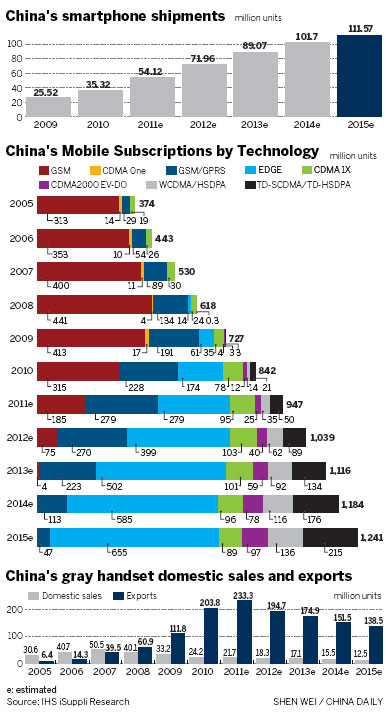
Zhang Xinsheng, an official at the telecom regulatory department of the Ministry of Industry and Information Technology (MIIT), said that 1.15 billion mobile phones were produced in China in 2010, but only 380 million handsets were traded domestically.
"A huge number of MIC mobile phones were exported last year," Zhang told China Daily.
He said that because MIIT issues mobile-network-access licenses for each device, it knows the exact number of mobile phones sold nationwide at any given time.
Strategy Analytics has estimated that approximately 70 to 75 percent of handsets produced in China were exported in 2010. The researcher also discovered that many small and medium-sized Chinese handset manufacturers only conduct export business.
Some Chinese mobile phone companies, such as G'Five and Tecno Telecom Ltd, may not be famous domestically, but are the among the top phone vendors in countries such as India and Nigeria.
The major markets for MIC phones are Southeast Asia, Africa, Latin America and Eastern Europe, according to Sun Wenping of the Shenzhen Mobile Communications Association.
"Chinese mobile phones are spreading across the world," Sun said.
Huawei, for example, has been the No 1 phone supplier in Venezuela for the past three years. It has sold 2 to 3 million handsets in the country every year since 2008 and accounted for 30 percent of market share in terms of shipments in 2010, said Zheng Fujiang, head of the company's China communications department.
The future roadmap
There are three development stages for MIC phone manufacturers. They are likely to produce shanzhai phones first and pour their products into the emerging markets, such as India and Nigeria, in addition to the domestic market.
Then they are gradually transformed into legitimate suppliers because of the pressure of the market environment. Meanwhile, they foster a good relationship with operators in the emerging markets and make customized products for carriers.
Sometimes, they also work for international brands, such as Motorola Mobility Inc and Samsung Electronics Co, to provide mobile phones for the big-name companies.
However, in the third stage, Chinese phone makers are likely to display an ambition to establish their own brands and target the more mature and profitable markets in Europe and North America. The Taiwan-based HTC Corp, is a typical Chinese mobile-phone producer, in that it has entered the market at the third-stage.
Most Chinese phone suppliers recently entered during the first or second phase, despite having been in operation for some years, according to Dave Dai, chairman and CEO of the Shenzhen-based phone maker, Cellon Group.
A number of companies, including Huawei, ZTE and TCL, have started to build their brands and make a name in the European and the US markets, he said.
Located in Shenzhen's newly established Nanshan Technology Park, Dai's office is near the buildings of TCL and ZTE. "In the arena of the global mobile phone market, we are competitors, but we work almost face to face."
Cellon entered the Latin American market in 2007 and has achieved an unexpectedly good performance there. The company doubled its revenue every year from 2007 to 2010, to $500 million last year.
At the beginning of this year, Cellon signed a contract to sell phones to one of the top three US telecom operators.
"The North American market has the strictest standards and the highest threshold, but on the other hand, it means you face fewer competitors there," Dai said.
Cellon is aiming to become a major provider for at least one of the top three US operators in the near future. Although it doesn't make phones under its own name at present, Dai said that is definitely a mid- to long-term goal.
Larger Chinese companies, including Huawei and ZTE, have even bigger ambitions.
In a written reply to China Daily, Huawei said it wants to become a mainstream handset brand, working in close cooperation with carriers worldwide. It expects to be in the global mobile phone suppliers' top five by 2014, it says.
He Shiyou, executive vice-president of ZTE, said the company hopes to become a second HTC Corp, whose market volume has received an enormous boost from the production of smart phones.
The company's flagship mobile phone, the ZTE Blade, has achieved unexpected success in the European market, with more than 1 million sold on the continent since it was launched in October last year.
"ZTE wants to become one of the world's top three mobile phone vendors by 2015," said He.