Apple eyes bigger slice of Chinese market
Updated: 2011-07-19 16:13
(Wall Street Journal)
|
|||||||||||


Apple's push into China comes relatively late, a timing issue that has its costs. Other companies, from Hewlett-Packard and Dell to Nokia, Samsung and Motorola, have long been investing in China's booming mobile and PC markets. Apple faces strong competition from these companies, which already enjoy healthy brand recognition, as well as from other firms such as HTC, Huawei and ZTE. The latter two are making inroads with inexpensive smartphones that sell for less than $150.
Over the past decade, China has become one of the world's most important consumer markets because of its sheer size and fast-growing economy, which surpassed Japan this year to become second in the world. Luxury brands like LVMH Mo?t Hennessy Louis Vuitton have reported a boom in demand. China overtook the US as the world's biggest car market in 2009.
Each day, tens of thousands of people stream through Apple's quartet of stores. Apple's revenue from China nearly quadrupled to just under $5 billion for the six months ended March 26 from a year earlier, though the region still comprises less than 10% of overall revenue.
Apple's strategy in China so far has been to maintain its prices—and profit margins—by targeting upscale shoppers. It doesn't discount and in some instances Apple gadgets cost more in China than in the US.
The iPad tablet starts at 3,688 yuan ($570) in China, compared with $499 in Apple's home market.
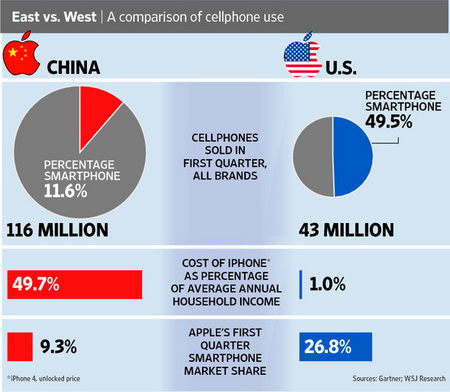
Both the iPad and the iPhone 4, which costs 5,999 yuan in China without a contract, would be a luxury for many Chinese consumers. The average household income was 12,076 yuan in the first half of this year, according to China's national statistics bureau.
It's unclear whether Apple will try to target a broader range of Chinese customers, many of whom prefer to buy prepaid phones. Mr Cook said in an earnings call in March that Apple "wanted to understand the market and understand the levers there."
Despite its popularity, Apple still has a tiny portion of the Chinese computer market. It is fourth in the smartphone market, with about an 8 percent share, partly due to its October 2009 entry into the Chinese market.
Apple's retail stores in China have more than 40,000 visitors per day—four times the average traffic in their American stores. Apple Chief Financial Officer Peter Oppenheimer said earlier this year that the company's existing China stores had both the highest traffic and the highest revenue on average of any Apple stores in the world.
But the company's existing China stores sit in some of the richest districts in two of China's most affluent cities. As the number of stores grows it could be difficult to match the performance they have had so far.
Overall, China represents a big—and relatively untapped—opportunity for Apple.
"China has the potential to become the second largest and perhaps even the largest market (for the company) over time," said Shaw Wu, an analyst with Sterne Agee in San Francisco.
The iPhone is likely to be offered through China Mobile in the next 12 months, analysts said. The timing of when the iPhone will arrive at China Mobile partly depends on whether Apple decides to offer the device for the carrier's homegrown technology standard, TD-SCDMA, or wait until the carrier rolls out a fourth-generation network called TD-LTE, which China Mobile has been testing in select cities.
The company faces growing competition from smartphones running on Google Inc's Android software.
The company's fifth and sixth Chinese stores are expected to open in Shanghai and Hong Kong in the coming months.
One typical Apple user in China is Jessie Cui, a 30-year-old in Shanghai who bought her first Apple desktop computer in 2003. She was so impressed by its design that she bought a Macbook, an iPod, an iPod Shuffle, an iPod Touch and an iPhone. "I want something different from what most people are using," said Ms Cui, who is now eyeing an iPad.