Banking
Local banks gaining ground on 'Big Four'
By He Wei (China Daily)
Updated: 2011-07-01 09:52
 |
Large Medium Small |
|
 |
|
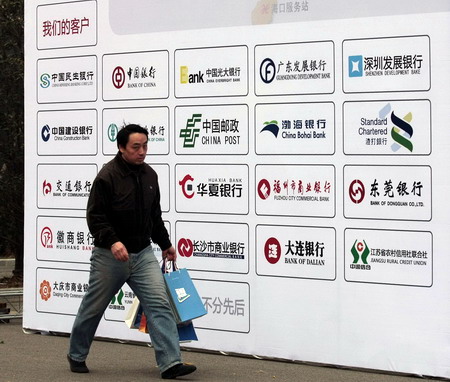
Smaller banks are gaining popularity in their competition with the four largest lenders, according to research conducted by McKinsey & Co. [Photo / China Daily] |
SHANGHAI - While the Chinese still prefer to open accounts in the "Big Four" banks in China, more and more are taking their business to competitor banks in a trend that is becoming more pronounced, according to a study conducted by the consulting firm McKinsey & Co.
The study drew on interviews held with nearly 20,000 residents of 13 Asian countries or regions. Of them, 3,000 lived in nine different Chinese cities.
"We're witnessing a consistent theme across Asia of the desire among consumers for the localization of banks," said Kenny Lam, a partner in McKinsey's Hong Kong office and the leader of the study. "In post-crisis ages, having a global brand may be less of a competitive advantage than before, and domestic players have just as good a chance to compete for customers as the global giants."
|
||||


According to the statistics, the most affluent among the respondents were also the most eager to work with local institutions when making investments; about three quarters of the respondents who fall into that group said they favor local institutions.
The Big Four banks - the Bank of China Ltd, Industrial and Commercial Bank of China Ltd, China Construction Bank Corp and the Agricultural Bank of China Ltd - have seen their share of all retail deposits in China fall from 66 percent in 2004 to 58 percent in 2011, according to McKinsey.
Smaller local institutions, such as the Bank of Communications Co Ltd, China Everbright Bank Co Ltd, China Merchants Bank Co Ltd and various city commercial banks have been catching up.
The biggest shift has occurred in third-tier cities - which are usually county or prefecture capitals -where 66 percent of the respondents have chosen to open reserve bank accounts in local banks and only 51 percent have decided to stay with the Big Four banks.
Many respondents said they prefer local banks because they employ staff that is more courteous, have branches in more convenient places and put signs in better places than the Big Four.
Zhou Yulu often makes use of a credit card issued by China Merchants Bank and spoke highly of that bank's services.
"I am a huge fan of the bank's credit card, since they provide tailor-made services to you," Zhou said. "As I am a regular user of the card, I can get an extension of a few days of my due date. Plus I can pay my monthly bill at almost every chain store on the street. Isn't that convenient?"
The erosion of loyalty to big banks appeared in another of the survey's findings. The percentage of respondents who said they "would recommend their financial institution to a family or colleague" dropped from 57 percent in 2007 to 47 percent in 2011.
The survey also suggested that Chinese consumers are becoming more cautious about investing money and are forming more long-term financial plans than Asians on average.
According to the results, the average number of financial products held by every Chinese resident is 4.04 and the rate at which the Chinese have acquired such products is double that of residents in other economies in the region.
In light of this, it is easy to understand why customers are turning to local banks, which often offer higher returns on investments, said Shang Xu, a clerk with the Bank of Shanghai.
"For instance, our latest investment product guarantees an annualized rate of return of more than 6 percent, while (the rate) is most likely about 4 percent in the Big Four," Shang told China Daily.
Even more essential to a bank's success, though, is providing considerate service, said Li Jing, an officer with Shanghai Rural Commercial Bank.
"Smaller banks are usually more flexible and the management teams are able to make instant changes tailored to customers' demands," Li said.
"Through that, they win a competitive edge over big banks in gaining wealthy customers, who account for 20 percent of the population but hold perhaps more than 80 percent of the assets."
| 分享按鈕 |