Opinion
The dos and don’ts for food safety
By Yu Haihu (China Daily)
Updated: 2011-06-17 16:30
 |
Large Medium Small |
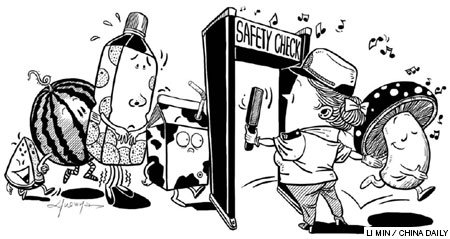
Food safety is a global issue. In recent years, incidents of food poisoning and discovery of carcinogens in food products have increased. Of late, an E. coli outbreak linked to salad vegetables has killed 36 people and left hundreds of others seriously ill in Germany. And DEHP, a plastic additive, has been detected in Taiwan-made food products and drinks.
As a supplier to major international markets, China is responsible for ensuring the safety of made-in-China food products. But food safety scandals have been reported at regular intervals on the Chinese mainland. The past few months alone have seen quite a few food safety scandals: dyes used in steamed buns, tainted "beef" and "lean meat powder". They have created panic among consumers, minimized their choices and stained China's image.
The mainland, therefore needs to reform its food safety system, and it can do so by taking a leaf out of Hong Kong's book on food safety supervision.
The mainland should streamline its food safety supervision mechanism and use its administrative resources to eliminate food safety problems. In Hong Kong, for instance, the Food and Environmental Hygiene Department and its affiliated Center for Food Safety are the only food safety watchdogs. The department regularly publishes pamphlets and distributes them free among residents and food producers to spread knowledge about food safety and the city's food regulations.
On the mainland, however, food safety watchdogs are scattered across different levels and have overlapping powers. As a result, food producers don't know whose regulations to follow. Worse, whenever a food safety scandal breaks out, quite a number of government departments, supposed to be in charge, have tried to shirk their responsibilities. Some local governments, in their eagerness to propel economic growth, have even shielded food producers that violate the country's food safety regulations.
The Hong Kong administration has made some other noteworthy efforts, too, to ensure food safety. Earlier this year, Hong Kong's Legislative Council enacted the Food Safety Bill, which will come into force in August. The bill introduces a system to register food importers, distributors and their import/export records. Even local fishermen have to register and furnish their fishing records. This will make it easier for the government to identify the source of contamination in case of a food safety scandal, and take immediate action.
To better enforce its food safety laws, the mainland should establish a similar food supervision system.
Hong Kong is also known for its system of accountability. No serious food safety poisoning case has been reported in the city in the near past. And whenever a food safety problem has arisen, regardless of its impact, food producers and food safety supervision officials have accepted their legal responsibilities. In fact, government officials are the ones to be rebuked the most by the Legislative Council.
The mainland would do good to establish such a system, for it would spur government officials to make active efforts to prevent food safety scandals.
Given the role the media play in spreading information, related authorities on the mainland should provide all necessary information to them whenever a food safety scandal breaks out. That is exactly what Hong Kong has done in the past. In case of a food scare, the Hong Kong government holds a press conference to give detailed information to the media, which passes it on to the public outlining the severity and impact of the incident and spelling out the precautions to be taken. And since journalists are held accountable for their reports, they refrain from fabricating or exaggerating facts.
Hong Kong's Food and Environmental Hygiene Department requires people running restaurants to take a 16-hour training course on food hygiene. This is a condition they have to meet whenever they renew their business license. The department also advocates food producers to follow business ethics and abide by regulations while procuring ingredients.
The mainland's health authorities, too, should make food producers realize the importance of ensuring hygiene when preparing, packaging and supplying food products.
Food producers tend to use additives to preserve the flavor or enhance the taste/appearance of a product. More often than not, they tend to use cheap additives, and in most cases neither food producers nor food additive suppliers know what chemicals (not to mention their proportion) have been used in the additives.
| ||||


China National Food Industry Association has started training food safety consultants. This is a praiseworthy move, for if all food producers on the mainland has certified food safety consultants to supervise their operations, food safety scandals can be prevented.
The author is director of Hong Kong Food Science and Technology Association and a professor at the Hong Kong Polytechnic University.
| 分享按鈕 |