Opinion
Time to separate treasure from trash
By Xie Jian and Du Huanzheng (China Daily)
Updated: 2011-05-31 15:30
 |
Large Medium Small |
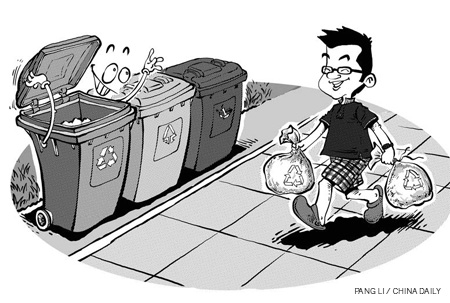
Municipal waste management is no easy task, but there is a win-win solution for Chinese cities that fits well with the country's ambitions for circular economy and sustainable development - separating trash from treasure.
Household waste is a serious problem in China today. The amount of municipal waste collected and transported each year jumped from 30 million tons in 1980 to more than 160 million tons in 2009. And it has become increasingly difficult to build landfills and incineration facilities, still the main mode of waste treatment in China, because of scarcity of land and public concern over their impacts on people's health and the environment.
Clearly, there is an urgent need to transform this traditional model, which relies on landfills and incinerators, into a modern one, which emphasizes "reduce, reuse and recycle".
While Chinese cities have made significant progress in solid waste management, there is a growing gap between China and developed countries in household waste separation and reuse. Waste disposal can be significantly reduced through the process of separation at source, reuse and recycling, which would help lower the cost of waste treatment and disposal, improve public health and the environment, and contribute to a more efficient use of resources.
| ||||


In recent years, a number of Chinese cities have begun carrying out household waste separation pilot projects. But none has truly succeeded because of inadequate waste collection and transportation infrastructure, and low public awareness and participation. Ningbo city in Zhejiang province is currently working with the World Bank to prepare an investment project coupled with technical assistance to put in place a modern waste management system featuring separation, recycle and reuse of household waste as a resource.
Many developed countries have successful experiences in waste separation and recycling that China can learn from. The focus is on treating waste as a "resource" not garbage. Almost all wastes can be used after they are separated, decontaminated and processed appropriately.
Among various waste separation models, a relatively simple waste classification and separation system adopted in many North American cities can be a good reference point for China. There, household waste is simply separated into dry recyclables (such as paper, plastic material, glass and metal), hazardous waste (which include batteries, electrical and electronic waste, paint, cleaners and fluorescent tubes), and everything else (such as food and other dirty waste that is hard to separate).
These wastes then can be sent for recycling, composting, waste-to-biofuel (ethanol or biodiesel) development and power generation. This three-stream approach is effective because it is easy to be accepted and implemented by residents and separation technology is available for it.
In Edmonton, Canada, the city government achieved 90 percent diversion of waste from landfills - the highest in North America - by adopting a simple method of residential waste classification and separation. Edmonton operates a dry waste-recycling center that separates and sends materials directly to markets. "Everything else" is largely treated through composting, biofuel development and power generation. Edmonton has significantly reduced waste disposal in landfills without incineration and successfully shut down a traditional landfill.
Taipei in Taiwan province, too, has achieved remarkable results in waste separation and recycling over a period of more than 10 years. Beginning in 1996, Taipei implemented a household waste separation policy and a "Keep Waste off the Ground" campaign, with waste management vehicles collecting all types of waste already separated by households at a fixed time every day. By 2009, residential waste had decreased from 2,970 tons to 1,009 tons a day, a reduction of more than 67 percent. Recycling has exceeded 45 percent, and the amount of waste transported to landfills in Taipei has reduced from its peak of 2,500 tons to only 59 tons a day.
Municipal waste management requires "soft" management and "hard" infrastructure both. For instance, community waste separation requires distinct transport, sorting, recycling facilities, and a series of policy management and financial incentive tools. The government needs to enhance public awareness and participation through education and communication programs. Media such as television, radio, newspapers, community bulletin boards, posters and community websites should be used to disseminate information and best practices to encourage acceptance, enthusiasm and participation of the public in waste management.
Municipal waste management normally involves hundreds of thousands of households in a city and presents many implementation challenges for local governments. It is often a difficult task for local political leaders. This explains why there has been no truly successful city experience in waste separation on the Chinese mainland.
But municipal waste management can be an important benchmark for evaluating the performance of local political leaders, and should be used as one of the criteria for determining their promotion. The public is waiting to see who will be the first person to truly solve the waste separation problem facing mainland cities.
Xie Jian is a senior environmental specialist with the World Bank, and Du Huanzheng is a professor of Jiaxing College in Zhejiang province.
| 分享按鈕 |