Economy
Japan not now on visitors' agendas
By Wang Zhuoqiong (China Daily)
Updated: 2011-03-21 09:44
 |
Large Medium Small |
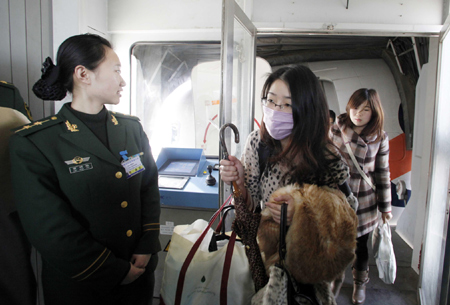
Two Chinese women arrive at Jinan International Airport by Shandong Air SC4094 on March 15. It was the first airliner to arrive in Jinan, capital of East China's Shandong province, from Japan after the 9.0-magnitude earthquake and tsunami.?[Photo /?China Daily]
People who were keen to see cherry blossom start looking elsewhere
BEIJING - Accountant Zhao Di was confident nothing could stop her enjoying a dream holiday marveling at the awe-inspiring cherry blossoms in Japan in early April.
Her mother, raised in more austere days and careful with her coins, had been squared. Her boss, tight with his holiday rosters, had also been persuaded to let her go. The 9,880 yuan ($1,504) trip had been bought.
Then, on March 11, disaster struck. The magnitude 9.0 earthquake struck, followed by the devastating tsunami.
These two events alone failed to deter the 30-year-old but when news emerged of the damage to nuclear power stations and consequent leakage of radiation, Zhao felt compelled, with a heavy heart, to abort her mission.
"I thought the country would recover soon after the quake. But I did not see the radiation coming. Suddenly I was left with no option but to cancel the trip," she said of the six-day journey to popular sakura, or cherry blossom, viewing destinations including Fukuoka, Osaka and Hakone.
"I was so sad for the damage to the cherry blossom and for the Japanese people."
The National Tourism Administration has warned Chinese tourists to remain cautious about visiting Japan and to avoid quake-hit regions. Echoing the calls from the administration, most tourism agencies have refunded tourists or given them an option to postpone their trip.
"We have stopped selling tours to Japan and are waiting for further instructions from the tourism administration," said Ma Xing, marketing and communications manager at Ctrip, a leading online tourism company.
Ctrip has canceled all its trips scheduled before March 31 and paid full refunds and is willing to refund customers who have booked a trip between April 1 and 30.
The company's cruises visiting South Korea and Japan remain on normal schedules but it is offering a refundable coupon to customers who want to cancel the trip.
Chinese tourists who were already in Japan are reported to be safe. By March 16, about 1,138 Chinese tourists from 45 tour groups remained unharmed in the country, according to the National Tourism Administration.
The effect on Japanese tourism will linger and even extend to Southeast Asian coastal destinations over fears of radiation, tourism experts have warned.
Most tourism agencies canceled or rescheduled their Japanese trips, hitting the country's industry reliant on it very hard, said Guo Chunling, media officer of the Japan National Tourism Organization in Beijing.
The numbers of Chinese outbound tourists to Japan have been booming since the island country launched the individual tourism visa in July 2009. Last year, at least 1.4 million Chinese tourists visited Japan, up 40 percent year-on-year. Traditionally, March and April are the peak season for Chinese people visiting the country.
"As a symbol of Japan, the sakura season is one of the things that Chinese tourists like to see the most," Guo said.
Some experts see the negative impact but said it might be temporary.
| ||||


But Wang Yanyong, professor of tourism development at the research center of Beijing Jiaotong University, said island trips to southeastern Asia will decrease because of the risk of more quakes and tsunami.
"Despite the government dismissing rumors of radiation and natural disasters spilling into China and other island countries, tourists still question whether it is safe to travel to coastal areas at such a sensitive time of the year," Wang said.
The professor said confidence will be restored in Southeast Asian destinations before the May Day golden week holiday and in Japanese venues during the later half of this year.
Those who had hoped to visit Japan are now searching for other places to go.
Zhao Di, who was granted annual leave for early April to see the blossom, has decided to go to Greece instead, using her refund. "Looking at the planet right now, the only place far away from the radiation center is Europe. It would be nice to shake off the shadow of winter and enjoy the sunshine on a Greek island," she said.
| 分享按鈕 |