Companies
The future's looking bright for Suntech
By Liu Yiyu (China Daily)
Updated: 2011-03-17 09:47
 |
Large Medium Small |
|
 |
|
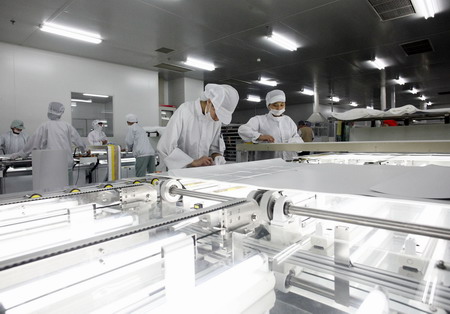
Workers on an assembly line that makes photovoltaic cells at the Suntech Power Holdings Co factory in Wuxi, China. With strong momentum in the US market, Suntech is planning to double or even triple its production capacity in its Arizona factory. [Photo / Bloomberg] |
SAN FRANCISCO - California, one of the greenest states in the US, has become a major destination for Chinese solar companies.
Suntech Power Holdings Co Ltd, based in Wuxi, Jaingsu province, one of the world's largest makers of solar panels, has its US headquarters in San Francisco in the state where most customers of the renewable-energy industry are based.
Suntech's solar panels are used by the California-based Google Inc to power its data center. The 2 megawatt (mW) installation at Google's global headquarters is the largest corporate installation in US history.
Two other Chinese solar companies, Yingli Green Energy Holding Company Ltd and Trina Solar Ltd, also have their US headquarters in California. The state accounts for half of the solar market in the North America region.
It is estimated that the US solar market will see growth double to 11 percent in 2011. Photovoltaic installations are projected to reach 2 gigawatts (gW) in 2011, as US investors with deep pockets begin funding solar installations in larger numbers as the economy rebounds.
In 2010, nearly 1 gW of new solar panel capacity was installed in the US, the highest total in the country's history.
Solar applications in the United States started about 30 years ago and government at all levels has been showing a strong determination to promote the installation by the use of a number of incentives.
San Francisco is now home to what city officials say is California's largest municipal solar installation. The city is aiming to get all of its electricity from renewable sources by 2020.
In the city's largest residential solar project, government subsidies cover as much as 85 percent of the total cost.
"Today, it is incentives that drive the market," said Brian Grenko, director of operations for Yingli Green Energy America. "Ultimately, technology and efficiency will be the driving forces."
Yingli sold 100 mW of solar panels in the US last year and expects sales to double this year, said Grenko.
|
||||


Those concerns increased in January when the Massachusetts-based module manufacturer Evergreen Solar Inc announced that it will be closing its 160 mW integrated wafer-cell-module complex in Massachusetts by the end of March and will shift its manufacturing operations to China.
"The US is unlikely to be a significant global competitor in the production of green technologies that are not relatively intensive in human and physical capital," said Frank Wolak, director of the Program on Energy and Sustainable Development at Stanford University.
"Regulatory controls and bank issues have kept some players away from the US market, while it is easier to enter China in terms of these aspects," said Harry Rozakis, president of Cyrium Technologies Inc, a Canadian-based manufacturer of Concentration Photovoltaic (CPV) cells.
Cyrium is developing the largest CPV project in China, which, according to its president, "cannot be done here in the US because of bank and regulatory issues."
"The establishment of partnerships in China helps us penetrate the market," said Rozakis, adding that his company had spent years working with Chinese local government before landing the project.
The story of the US solar module manufacturer, First Solar Inc, which is building the world's largest solar power plant in China, is another example of the importance of finding a local partner in China.
The strategy works in reverse for Chinese makers of solar products who want to enter the world's biggest potential solar power market.
GCL Solar Energy Inc, a subsidiary of GCL-Poly Energy, China's largest polysilicon producer, is expanding its market share in the US by investing in local projects.
The company said it has hundreds of projects in the US, which makes it the largest investor in the US solar sector.
"Our top concern is policy and government support," said Liu Yumin, president of GCL Solar, "All we need is consistent policy and to be treated as a local company," Liu added.
In the clean-technology sector, there is a greater volume of investment flow from China to the US, partly due to the fact that China has more policy controls in the sector, according to Gerd Geotte, managing partner of Siemens Venture Capital.
"The US has a comparative advantage in research and development (R&D), entrepreneurial talents and technological innovation, while China is good at perfecting manufacturing, which will ultimately drive down the costs," said Stanford University's Wolak.
However, the problem of intellectual property rights has become one barrier to collaboration, and one that makes foreign companies reluctant to bring their new technologies to China, said Wolak.
| 分享按鈕 |