Economy
Foreign exchange reserves hit record high
By Wang Xiaotian (China Daily)
Updated: 2011-01-12 09:09
 |
Large Medium Small |
|
 |
|
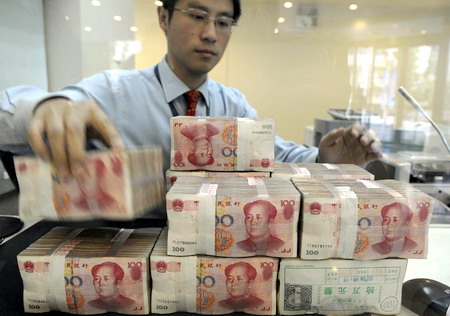
An employee counts yuan banknotes at a bank in Hefei, Anhui province. China's foreign exchange reserves hit a record $2.85 trillion at the end of 2010.?[Photo / Reuters] |
Experts say expectation for further yuan appreciation behind the rise
BEIJING - China's foreign exchange reserves rose to a record $2.85 trillion at the end of 2010, an 18.7 percent increase year-on-year, sparking concerns about the country's already excessive liquidity, analysts said.
Compared with nearly $2.65 trillion in foreign reserves by the end of September, the figure increased by $199 billion in the fourth quarter, marking the fastest rate on a quarterly basis in 2010, according to a statement from the People's Bank of China released on Tuesday.
Spurred by yuan appreciation, the expectation of further interest rate hikes, and the monetary-easing policy in the US, the country's foreign reserves have grown rapidly since the third quarter of 2010, analysts said.
Yi Gang, vice-governor of the central bank and head of the State Administration of Foreign Exchange (SAFE), said in an article in China Forex magazine that the country will increase the flexibility of its currency exchange rate this year to reduce the trade surplus and inflationary pressures caused by ample liquidity.
As the yuan's value rises, the reduced trade surplus (a major ingredient of the foreign exchange reserves) and possibly lower inflows of speculative capital from overseas would help ease the problems caused by excess liquidity, ranging from inflation to asset bubbles, analysts said.
Wang Tao, head of China economic research at UBS Securities, said in a research note that the central bank is facing the challenge of persistently large foreign reserves accumulation, and she expected further net issuance of central bank bills and more hikes to banks' reserve requirement ratios in 2011.
The reserve requirement is the ratio of money that lenders are required to keep in reserve. It is a tool used by the central bank to control market liquidity.
China has been facing the problem of excessive liquidity since the government instigated stimulus measures worth $586 billion in late 2008, and adopted its "moderately loose" monetary policy to heat up an economy battered by the global financial crisis. It is believed that increased capital inflows, as investors sought a safe haven in China, could also have contributed to the problem.
In 2010, inflation has become more apparent as a result of the expansion of lending in previous years. In November, China's consumer inflation jumped to 5.1 percent, the fastest clip in more than two years.
In 2010, new yuan loans reached 7.95 trillion yuan ($1.2 trillion), exceeding the government's target of 7.5 trillion yuan.
| ||||


The monetary easing policies adopted by the world's major economies also posed the threat that increased capital inflows will fuel inflation, said Liu Mingkang, the country's chief banking regulator in December.
"Cross-border capital inflows could have increased remarkably in the fourth quarter, based on a rough calculation of the newly added foreign exchange reserves, deducting foreign direct investment and the trade surplus," said E Yongjian, an economist with the Bank of Communications. "They (capital inflows) have contributed a lot to the rapid growth of portfolios."
As China's import growth outpaced that of exports, its trade surplus in December was $13.1 billion, an eight-month low, while foreign exchange reserves increased by $16.4 billion over the period.
E said the big increase in foreign reserves in December was mainly attributable to stronger expectations of yuan appreciation.
As of Dec 31, the yuan's reference rate against the dollar was 6.6227 yuan, the highest since 2005, and it was more than 3 percent higher than in June.
Most institutions have predicted that domestic GDP growth will remain above 8 percent in 2011, and the yuan will appreciate at a pace between 3 and 5 percent, which may further attract foreign capital inflows.
"The yuan is expected to appreciate about 5 percent against the US dollar, partly due to a systematic depreciating pressure of the US dollar," said Shen Gaoming, head of China Research of Citi Investment Research with Citigroup.
Gao Changxin contributed to this story.