Banking
PBOC to keep credit, capital levels in check
By Wang Xiaotian (China Daily)
Updated: 2011-01-06 09:21
 |
Large Medium Small |
|
 |
|
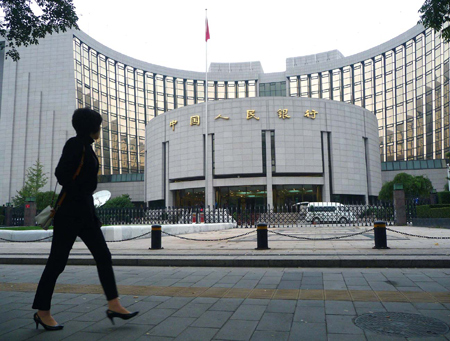
The People's Bank of China (pictured above), the country's central bank, raised the reserve requirement ratio six times and interest rates twice in 2010 to control liquidity and inflation.?[Photo / China Daily] |
BEIJING - The People's Bank of China (PBOC), the country's central bank, will check credit and capital levels of commercial banks each month to determine the reserve requirements for individual lenders, viewed as a measure to strengthen control over banks' monthly credit.
The China Securities Journal reported on Wednesday that banks may have to set aside more reserves if their capital-adequacy ratios cannot meet the government-set standards, citing an anonymous source close to the People's Bank of China.
"The key point of the differentiated reserve requirements lies in how important the individual financial institution is to the overall economy. Apart from systematic importance, its capital adequacy rate, operational stability and other factors will also be taken into account," the source said.
The differentiated reserve requirements will be calculated by multiplying capital-adequacy shortfall with a stability parameter, and banks that fail to meet such criteria will be ordered to adjust their credit immediately, according to the report.
A grace period of nine months will be granted to banks before the regulation is implemented, it added.
"The move indicated that the central bank wants tighter control over the monthly credit supply, to keep new loans at a manageable pace," said Li Wei, an economist with Standard Chartered Bank.
In the first 11 months of 2010, new yuan-denominated loans in China exceeded 99 percent of the government-set 7.5 trillion yuan ($1.14 trillion) limit. Analysts predict the year's credit will reach 8 trillion yuan.
"As banks usually tend to lend out more money as soon as possible, set monthly levels would help the government to control credit in a more timely and efficient manner and guarantee achievement for the annual credit target," said Lian Ping, chief economist with the Bank of Communications.
Over-liquidity led by superfluous credit and excessive money supply are regarded as major contributors to the country's inflation. The consumer price index, a main gauge of inflation, accelerated to a 28-month high of 5.1 percent in November.
To soak up excess liquidity and curb inflation, the central bank raised the reserve requirement ratio for banks six times and increased interest rates twice in 2010 to maintain healthy economic development. Currently the reserve requirement ratio for most banks is 18.5 percent.
In addition, the PBOC increased the one-year lending rate to commercial banks by 52 basis points to 3.85 percent, and raised the discount rate by 45 basis points to 2.25 percent in December - both increases were the first in two years.


"We should adopt a prudent stance to counter the over-expansion of the economy, which was stimulated by positive measures during the global crisis. Emerging countries should build up a counter-cyclical capital buffer now and adopt higher capital adequacy standards," Zhou said at a forum at Peking University.
The central bank is also planning to reduce the amount of interest paid on banks' excess reserves to cut costs, the newspaper reported. It currently pays 1.62 percent annually on statutory reserves and 0.72 percent on the extra reserves.
"The consequent reduction of extra reserves means usable money for commercial banks to lend money and buy bonds will decline, and capital flows will certainly be slowed down," said Li.
Zhou said in an earlier interview that apart from reducing money supply through usual measures such as raising reserve requirements, the central bank could also soak up excess liquidity by restricting the flow of capital.