Economy
Traditional medicine prices are elixir for sellers
By Zhang Yue (China Daily)
Updated: 2010-12-22 09:33
 |
Large Medium Small |
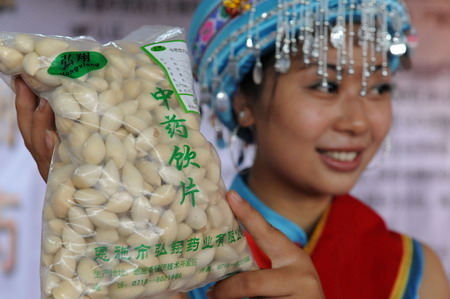
An exhibitor promotes her wares at a traditional Chinese medicine fair in Bozhou, Anhui province. [Photo / China Daily]
Trader hoarding, supply shortages drive up prices, increasing profits
BOZHOU, Anhui - The year 2010 has seen enormous fluctuations in the price of traditional Chinese herbal medicines, price changes that have put pressure on people who need them for their health, but have benefited traders in the time-honored remedies.
A report released in November by China's Association of Traditional Chinese Medicine found that the cost of more than 25 percent of herbal medicines more than doubled in the second half of 2010.
The city of Bozhou, in East China's Anhui province, has been known as the nation's center of traditional Chinese medicine since the 1980s. Its trade center for these medicines, the largest in the country, attracts thousands of herbal-medicine growers and traders at 8 am each morning.
"More than half of Bozhou's residents have been in the herbal-medicine trade for many years," said Li Yunling, a former wine seller.
Li became involved with herbal-medicine trading this year after learning that his neighbor earned more than a million yuan with it in 2009.
"This is an extraordinary year," said 64-year-old Cui Jubin, who has been a herbal-medicine trader in Bozhou for 15 years. He said only 2003 compares with it in terms of price changes - the price of radix isatidis, used to fight the flu, increased almost tenfold due to the SARS outbreak.
Cui started his trading this year with the Japanese Pagoda Tree Flower-bud, a common herbal medicine used to reduce fever. One of his partners had learned while visiting the Guangxi Zhuang autonomous region, a major producer of the herb, during the Spring Festival that supplies of the herb were likely to be scarce because there were fewer growers.
"A decrease in herb production usually leads to an inflated price, so I decided to buy some and wait for the price to rise," Cui said.
Cui bought 10 tons of the flower-bud for 20 yuan ($3) a kg and sold some of it for 60 yuan a kg. He earned more than he expected, 32,000 yuan in three months - a monthly salary of 2,000 yuan is considered good in Bozhou.
"Most herbal medicines are grown in the southwest of the country, which saw flooding and drought this year that reduced production," said Xing Zhenjie, owner of a research lab in Bozhou that guides growers in herbal-medicine cultivation. "Another key factor in this year's price increases is that some traders monopolized stocks of certain herbal medicines."
As an example, he mentioned radix pseudostellariae, used to treat stomach and spleen ailments, which went from 20 yuan a kg to more than 160 yuan. Traders who hoarded the medicine earned millions of yuan.
Cui has a daughter and two sons, each of whom have been operating their own traditional-medicine business for years. The quick profits this year have attracted a third generation of the family to join in. Cui's 18-year-old grandson, who took his college entrance exam this summer, changed his plans three months ago to learn the medicine trade with his grandfather.
"Trading medicine is seen as the best way to earn a living in Bozhou," Cui said, "It can bring you quick profits. Most college graduates earn roughly 2,000 yuan a month. I can see little point in sending him to college if he can learn to run the business as well as I do."
Cui said that he is thinking about buying a 100,000 yuan car to reward his grandson for his hard work this year.
| ||||


"Each mu (0.066 hectares) of radices paeoniae alba needs an investment of about 1,000 yuan," said Zheng Zhiwen, who works for a Bozhou-based website that focuses on the price of common herbal medicines. "And it takes five years for growers to see their investment start to pay back."
For years, before SARS started in 2003, radices paeoniae alba cost about 3 yuan a kg. This year, limited production drove the price to around 20 yuan a kg.
Price fluctuations have drawn crowds of area residents to the trade center almost daily. Thousands of traders squeeze into stands on the center's second floor each morning. There they show samples of their medicines and loudly haggle with buyers - the crowds make shouting necessary. The deals they reach are usually for large amounts of medicines.
The soaring prices of herbal medicine are also affecting overseas markets. Xiehecheng, a factory in Bozhou that processes herbal medicines, is the largest exporter in Anhui province.
A factory sales staff member said the export price of radices paeoniae alba, their major export product, rose from $3 to $6.2 a kg. But he said overseas demand has remained steady and yielded good profits this year.
But Xing thinks that the rising prices are likely to affect the business outlook at some point.
Cui has two more tons of Japanese Pagoda Tree Flower-bud he is holding onto as he waits for another price surge, which he expects in mid 2011.
"This is like scalping," he said, "Some people I know earned 1 or 2 billion yuan this year. But they might be the ones who will lose billions of yuan next year. Still, I believe in the potential of herbal medicine."