Energy
Coal and cars combine to increase pollution in North
By Wang Qian (China Daily)
Updated: 2010-12-08 13:38
 |
Large Medium Small |
|
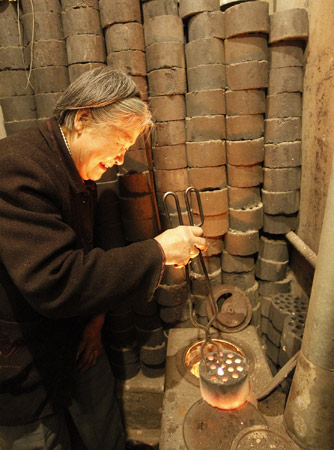 |
| A resident surnamed Song, 74, adds a coal briquette to a stove for heating her home at Nanguanfang Hutong in Beijing's Xicheng district on Nov 15. In many old houses in the capital's hutong, or traditional alleyways, residents still need to burn coal for heating.[Photo/China Daily] |
BEIJING - Experts blame coal-fired heating in winter in most northern parts of China for worsening pollution.
Most monitored cities in northern China have been suffering from slightly polluted air. For instance, the average air pollution index (API) for Harbin, capital of Heilongjiang province, reached 111 on Tuesday, figures from the environment authorities showed.
Air quality has been worse since winter, with Beijing's API reaching 199, while the index in the Olympic Sports Center rocketed to 305 on Thursday, according to figures released on Friday by the Beijing municipal environmental protection bureau.
An API reading below 50 indicates "excellent" air quality, while 50 to 100 shows "healthy" air and above 100 means that the air is polluted.
When the index exceeds 300, the air is severely polluted and harmful to people's health.
Zhu Tong, an environmental professor at Peking University, told China Daily that heating by burning coal contributes greatly to the worsening air quality, because the amount of pollutants released by coal burning increases dramatically in winter.
Coal burning is a common heating method in northern China during winter.
The lack of wind in winter helped pollutants caused by coal burning and vehicle exhaust emissions to stay in the air, Zhu said.
"Due to the dry winter and coal burning, haze and smog often form in northern areas during the heating season," said Sun Simin, chief representative for Asia-Pacific of the Clean Air Task Force, a United States-based nonprofit organization dedicated to reducing atmospheric pollution.
On Tuesday, the number of particles fit for breathing reached 0.194 milligrams per cubic meter in Baotou, an industrial city in the Inner Mongolia autonomous region in North China, according to the latest data released by the China National Environmental Monitoring Center on Tuesday afternoon.
Since Nov 25, the center has published online air-quality information for 113 major cities across the country, with the levels of sulfur, nitrogen dioxide and particulate matter updated every hour.
| ||||


The city's coal consumption during the heating season is about 19.4 kilograms a square meter, Gao Hongrui, manager of the Chengdong Heating Center in Shunyi district, Beijing, told Xinhua News Agency in 2009.
It is calculated that Beijing needs nearly 4 million tons of coal for heating during winter, and every ton of standard coal can release about 2.7 tons of carbon dioxide and 8.5 kg of sulfur dioxide.
Coal is used to produce 80 percent of China's energy, which means that it has become a major contributor to the country's worsening air quality, Sun said.
A report released by the Ministry of Environmental Protection in early November showed motor vehicle exhaust emissions had become the main contributor to worsening air pollution in big Chinese cities as the country undergoes a surge in car sales.
During the 2008 Olympic Games, Beijing operated under traffic restrictions to ensure good air quality for the event.
To alleviate air pollution, Beijing is expected to close all its coal-fired power plants in the next five years and invest about 30 billion yuan ($4.5 billion) on setting up a gas heating system, China Economic Weekly reported in October.