|
Urban women catch shopping fever |
Urban Chinese women are spending more and saving less as they poured 63 percent of their incomes into consumer goods ranging from clothes to cosmetics last year, a poll has found.
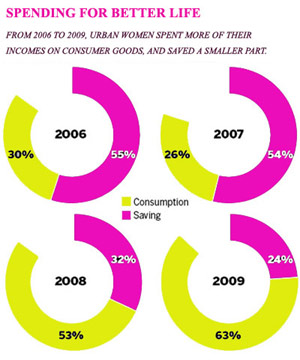

Also, women saved only 24 percent of their incomes last year, according to the survey released on Tuesday by the Women of China magazine.
By contrast, in 2006, urban Chinese women spent only 30 percent of their incomes on consumer goods and saved 55 percent.
The survey showed that urban Chinese women put less money in their bank accounts and developed a growing passion for spending, which is totally different from the patterns just a few years ago, said Liu Zhonglu, the organizer of the survey.
The survey, which polled 1,074 women in 10 big cities such as Beijing and Shanghai, found most of their spending went to clothing and apparel for the past four years.
Meanwhile, their spending on cosmetics, health-related goods, traveling and digital equipments has also grown sharply, according to the survey. [Full story]
|
Luxuries in China |
 |
Luxury brands wrest back China market Top global luxury brands like Burberry and Coach are pouring funds into China's multi-billion dollar luxury market, wresting control of their brands from Chinese partners as they swoop back into a market set to become world No 1. Many piled into China over the last decade, pairing with re-sellers and joint venture partners, but with so much at stake, they are severing these ties and bringing their own considerable financial and marketing muscle as well as expertise to China.[Full story] |
|
Luxury brand makers scent more profits A new era in global luxury brands is coming to China with more companies in the sector buying back direct control of their operations in the country from local business partners. Last month, Burberry, the UK's largest luxury company, bought its Chinese franchises for $107.65 million to unify its brand. After the completion of the deal, 50 boutiques and assets of its Chinese partner, Hong Kong-based Kwok Hang Holdings, will be managed directly by Burberry. [Full story] |
|
|
Chinese luxury wannabes try to raise their profile Billionaire investor Warren Buffett, often dubbed the Oracle of Omaha, has seen the future of fashion in the most unlikely of places, bearing a "Made in China" label better known for its cheap than chic. "I threw away the rest of my suits," beams Buffett in the 2007 video, adding that he and Microsoft founder Bill Gates are fans of Chinese suit maker Trands and would be great salesmen for the company based in the northeast Chinese city of Dalian.[Full story] |
|
Foreign brands swarm to China |
|
 |
Foreign top shops flock to Beijing Another wave of high-end international stores will set up shop in Beijing this year as the capital continues its campaign to become one of the world's top cities. Beijing aimed to introduce six more elite retailers and 40 percent of the world's luxury brands will have a presence in the city, a senior commerce official said.
More H&M China sales up to $219b |
|
Gap hopes to fill the gaps
Gap Inc, a global apparel retailer, plans to enter the Chinese market soon, by opening four outlets within this year. The company, which spent two years on market research before entering China, plans to open two outlets in Beijing and two in Shanghai. "Gap will wholly own our Chinese stores because Gap attaches great importance to business in China, the third largest apparel market in the world," said Redmond Yeung, president of Gap in China. [Full story] |
Esprit plans expansion in Chinese mainland Europe-focused Esprit Holdings, the world's No 7 fashion retailer by market value, posted a forecast-beating 5.2 percent fall in profit for its fiscal first half, saying it aims to expand its Chinese mainland network and broaden its footprint in Asia to improve its geographical balance.
The fashion group said there was vast potential to improve its penetration in mainland, and it would continue its expansion to more than 450 cities from the current 150. |


|
E-commerce booms in China |
|
Online shopping gaining ground in China
According to the survey, books and clothing, accessories and shoes top the list of planned online purchases in the next six months for Chinese online consumers. Compared with other countries in the Asia Pacific region, Chinese online consumers are the keenest to purchase clothing online, followed by consumers in South Korea (56 percent) and Philippines (37 percent). [Full story] |
|
E-commerce set for rapid growth E-commerce, dubbed as the "new engine" of growth, is helping China sustain its foreign trade at a time when the nation's exports and imports have been decelerating for months, said Vice-minister of Commerce Jiang Yaoping. During a press conference on China's E-commerce Report 2008-2009, he said China's e-commerce industry will grow "at a high speed" in the coming years and the nation is soon expected to overtake Japan as the world's third-largest nation in terms of value of e-commerce transactions, given that e-commerce is gaining recognition nationwide. [Full story] |
|
Competition intensifies in online team-buying market
The potentially lucrative business model of online team-buying websites are also taking in more revenues, as shown by the number of such websites which more than doubled to about 900 in July, according to figures from a Beijing-based Internet analysis firm, Analysys International. [Full story] |
|
E-commerce volume surged to 2.25t yuan in H1 China's e-commerce industry is expected to see rapid growth in the next few years, with the average annual growth rate surpassing 35 percent, a top government official said on Tuesday. Qian Xiaoqian, deputy director of the State Council Information Office, said online shopping is become more and more popular in the nation as more people have started using the service. [Full story] |
 Online consumers from China are the most prolific online shoppers in the Asia Pacific region and nearly 95 percent of them are planning a web purchase in the next six months, said John Burbank, chief executive officer of Nielsen Online, the online division of research firm Nielsen.
 With huge discounts, sometimes even below 10 percent of original prices, China's online team-buying websites, familiar as Groupon.com in the US, are drawing an increasingly large army of buyers.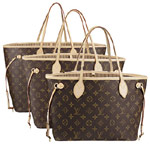
|
Voices - to buy or not to buy? |
|
Family values deep-rooted in Chinese consumers' minds Most Chinese think of the needs of their families when buying things, a study report by Synovate released on Wednesday showed. The study, named Media Atlas China, found that some 77 percent of respondents in the Tier 1 cities strongly agree or agree that they usually think about the needs of their families when buying things. Synovate surveyed 68,000 consumers across 66 cities and rural areas in the Chinese mainland from December 2009 to June 2010. [Full story]
|

|
Less stuff, more happiness
As the months passed, out went stacks of sweaters, shoes, books, pots and pans, even the television after a trial separation during which it was relegated to a closet. Eventually, Tammy Strobel and her husband Logan Smith, both 31, got rid of their cars, too. Today, three years after the couple began downsizing, they live in Portland, Oregon, in a studio with a nice-sized kitchen. They have money to travel and to contribute to the education funds of nieces and nephews. And because their debt is paid off, Ms. Strobel works fewer hours, giving her time to be outdoors, and to volunteer, which she does about four hours a week for a nonprofit outreach program called Living Yoga. [Full story] |
Everybody wants luxury, but not at any price If you've ever walked into any of the familiar looking Western luxury brand stores around Beijing, chances are you've walked straight back out again when noticing the less familiar prices.Luxury goods are unbelievably high-priced in Beijing, due to a combination of high tax and store owners desperate to exploit the immodest egos of Beijing's new money. Foreign luxury items are subject to a significant tax on entry into China, aimed at redistributing wealth and, judging by the sales figures, this must be a huge amount. [Full story]
|
Luxury goods can't buy happiness China now accounts for more than a quarter of the world's purchases of luxury goods. At this pace, it will soon bypass the US to become the top market for such products after Japan, even though its per capita income is still much lower than in America. Indeed, according to Du Junfei, a professor of Nanjing University, while purchases of luxury goods amount to 4 percent of consumer's assets worldwide, the figure in China is as much as 40 percent or higher. [Full story] |
Is the fashion industry eco-friendly? No I was a fashion writer for a couple of years, but the luxury industry could neither make me fall in love with it nor respect it. The first reason is obvious: astronomical prices. But the second reason, environmental unfriendliness, which deserves more attention. Fashionists may argue that I'm not aware of the eco-fashion products that have hit the market one after another recently. The famous "I am not a plastic bag", jeans made from organic cotton and clothes made from garbage bags are just a few examples, they would say. And then, of course, they would mention charity donation programs held by big brands to help the impoverished people and protect endangered animals. [Full story]
|

Editing by Qiang Xiaoji and Nie Peng