Opinion
Companies warned of increasing labor costs in China
By Wang Xing, Lan Lan and Wang Xiaotian (China Daily)
Updated: 2010-06-10 07:23
 |
Large Medium Small |
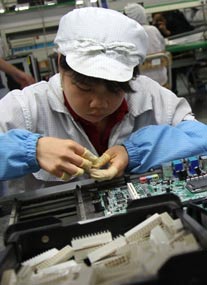
BEIJING - Foreign and domestic enterprises should brace themselves for hefty wage rises in the coming years after labor discontent at Foxconn and Honda units in the Pearl River Delta area, experts have said.


Wages for 150 million migrant workers increased 19 percent in 2008 and 16 percent in 2009, according to Cai, who said labor costs will continue to rise.
On Sunday, Taiwanese-owned Foxconn Technology Group announced a second rise that would increase pay by up to 65 percent at its factories in the southern city of Shenzhen.
Earlier, Honda offered a 24 percent pay hike to its auto parts workers in Foshan, Guangdong, to bring an unprecedented strike to an end.
In addition, 14 provinces and regions raised minimum wage levels this year, with the highest at more than 20 percent.
Shenzhen, a southern manufacturing hub where Foxconn is based, plans to raise the minimum wage by an average of 15.8 percent from next month, the city government said on Wednesday.
|
|
"Companies that cannot adapt to the city's development will have to move out as a result," he told reporters.
The rising cost of labor has prompted speculation that global consumer electronics makers may consider moving their factories to neighboring countries such as Vietnam, India and Indonesia, where wages are lower.
Industry experts, however, said the recent pay rises in such companies as Foxconn are not a prelude to an end to China's role as the "world's factory".
Neither do they expect an exodus of foreign companies from China, citing an unfavorable investment environment in alternative countries and high corporate relocation costs.
"In theory, the salary hikes will force firms to move their factories (from China) to regions where labor costs are cheaper, but that possibility is very slim," said Li Xiaogang, director of the Foreign Investment Research Center at the Shanghai Academy of Social Sciences.
He said China's role as the "world's factory" is not only because of its lower labor costs but also thanks to its sound infrastructure, political stability, a huge domestic market and high labor skills, which few of its neighboring countries can match.
Although enterprises may raise concerns over rising labor costs in China, "I think their expression (of intent to move out of China) is a bargaining tactic that aims to put pressure on the Chinese government for some benefits," Li said.
But some overseas-invested enterprises, especially exporters of inexpensive clothing and other low-end goods, are already under strain.
"It is very difficult for us," said Danny Lau, chairman of the Hong Kong Small and Medium Enterprises Association. He said some 2,000 to 3,000 of an estimated 50,000 Hong Kong-owned factories in the Pearl River Delta, an export hub, might close this year.
The Taiwan Electronic and Electrical Manufacturers' Association, which represents electronic manufacturers on the island, is encouraging Taiwanese electronics makers to build new facilities in Asian countries such as Vietnam, India, Indonesia and Malaysia where labor costs are lower, the Wall Street Journal reported, citing Luo Huai Jia, the association's vice-president.
The report also said major firms such as Hong Hai, which owns Foxconn, TPV and Compal Electronics plan to diversify their factories that are concentrated in the Chinese mainland.
But industrial experts said that it may not be a good idea for them to move out.
James Lei, director of consumer electronics research at research firm Instat, said compared with other countries, moving to inland Chinese regions such as Sichuan and Chongqing may be a better choice.
"I think China's neighbors are not yet ready to fulfill orders currently executed by millions of Chinese migrant workers," he said.