World Business
Investors shun Buffett's advice
By Alexis Leondis (China Daily/Agencies)
Updated: 2010-05-28 10:03
 |
Large Medium Small |
|
 |
|
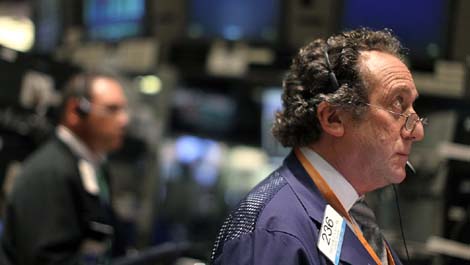
Traders work on the floor of the New York Stock Exchange. Investors pulled an estimated $14 billion from US stock and bond mutual funds in the week ended May 12, according to the Investment Company Institute. [China Daily] |
Unstable market means cash is becoming more popular in the United States
NEW YORK: Howard Gellis, former head of the corporate debt group at Blackstone Group LP, isn't taking Warren Buffett's investment advice to pick stocks over cash.
"The events of the last month have reinforced why I'm absolutely not putting any new money in the stock market," said Gellis, 56, who's retired and lives in Palm Beach Gardens, Florida. "You shouldn't put any money in the market you can't afford to lose."
|
||||


Stocks are attractive because of corporate earnings forecasts and favorable valuations, said Rubin of Westport, Connecticut-based Birinyi Associates, a money management and research firm.
Investors had about 60 percent of their portfolios in stocks, 20 percent in bonds and 20 percent in cash, according to a survey last month by the American Association of Individual Investors, a nonprofit investment education group in Chicago.
That compares with an average recommendation of 8 percent allocated to cash from strategists at brokerages compiled by Bloomberg, including Bank of America Corp and JPMorgan Chase & Co.
"Clients want to make sure a dollar stays a dollar and protection from loss is the paramount goal rather than increasing money every day," said Jane King, president of Fairfield Financial Advisors, a Wellesley, Massachusetts-based fee-only firm with clients who have $5 million to $10 million in net worth.
Investors pulled an estimated $14 billion from US stock and bond mutual funds in the week ended May 12, the first net withdrawals since March 2009, according to the Investment Company Institute, a trade group in Washington. The Standard & Poor's 500 Index has declined 5.2 percent this year and has gained 59 percent since the market low in March 2009.
The May 6 market rout that drove the Dow Jones Industrial Average to an almost 1000-point drop before recovering has contributed to the aversion to risk. The Chicago Board Options Exchange Volatility Index (VIX) surged as much as 128 percent since the beginning of the year to a high of 45.79 on May 20.
"Trust in the market is elusive at best right now because of erratic economic news and the role greed and avarice played in the market meltdown," said Helen Modly, a fee-only planner at Focus Wealth Management in Middleburg, Virginia. "Folks naturally wonder who exactly is behind the curtain here."
Less bullish
The number of individual investors who are bullish for the next six months fell to 36.6 percent the week ended May 12 compared with a high in 2010 of 48.5 percent, said the American Association of Individual Investors.
Uncertainty about the resolution of Europe's debt crisis and stabilization of US economic conditions, including employment, fiscal policy, tax policy and the deficit, is keeping investors on the sidelines, said Carmen Reinhart, an economics professor at the University of Maryland in College Park.
Money available for immediate spending from sources such as savings accounts, checking accounts and money-market funds, increased 26 percent to $9.36 trillion as of May 10 compared with $7.44 trillion in May 2007 before the recession began, according to data from the Federal Reserve.