World Business
RBA raises the bar for further rate increases
By Jacob Greber and Daniel Petrie (China Daily)
Updated: 2010-05-06 10:00
 |
Large Medium Small |
|
 |
|
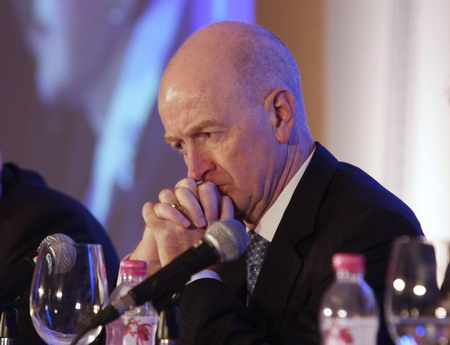
Reserve Bank of Australia Governor Glenn Stevens' job is now to decide whether factors such as surging investment in mines will push inflation above the bank's 2 percent to 3 percent target range without further action. [Bloomberg] |
SYDNEY - The Reserve Bank of Australia (RBA) signaled a higher bar for interest-rate increases after becoming the world's first major central bank to withdraw "emergency" stimulus used during the global financial crisis.
Governor Glenn Stevens raised the benchmark rate for a sixth time in seven meetings, to 4.5 percent, and said lending costs are back to "average" for most borrowers. The bank will hold off on a boost next month, according to all 24 economists surveyed by Bloomberg News after Tuesday's decision.
Stevens' job is now to decide whether surging investment in mines, along with a 20 percent jump in house prices and rising commodity costs, will push inflation above the bank's 2 percent to 3 percent target range without further action. One keen observer: Prime Minister Kevin Rudd, who faces an election within a year and may be vulnerable should rates start to erode households' purchasing power.
"There is now a far stronger case for the Reserve Bank to pause, especially as it now believes borrowing costs are back to 'normal'," said Craig James, a senior economist at Commonwealth Bank of Australia in Sydney. "Until now, consumers have remained confident, but the rate hikes have made them reluctant to spend."
The central bank's next steps will be "to move monetary policy to restrictive settings, designed to slow the economy down", James said.
The Australian dollar, which has climbed 23 percent in the past 12 months, tumbled against the US dollar by the most in three months after Stevens said that the bank's increase in borrowing costs from a record-low 3 percent in early October was a "significant adjustment".
The local currency traded at 91.01 US cents at 12:28 pm in Sydney from 92.45 before the decision was announced. Traders are betting there is a 16 percent chance of a quarter-point increase in benchmark rate on June 2, according to Bloomberg calculations based on interbank futures on the Sydney Futures Exchange at 12:05 pm.
Stevens, unlike counterparts in the US and Europe, is under pressure to extend a world-leading round of rate increases as Australia's economic expansion strengthens.
| ||||


Stevens said that inflation, which peaked at 5 percent in 2008, may not slow as much as earlier forecast and "now appears likely to be in the upper half of the target zone over the coming year."
By contrast, the governor predicted three months ago that inflation "would be in line" with its target range. The central bank will publish its latest forecasts for inflation and economic growth on Friday.
"The RBA's growth and inflation forecasts are clearly in the process of being changed," said Stephen Roberts, a senior economist at Nomura Australia Ltd in Sydney.
Stevens "has only a relatively limited window to pause at average interest rates" and will resume increasing borrowing costs in the fourth quarter, taking the benchmark to 5.25 percent in early 2011, Roberts said.
Reports on Wednesday showed home-building approvals rose in March at the fastest pace since 2002, surging 15.3 percent from February, and an index of the nation's services industry expanded in April for the first time in five months.
The jump in approvals "is encouraging and a good leading indicator for employment, particularly for workers in the construction industry", said Michael Turner, an economist at 4Cast Ltd in Sydney.
Continued rate increases may pose a danger for Rudd's Labor Party, which has seen voter support slump to the lowest level since before taking power in 2007 and faces an election within the next year.
Australian leaders are vulnerable to rate increases as more than two-thirds of the population own homes, compared with less than 50 percent in some European nations.
Bloomberg News