Opinion
Debate: Urbanization
(China Daily)
Updated: 2010-03-29 07:52
 |
Large Medium Small |
Su Qi: Cities play role of safety valves for the jobless
China is veering toward knowledge-based industries, making it difficult for semi-skilled and unskilled workers to get jobs in cities. As a result, many experts have concluded that rural areas should absorb cities' surplus workforce.
The problem is very few rural workers would choose to return to their hometowns and find work there even if their job prospects diminish greatly in cities, says Su Qi, a Beijing-based commentator.
Creating jobs for rural workers in their hometowns seems to be a win-win situation. Many would say this is possible because local governments have been complaining about shortage of workers. It may be true that fallow land in rural areas can be turned into farms, which would absorb cities' surplus workforce and improve the overall social order.
But this logic is flawed, Su says.
Experts want to make life better for migrant workers and give them a voice that would be heard by the authorities and society as a whole. But the problem is that it's the workers who have decided to migrate to cities.
If that is the case, will they want to return to the countryside? Compared to cities, rural areas offer a dull future that involves backbreaking labor in the fields and few chances of prospering.
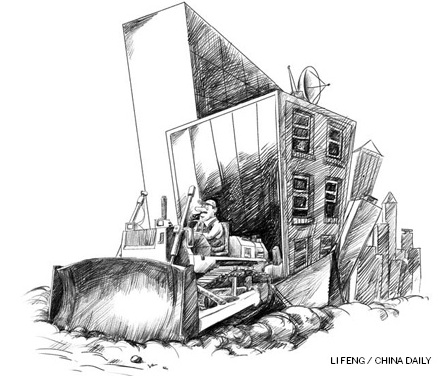
In contrast, cities offer dreams. They offer enough roads to success no matter how rough they are even if they cannot provide real job at times. In fact, Chinese cities play the role of safety valves, releasing the pressure generated by rising unemployment, Su says.
Besides, history shows that people have always been attracted to cities in search of a better life. Take China for example. The tussle between a huge population and limited land since the end of the Qing Dynasty (1644-1911) has been eased mainly by exploiting large areas in the northeast and urbanization drives along the coastline.
From the end of the Qing Dynasty to the early 1940s, the population in the northeast grew from 10 million to 44.5 million. And migrant population in emerging northeastern cities grew at a pace faster than even Shanghai's, he says.
|
||||


Although the slums on the fringes of cities are seen as a side effect of urbanization, the condition of those living in them is less painful than what it would have been in the other two possible scenarios.
The first is the ecological devastation caused by their forcible return home. Developing countries learned a bitter lesson in the 1960s after succeeding in increasing average farm yields and setting free large number of laborers, who then rushed to reclaim huge swathes of primeval forests and caused ecological disasters, Su says.
The realistic and feasible way for China, therefore, is to eschew the policies that encourage rural people to go back home. Instead, it should consider how to develop cities better as a safety valve to release the pressure of unemployment generated by the country's rapid economic development.