Top Biz News
Chinese seafood traders fish for business at Boston show
By Kelly Chung Dawson (China Daily)
Updated: 2010-03-27 09:43
 |
Large Medium Small |
|
 |
|
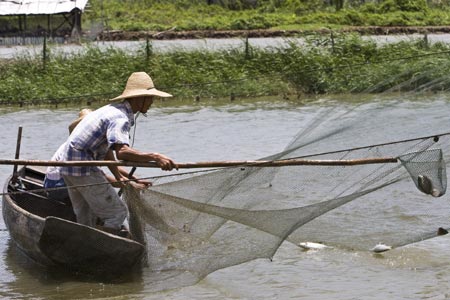
Fishermen at a fish farm in southern China. Most Chinese fish exported to the US is purchased from fish farms and then trucked to nearby factories to be gutted, filleted and frozen. [Agencies] |
BOSTON, Massachusetts - Chinese seafood exporters recovery from food safety scandals and their bid to boost business in the United States were demonstrated by an increased presence of the nation's firms at the 28th annual International Boston Seafood Show (IBSS).
Of the 869 seafood vendors in the cavernous Boston Conference & Exhibition Center at the show which ended on Tuesday, 147 were Chinese.
They joined 17,000 buyers and sellers from more than 90 countries, who sampled wares and tried to get a piece of the multi-billion dollar seafood market.
"There's definitely been an increase in Chinese companies participating," said Mary Larkin, group vice-president of Diversified Business Communications, which organized the event. "There's a strong processing and export business coming to the US from China."
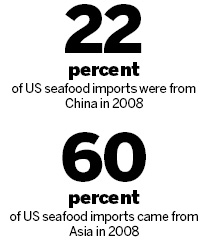
According to the most recent statistics available from the US National Marine Fisheries Service, 22 percent of US seafood imports were from China in 2008, with 60 percent of total seafood imports coming from Asia.
Xiao Yanming, of China's Dalian Yingjie Foods Company, said: "People want to buy from China because the price is cheaper. Lower labor costs have allowed Chinese companies to keep prices extremely competitive."
Zhenye Aquatic, like most companies at the conference, aims to expand in the US market, which is the largest seafood market in the world, followed by Japan.
"There's a lot of competition in the market for the US, so you'll see that Chinese companies want to sell at a very low price to get their share of the market," said a US wholesaler who wished to remain anonymous.
Most of the Chinese fish is purchased from fish farms and then trucked to nearby factories to be gutted, filleted and frozen. The packaged fish is then taken to Shenzhen or another port and packed into containers and shipped to Seattle, Los Angeles or New York.
In the past, American wholesalers distributed the fish to supermarkets and restaurants around the US, but this is changing, according to Steven Hedlund of Seafood.com, a publication that tracks seafood commerce.
"A lot of Chinese companies are starting to do the importing and exporting themselves, cutting out the middlemen," he said.
Many of the Chinese companies represented at the conference were selling fish farmed elsewhere in the world and processed in China before being exported to the United States. This practice has met some resistance at the local level in places like Canada and Alaska, Hedlund said.
"There's some resentment there," he said, referring to China's processing practices.
"But within the industry and (among) people who are trading globally on a daily basis, it's considered commonplace."
Chinese companies do it because it's cheaper, said Deng Shidong, export manager for Rhino Foods Limited, based in the coastal city of Qingdao, Shandong province. The quality remains the same, he said.
"This kind of processing uses a lot of labor, and requires a high number of workers. Americans won't do it for the same price."
Since food safety scandals garnered international press coverage in 2008, wholesalers and vendors alike have been extremely cautious.
"You have to be very selective about which companies you're buying from," the US wholesaler said. "You have to visit the factories and make sure the quality is good. Chinese companies work hard, and the more inspections, the better the quality."
|
||||


"People within the industry understand that just like in the United States, there are good apples and bad apples," Hedlund said.
"There are certainly processors that aren't up to code, but there are also facilities in China that are just as, if not better than, here in the United States. Within the trade, there's a perception that China is reacting to the food safety issue, and in the right direction."