Top Biz News
Toasting the future of China's wine industry
By Andrew Moody and Bao Chang (China Daily)
Updated: 2010-02-01 08:00
 |
Large Medium Small |
|
 |
|
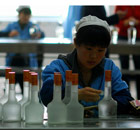
Chinese people sample a new red wine at a wine-tasting party. The drink is becoming trendy. [CFP] |
Sales reach record heights as its popularity soars among the young and fashionable
Guo Guangbo likes to drink red wine when he parties with his friends in Beijing.
The 24-year-old civil servant, from Qingdao in Shandong province, is one of China's burgeoning young affluent wine-drinking generation.
They opt to drink wine because it is seen as fashionable, rather than the traditional alcoholic drinks often preferred by their parents.
Sales of wine in China last year were 44 billion yuan ($6.44 billion) at retail price, up 12 per cent on 40 billion yuan in 2008, according to research by global management consultants AT Kearney.
"I mostly drink red wine at parties with my colleagues and at business dinners. I think drinking has become a new social language in China. It promotes friendly relations between people during parties," said Guo.
"If we don't drink, you don't get the same atmosphere and things are not as lively."
Whether exuberance is what you are after or not, Irene Cai, who covers the drinks industry for AT Kearney in Shanghai, says wine drinking is very much the in thing to do.
"Young people in China are to some extent trying to copy the western lifestyle. They mainly drink wine at restaurants and parties but as it is becoming more available from specialist wine retailers, they are also starting to drink at home as well," she said.
Although demonstrating annual double-digit growth in recent years. China's wine consumption at 0.4 liters per person a year is still quite low in the international league table.
In France, where wine is culturally embedded, people drink 50 liters a year with consumption in Australia another major wine producing nation, 25 liters and in the United States 15 liters, according to AT Kearney figures.
If China's per capital wine consumption was to only increase slightly because of the scale of the population it could easily shift the center of gravity of the world's wine industry.
Wine production
China is also an emerging wine-producing nation in its own right with brands such as Great Wall, Changyu and Dynasty.
China already produces more wine than Spain and Portugal combined and some of its brands are already stocked in supermarkets in the West, competing successfully against New World wines from countries such as Chile.
Ma Fei, a spokesperson for Great Wall, whose range extends from budget-end wines to Sanggan, which was served to US President Barack Obama at a state banquet in Beijing recently, hopes the Shanghai Expo will put Great Wall firmly on the international map.
"I hope the Expo will further develop brand awareness around the world. It is the sole red wine brand appointed by the Expo committee. It will be served to the politicians and to the business elite alike," he said.
One of the main features of the China wine market, as supposed to western markets, is the predominance of red over white wine. Around 80 per cent of the wine drank in China is estimated to be red. A lot of Chinese white wines, by common consent, tend to be inferior to western brands.
"This has something to do with the fact that white wine production started much later in China," said Cai at AT Kearney. "It is also linked to red being associated with parties and happiness so it is appropriate to give red wine as a present."


Some restaurants in China only serve overseas wine to cater for the tastes of foreigners and increasingly wealthy Chinese consumers.
Guan Miaonan, manager of the popular South Beauty restaurant and Lan Club in the Guomao area of Beijing, said Chinese consumers now tend to opt for foreign wines rather than the Chinese ones. "Our customers who drink wine during dinner tend to order wine priced between 600 and 1,000 yuan," he said.
Wei Wenhe is general manager of Domus, an upmarket French restaurant in downtown Beijing, which has two cellars both stocked with just foreign wines. "Most customers who eat at the restaurant prefer imported wine and we have no plans of introducing domestic brands in the future," he said.
Cai at AT Kearney says a lot of Chinese consumers think some foreign wine is better just because it is more expensive and often don't realize that many Chinese wines are of quite high quality. As a result a lot of foreign wine makers have a vested interest in leveraging up their prices.
"A lot of quite low-tier foreign wines sell at a high price in China. Consumers in China have very limited knowledge about wine. It is very difficult for them to assess the quality of either branded or even non-branded wine."
Joy Huang, a research analyst with market research company Euromonitor, based in Shanghai, said one of the problems was consumers had no system of classification to guide them.