Top Biz News
Thirsting for a solution
By Fu Jing (China Daily)
Updated: 2009-11-25 07:52
|
Lan Wuhua, 31, uses a fresh water well plumbed by Oxfam Hong Kong in Huolianwan village, Gansu province, where residents have struggled to get access to clean drinking water. |

After nine months without seeing a drop of rain, farmers in Northwest China's Gansu province had no choice but to head for the nearby temples and pray. Not only did they desperately need water to irrigate crops, they also needed it to quench their own painful thirst.
The prayers were finally answered months later when one night in July the clouds erupted with thunder and lightning, lashing the impoverished province with rain. But the farmers' relief was short-lived. 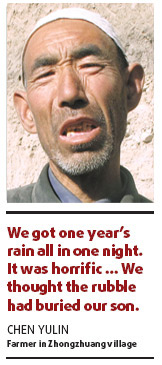
The torrential downpour was just as vicious as the scorching drought and, after just half an hour, the floods and mudslides began, with strong winds, swollen rivers and avalanches of falling rocks working together to destroy the villagers' homes.
You could be forgiven for thinking this was a scene from the new Hollywood blockbuster movie 2012. For the residents of Dingxi, a city in one of China's poorest areas, it was a harsh reality.
"We got one year's rain all in one night. It was horrific," said Chen Yulin, 55, who lives with his wife Ma Yuying in Zhongzhuang, a village surrounded by barren mountains.
The couple's shabby, four-room home sits at the foot of a steep slope and was battered by rain and rocks during the storm, to the extent that the ceiling of the room where their 14-year-old son was sleeping collapsed in the night.
"We were devastated. We thought the rubble had buried our son," said an emotional Chen. "Luckily, the room didn't fall down completely and, after searching for him in the darkness, we found our terrified son crouching in a corner. He was safe."
The July storm is likely to be the only rainfall this year in villages around Dingxi, which is in a mountainous region neighboring the Qinghai-Tibet Plateau. Residents here have suffered for centuries, according to the history books, which all note that the area is notorious for the "severest hardships and poverty under the heavens".


The numbers support their belief. Scientist have already discovered that the Earth's surface temperature has increased about 0.6 C in the past century, while local metrological data has shown that, in Gansu, land temperatures have risen by 1.1 C in the last 50 years.
And not far from the western Chinese province lies the Himalayan glacial area, which experts say has shrunk by around 20 percent since the beginning for the 20th century.
Last year, just 350 mm of rain fell in Dingxi, half of the national average. So far this year, the city and surrounding communities have had only 160 mm, said the city's metrological bureau.
The rainy season, which used to last from July until the skies ran dry in September, now lasts just a month, say residents.

The years of chronic drought have already had a dramatic effect on the local geographical features. Records show that even in the 1930s the region was awash with snowy mountains and swamplands. Now, the environment is now mainly dry and dusty.
"We experience frequent heat waves, hail and flash floods, which have all worsened the already bad living conditions me and my neighbors must endure," said Mao Zhiying, village chief for Zhongzhuang.
The average annual income per capita is just 800 yuan ($115), one-sixth of the national average for farmers. Floods have repeatedly washed away properties, and without government subsidies it would be hard for families to rebuild their homes and lives, said Mao.
This winter, Chen and his family are sleeping in the only room in their home not collapsed or severely damaged by the July storm.
"We have no money to move or rebuild our house," said the farmer, whose family survives every year on well below the national poverty benchmark, set at 1,196 yuan. For them, the cost of reconstructing their home, roughly 20,000 yuan, is a colossal sum.
According to official figures, China has around 44 million people living in poverty, and Gansu is home to a tenth of this population.
China has successfully cut the number of poor from 250 million in the 1980s to about 40 million today, according to government statistics.
However, when measured against the United Nation's poverty criteria for developing nations - citizens who survive on less than $2 a day - almost one in 10 Chinese fall under the line, according Yu Qingtai, Chinese special representative for climate change negotiations.
Official statistics indicate that amap of China's poverty-stricken areas almost perfectly matches a map of ecologically fragile regions, while officials have pointed the finger at climate change as the main culprit for citizens' financial hardship.
Figures from Oxfam Hong Kong, a non-government organization, show that more than 95 percent of the nation's poor people live in ecologically fragile areas, making them most vulnerable to changing weather patterns.
"Global warming is inducing sandstorms, hail, floods, snowstorms and landslides, which are detrimental to ecologically sensitive areas and hamper poverty relief efforts," said Su Zhenxiang, deputy diector of the Gansu provincial poverty-alleviation office.
He explained that his job has helped him witness firsthand the changes in the natural environment for more than 30 years.
"This river flowed all year round when I was a kid," added 42-year-old village head Mao, standing on the banks of a dry riverbed in Zhongzhuang. "I used to swim here then, but even washing your face is a luxury for villagers now."