BIZCHINA> Top Biz News

|
BIZCHINA> Top Biz News
|
|
More rural areas turn to biogas
By Yu Tianyu (China Daily)
Updated: 2009-07-20 11:52
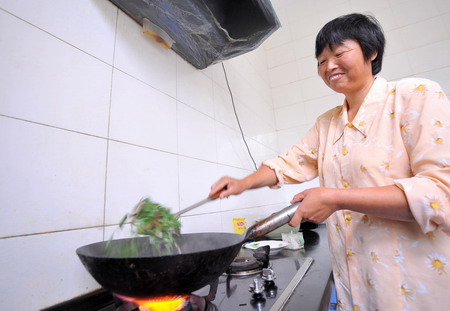
She routinely cooks three meals a day for her family of four in a clean, neat kitchen decorated with white tiles. It is very different from the image of traditional rural kitchens that often turn grimy from burning coal. Eight years ago, Wu enlisted the help of fellow villagers to build a small, simple biogas generation plant in her garden with 2,000 yuan ($292.78) of her own funds and a government subsidy of 1,500 yuan. She is among many of China's farmers who are benefiting from the government's initiative to develop biogas projects in rural China. The goal is to combat pollution and improve the living conditions of farmers. Wu raises 30 pigs and grows crops on less than one hectare of farmland. Animal and crop wastes are transported into her farm's biogas digester pool. Wu uses the processed animal wastes as fertilizer for her vegetables. She said urban residents prefer so-called "green vegetables" that can be sold at a price about 30 percent higher than vegetables fertilized with chemicals. Plus, the biogas produced by the plant wastes can supply her family's daily cooking and lighting needs, she said. Green savings The biogas system saves Wu more than 1,000 yuan each year versus the cost of buying coal. "It's quite safe and convenient," Wu said. "Before, I had to spend more than an hour cooking a meal, because it takes a long time to burn coal," Wu said, expertly turning on her biogas stove to boil water. "But now, it takes just half an hour." In other rural homes and communities, large quantities of agricultural wastes are not captured. Crop residues are burned in open fields, and animal wastes are discharged in a way that pollutes streams and groundwater resources.
After five years of research, the Ministry of Agriculture and Asian Development Bank (ADB) initiated its Efficient Utilization of Agricultural Wastes Project in 2003. The ADB offered $33.1 million in loans targeting rural Shanxi, Hubei, Henan and Jiangxi provinces. With $8.2 million in ADB loans, the Shanxi provincial authority also allocated $8.1 million in matching funds, along with an $841,000 grant from the Global Environment Fund (GEF). The ADB project, with its supporting funds, focused on 1,685 projects combining biogas pools, greenhouses, vegetable growing and livestock operations. Another 3,500 projects combine biogas production, vegetable growing and livestock operations. An additional six large-scale biomass projects were planned. The ADB projected that all projects will be completed by the end of this year. Farmers received loan funds equivalent to half the construction costs of their biogas projects, said Liu Wenyong, deputy director of the Shanxi Rural Energy Office. Liu said loan repayment schedules were based on the income levels and living conditions of the farmers. Farmers also were provided technical support and training to ensure that the biogas facilities are sustainable, Liu said. "Through the ADB biogas projects, we trained more than 9,000 people, including 8,000 farmers and 300 biogas facility experts, construction workers and management staff," he said. "The greatest achievement is that more than 60 percent of the trainees are women, since women are the main users of biogas for cooking and other purposes in their homes," he said. Xinxing Co in Jiaocheng county received a $200,000 ADB loan to build a new pig farm. The farm, scheduled for completion next year, will include blue biogas tanks. A nearby biomass plant will process pig dung to produce biogas. The farm's production capacity will increase from 2,200 pigs to about 9,000 animals. "So far, 100 households near here are using biogas without any charges to them that is produced by the pig farm," said Ren Jianguan, an agricultural official with Jiaocheng county. The company plans to support the energy needs of more than 300 households once the larger pig farm is fully operational. In the future, the energy from the farm will be priced at 1.2 yuan to 1.5 yuan per cu m. However, that cost is still lower than the cost of burning coal, Ren said. The province wants to develop large-scale gasification plants to serve more villages and also establish biogas projects in remote mountain areas, Ren said. According to an ADB document, the ADB's Efficient Utilization of Agricultural Wastes Project ultimately will benefit about 34,080 households in 145 villages within the four selected provinces. Biogas benefits The potential environmental benefits include a reduction in carbon dioxide emissions of about 78,338 tons per year. That can add up to a reduction of more than 1 million tons over the lifetime of the project, according to ADB projections. According to national statistics, 26 million households in China were using methane from biogas sources for cooking and heating by the end of 2007. That number rose to 31 million by the end of 2008. In the past five years, China has invested more than 10.5 billion yuan in government bonds for construction of biogas projects in rural areas, including 98,600 villages. Hong Fuzeng, an agricultural expert, said that biogas projects have become a major tool to help China achieve its energy-saving, emission-reduction goals in rural areas. China encouraged the development of biogas as part of the Renewable Energy Law, which became effective last year, and also as part of the country's Mid- and Long-Term Development Program for Renewable Energy. (For more biz stories, please visit Industries)
|
||||||
主站蜘蛛池模板: 欧美国产综合欧美视频| 日本熟妇色xxxxx日本免费看| 伊人久久大香线蕉av色婷婷色| 成人h动漫无码网站久久| 久久人人爽天天玩人人妻精品| 久久精品中文无码资源站| 天天爽夜夜爽人人爽曰| free性开放小少妇| 国产熟女丝袜av一二区| 无码精品人妻一区二区三区中| 国产破外女出血视频| 人妻饥渴偷公乱中文字幕| 这里只有精品免费视频 | 日韩精品一区二区在线看| 国产卡一卡二卡三免费入口| 91精品一区二区蜜桃| 日韩人妻无码一区二区三区| 国产精品无套高潮久久| 亚洲熟妇乱色一区二区三区| 日本一区二区精品色超碰| 国产黄色一级片在线观看| 亚洲精品视频一二三四区| 精品人妻中文字幕av| 人人人爽人人爽人人av| 久久精品中文字幕少妇| 国产精品一区在线蜜臀| 在线观看91精品国产不卡| 女人香蕉久久毛毛片精品| 国产精品熟女乱色一区二区| 国产国拍亚洲精品永久软件| 高清破外女出血AV毛片| 国产av永久无码天堂影院| 久久久99精品成人片中文字幕| 欧美自慰一级看片免费| 亚洲男人第一av天堂| 人妻换着玩又刺激又爽| 亚洲中文字幕久久精品品| 亚洲熟女精品一区二区| 国产亚洲人成网站观看| 91系列在线观看| 韩国午夜理论在线观看|