BIZCHINA> Top Biz News

|
BIZCHINA> Top Biz News
|
|
New yuan loans surge
By Wang Xu (China Daily)
Updated: 2009-04-17 07:59
 The explosive credit growth over the past few months has propped up the sagging economy, but it may also plant the seed for an asset price bubble and inflation, according to experts.
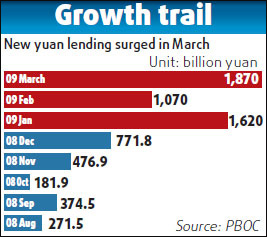
China's annualized GDP growth dropped to a 10-year low of 6.1 percent in the first quarter, on poor foreign demand and weak domestic investment. However, the nation's new yuan loans hit a record high of 1.89 trillion yuan in March, pushing the total new loans for the first quarter to 4.58 trillion yuan, nearly equal to the 4.9 trillion yuan new loans issued in 2008. The strong growth came after the government relaxed its curbs on loan growth last November, and tried to boost the economy with "ample liquidity" and a $586 billion stimulus package. Analysts say the new loans will take a few months to translate into real demand, as the borrowers may soon kick off the construction of a new wave of infrastructure projects including railways and airports.
"If the current situation of ample liquidity could last, industrial production will start to rebound in 10 months," Fan Jianping, chief economist, State Information Center, said. Analysts say Chinese lenders may need to extend more than 7 trillion yuan in new loans to achieve the official aim of 8 percent GDP growth this year. The government said earlier that it expected Chinese banks to extend more than 5 trillion yuan in new loan this year. "It's nothing to be surprised at if the new loans hit even 8 trillion yuan this year," Frank Gong, head of China research with JPMorgan Chase, said. "Since local enterprises don't have enough profits, they can only turn to the banks." While the new loans may prove a boon for cash-strapped enterprises, some economists warned that it may give rise to inflation and inflate a new asset bubble. "The current credit growth is too much," said Wang Xiaoguang, economist with the Institute of Economic Research with the National Development and Reform Commission. "It may lead to an asset bubble." The Shanghai Composite Index closed at 2534.13 points yesterday and it has rebounded nearly 40 percent from the beginning of this year, the strongest among all major stock markets. Some analysts say that part of the new loans might have gone into the stock market, which helped fuel the rebound. "Another concern is inflation," said Liu Shijin, vice-president of the Development Research Center of the State Council. "Once the economy starts to recover, the rapid money growth would quickly translate into inflation.
(For more biz stories, please visit Industries)
|
主站蜘蛛池模板: 精品久久久无码中文字幕| 日本黄色不卡视频| 亚洲综合精品香蕉久久网| 亚洲一区成人在线视频| 亚洲一区二区三区在线观看播放| 亚洲综合色区中文字幕| 亚洲精品熟女一区二区| 亚洲av无码成人网站www| 亚洲人成网站在线观看播放不卡 | 欧美成人一卡二卡三卡四卡| 日韩av一区二区三区精品| 老子影院午夜精品无码| 亚洲AV无码久久精品日韩| 亚洲国产中文字幕在线视频综合| 亚洲日本在线电影| 99久久久无码国产麻豆| 亚洲一二三区精品美妇| 微拍福利一区二区三区| 中文字幕日韩有码一区| 制服丝袜长腿无码专区第一页| 亚洲另类无码专区国内精品| 九九热精品在线观看| 久久精品国产自清天天线| 色猫咪av在线网址| 精品亚洲国产成人痴汉av| 国产成人AV大片大片在线播放 | 无码人妻aⅴ一区二区三区日本| 色偷偷亚洲女人天堂观看| 亚洲sm另类一区二区三区| 欧美白妞大战非洲大炮| 国产精品福利自产拍久久| 国产精品一区在线蜜臀| 无码一区二区三区av在线播放 | 综合色区亚洲熟女妇p| 国产边打电话边被躁视频| 亚洲国产码专区在线观看| 亚洲欧美日韩尤物AⅤ一区| 中文字幕亚洲人妻系列| 日本黄页网站免费观看| 国产不卡在线一区二区| 国产亚洲综合另类色专区|