BIZCHINA> Review & Analysis

|
BIZCHINA> Review & Analysis
|
|
Foreign exchange assets require restructuring
By Wang Daxian (China Daily)
Updated: 2009-03-23 07:43
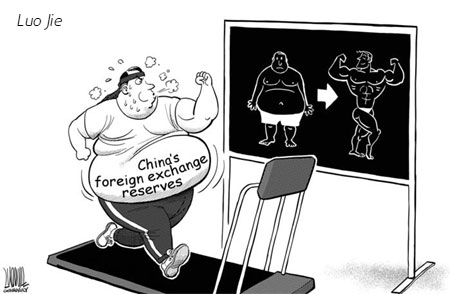 Against the backdrop of a financial crisis that threatens to get even worse, the government has two means to manage China's foreign exchange reserves: One is to take proactive measures to prevent foreign exchange reserves from increasing too rapidly; the other is to improve the foreign exchange reserve structure as well as the structure of financial assets and commodities in the country's international reserves.
China should gradually adjust the structure of its reserve currencies but avoid taking any drastic steps. Roughly speaking, US dollar assets account for 70 percent of China's foreign exchange reserves, euro assets for 20 percent and Japanese yen assets for 10 percent. China should make plans for gradually reducing its dollar assets while increasing its euro assets over a period of time and for China's own benefit, long enough to ensure that the US currency maintain a relatively stable value. China should also make efforts to increase its commodity assets and reduce its foreign exchange reserve assets in its international reserves. The international crude oil price has plummeted from nearly $150 a barrel at the highest to around $40 now. Gold, which once topped $1,000 an ounce, has come down to about $900 per ounce. Under such circumstances, China should buy crude and gold assets. Because of the negative correlation between the prices of gold and the US dollar, many countries, in the developed world in particular, have already moved to increase their gold reserves. By contrast, China's gold reserve, which stands at 600 tons, only occupies 1.1 percent of its international reserves, far lower than the world average of 10.2 percent. As the yuan is not fully convertible, nor is it an international settlement currency, China may consider the following two means to help resolve the huge pressure to appreciate the yuan caused by the country's huge foreign exchange reserves.
First, China should continue to encourage foreign financial institutions to issue yuan bonds. They can use the funds raised on the bond market to buy US dollars from the Chinese central bank. Apart from the benefit of lending US dollars to foreign investors, such an arrangement can also lower investment risks, especially the exchange rate risk, compared with buying US Treasury bonds. Second, Chinese commercial banks should be allowed to extend yuan loans to foreign banks, which in turn can use the borrowed money to buy US dollars from China's central bank and pay back the principal and interest later on an annual basis. Both arrangements will be conducive to the process of turning the yuan into an international currency that is fully convertible. Moreover, the Chinese government can spend the foreign exchange reserves on advanced equipment from abroad to help foster China's innovation. The government can also use the foreign exchange reserves to procure equipment overseas to improve the country's educational and medical facilities, for construction of rural infrastructure, for energy conservation, and for work safety and environmental protection. These State-owned assets can also be sold to domestic institutions and enterprises at preferable prices. By this means, the private sector, traditionally at a disadvantage in competing with State sectors, will get a shot in the arm for development. The root cause for the continuous increase in China's foreign exchange reserves points to the imbalanced structure of its economy. Therefore, China needs a fundamental change in its mode of economic growth. China should make its monetary policy more independent and further reform its exchange rate forming mechanism, making it more flexible. In addition, the two-way floating of the yuan's exchange rate will ease market expectations of yuan appreciating and discourage advance collection of foreign exchange payments by exporters, or delayed payments in foreign exchange by importers. The author is a special researcher with the Shanxi Academy of Social Sciences. The article was reprinted from Shanghai Securities News
(For more biz stories, please visit Industries)
|
|||||
主站蜘蛛池模板: 精品一卡2卡三卡4卡乱码精品视频| 久久精品国产亚洲精品色婷婷 | 亚洲va久久久噜噜噜久久狠狠| 岛国精品一区二区三区| 国产自拍在线一区二区三区| 99在线视频免费观看| 中文字幕亚洲综合久久| 大香j蕉75久久精品免费8| 日本午夜精品一区二区| 色偷偷www.8888在线观看| 好看午夜一鲁一鲁一鲁| 日韩亚洲国产激情一区二区 | 国产欧美精品aaaaaa片| 欧美人与禽2o2o性论交| 亚洲AV无码专区电影在线观看 | 亚洲av永久无码精品水牛影视| 日韩亚洲AV无码一区二区不卡| 奇米四色7777中文字幕| 好爽受不了了要高潮了av| 久久精品国产高潮国产夫妻| 日本高清视频网站www| 中文字幕无码免费不卡视频| 成人AV专区精品无码国产 | 国产精品私拍99pans大尺度| 国产性生大片免费观看性| 国产一区二区三区小说| 国精品午夜福利不卡视频| 国产免费久久精品99reswag| AV最新高清无码专区| 四虎永久免费很黄的视频| 少妇被粗大的猛烈进出免费视频| 国产欧美在线一区二区三| 3d动漫精品一区二区三区| 少妇被黑人到高潮喷出白浆| 国产精品乱子伦一区二区三区 | 人妻日韩精品中文字幕| 午夜免费无码福利视频麻豆| 国产精品福利中文字幕| 日本55丰满熟妇厨房伦| 噜噜综合亚洲av中文无码| 国产乱人伦偷精品视频不卡|



