BIZCHINA> Editor Choice

|
BIZCHINA> Editor Choice
|
|
A green dragon spreads its wings across China
By Yu Tianyu and Qi Taren (China Daily)
Updated: 2009-03-09 07:52
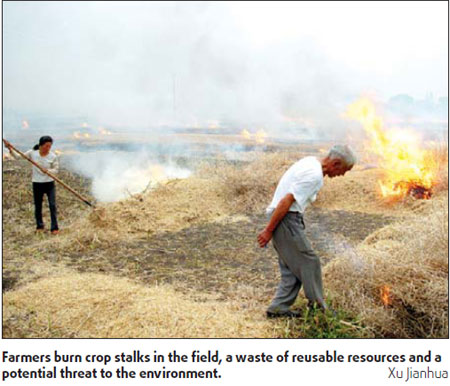
Sixteen years ago, when he was Chinese advisor to Volvo Truck Corporation, Jiang Dalong was inspired by his superior, Karl-Erling Trogen, and became interested in the environment. A native of Shandong, Jiang had wanted to help the farmers of his native land and he found a way to combine his two interests. The result was Dragon Power Co Ltd (DP), China's largest biomass energy producer. " I knew he was interested in environmental issues and also wanted to do something good for farmers," Trogen recalled last Friday in a telephone interview. "It was a dream for him to combine green electricity and give the farmers the opportunity to raise their standard of living. We found each other and had many discussions about what we could do." DP occupies about 92 percent of the Chinese biomass power market, with 13 operating power plants and six others under construction. DP generates 2.05 billion KWh of electricity from composting 2.4 million tons of crop stalks and other plant materials. This year, DP will begin construction on an additional 10 power plants at 300 million yuan apiece. By the year 2010, the company expects to be operating 50 plants to supply 7.5 billion KWh of electricity annually. By that time, the company is expected to have created 80,000 new jobs in rural areas through the collection, storage, transportation and processing of hay. "He is both a visionary and action oriented," Torgen said of Jiang. "He always wants to move. He is very fast and sometimes if is difficult for me to follow him!" So far, DP has created 15,000 jobs in rural areas and pays local farmers 600 million yuan a year. At the same time, it has helped decrease CO2 emissions by some 2.3 million tons. "I believe this is a good commercial model, however, in the initial stage of its development, there are tremendous difficulties," Jiang said. "For one, startup costs are very high and we have to invest a huge amount at the beginning." According to Jiang, startup costs for a biomass power generation plant is four times that of a coal-fired power plant. Currently, the government gives a 0.25 yuan subsidy per KWh to biomass power plants, but it is not enough to recover investment costs, Jiang said. China is abundant in biomass resources, with an annual 700 million tons of hay - equal to 500 million tons of coal, a third of China's annual output, in energy potential - and 100 million tons of other agricultural materials. However, apart from use for cooking, heating and making of paper, half of these materials are discarded. Farmers burn hay and crop stalks in their fields for the following year's planting season, rather than composting these materials. Most cannot afford the cost to do so. To Jiang, this is not only a waste of resources, but a potential threat to the environment. He said he was astonished to find that on average, Beijingers lost 13 days of clear skies a year to air pollution from the burning of hay and crop stalks in the surrounding rural areas. The Beijing-Shanghai Highway was blocked intermittently for about one month each year because of air pollution and low visibility. Start-up company In January 2004, Jiang established DP with only six staff. He imported technologies from Denmark and planned to do further research and innovation. When DP began construction of the first biomass power generation plant in Shandong province's Shanxian county, none of the locals believed it would work. In late 2006, DP put a plant with a capacity to produce 30 mw into operation. The plant can generate 220 million KWh of electricity and process 200,000 tons plant matter a year, reducing CO2 emission by 100,000 tons per year. Compared to a traditional coal-fired power plant, it saved an equivalent 70,000 tons of standard coal. As the local government and farmers started to benefit from the project, more and more people became interested and supportive of biomass power generation. "We set up some purchasing stations in many of villages and employ some farmers as agents to help us purchase hay," Jiang said. "It generates lots of work opportunities in rural areas." Lao Chen, a farmer living in Shanxian county, the location of DP's first biomass power plant, makes 820 yuan for a truckload of hay, enough to cover his daughter's tuition and his mother's medical expenses. His truckload of hay will generate 4,000 KWh of electricity and also help reduce CO2 emission by 3,500 kg, Jiang said. "We pay an average of 242 yuan for a ton of crop stalk and hay," Jiang said. "Assuming that one family's field can produce 2.5 tons of crop stalks and hay, they can earn 605 yuan just by selling something they used to burn as waste." The average annual income for Chinese farmers was 4,761 yuan per capita in 2008, according to National Bureau of Statistics of China. According to Jiang, a 30 mw biomass power plant can bring in 60 million yuan a year to local farmers and create 1,000 work opportunities. DP would face its toughest challenge in 2007. Because of high investment costs and the rising operating costs Jiang's company began to run a deficit. Unlike the wind and solar power industries, he was not receiving enough government subsidies. Between rising prices for materials and the government-regulated price for electricity, Jiang found it difficult to make a profit. He approached Citibank officials for funding. Rather than talk about how promising his company was, he told Citibank about his childhood in a poor rural area, about how it Chinese farmers would benefit and China's environmental problems. He received a crucial $150 million in loans, which later was converted into equity. "He is socially very competent and it is easy to like him," Torgen said of Jiang's approach to doing business. "He is very open and honest. He always asks you about your family." Jiang is still confident that the government will institute policies to encourage the development of biomass power generation, and has begun to refund the value-added tax. "If farmers can turn these resources into money in their pockets, and enterprises such as DP can turn these resources into electricity, it is an immense contribution to the Chinese people, to the country and to the world," Jiang said. "Surely profits will follow." "I imported the technologies from Denmark," he added. "Now I'm very willing to export these world-leading technologies to any country because there is no boundary when it comes to protection of environment and elimination of poverty." Jiang's mentor Torgen agreed. "If I had told you five years ago that Dragon Power would be operating 19 clean energy power stations, you would have said that I was dreaming," Torgen said. "He has delivered on that and that is fantastic. Nowhere else in the world would that have been possible."
 (For more biz stories, please visit Industries)
|
主站蜘蛛池模板: 国产在线中文字幕精品| 亚洲熟妇激情视频99| 日本亚洲欧洲另类图片| 国产成人精品97| 国产av综合一区二区三区| 99亚洲男女激情在线观看| 天堂影院一区二区三区四区| 日韩国产欧美精品在线| 乳欲人妻办公室奶水| 国内少妇偷人精品免费| 一本色道久久加勒比综合| 四虎永久精品在线视频| 国产精品视频一区二区三区无码| 国产亚洲综合另类色专区| 人妻放荡乱h文| 成人免费无码视频在线网站| 少妇粗大进出白浆嘿嘿视频| 高清欧美精品一区二区三区| 亚洲国产精品无码一区二区三区| 四虎国产精品永久入口| 亚洲性日韩一区二区三区| 加勒比无码人妻东京热| 九九久久人妻精品一区色| 18岁日韩内射颜射午夜久久成人| 国产美女久久久亚洲综合| 肥大bbwbbw高潮抽搐| 国产无遮挡无码视频在线观看| 婷婷四虎东京热无码群交双飞视频| 又黄又爽又猛1000部a片| 国产性色的免费视频网站| 久久99精品久久久久久齐齐百度| 亚洲精品一区二区制服| 黑人巨大亚洲一区二区久| 99中文字幕国产精品| 国内久久久久久久久久| 奇米四色7777中文字幕| 国产深夜福利在线免费观看| 九九热视频在线免费观看| 91精品国产综合久久精品| 黄色不卡视频一区二区三区 | 日韩 一区二区在线观看|

