BIZCHINA> Top Biz News

|
BIZCHINA> Top Biz News
|
|
Pollution levels, energy use drop
By Xiao Yu (China Daily)
Updated: 2009-03-09 07:49 China made progress in reducing its energy use last year, according to a government report.
Even a small drop in China's energy use can save tens of millions of tons of coal. The Chinese government had earlier vowed to reduce its energy consumption by 20 percent per 1,000 yuan of GDP from 2005 levels, during the 11th Five Year period (2006-2010). But the country only cut it by 5.38 percent over 2006 and 2007, about a quarter of the five-year target. But preliminary statistics showed that in 2008 China's emissions of sulfur dioxide (SO2) and chemical oxygen (COD), two major pollutants, have likely dropped 7 percent and 5 percent, respectively, from their 2005 levels. The country's 11th Five Year Plan requires they be reduced by 10 percent from the 2005 level by 2010. Deputy environmental minister Zhang Lijun said the country may surpass these targets before the deadline.
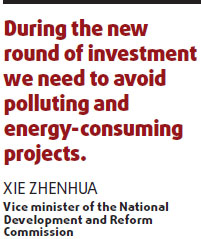
But China fell short of its target reductions of the two pollutants in the plan's first two years. The two indexes dropped only 2.14 and 3.16 percent, respectively, from 2005 level by 2007, less than the expected 4 percent. Zhang said that the Ministry of Environmental Protection (MEP) has disapproved or postponed approval of 156 polluting or energy consuming projects. China needs to "sprint" in 2009 to achieve its green goals, said Zhou Shengxian, environmental minister. The country also closed inefficient production facilities in industries such as papermaking, coal and ethanol, since 2006, said Zhang. China increased its capacity to treat medical waste (by 6 percent), residential waste (by 8 percent) and daily waste water (by 35 percent) since 2005, he added. China's investment in ecological protection will increase to 1.53 trillion yuan from 700 billion yuan, according to the plan, and 350 billion of China's 4-trillion stimulus package is earmarked for environmental investment. "During the new round of investment we need to avoid polluting and energy-consuming projects," said Xie Zhenhua, vice minister of the National Development and Reform Commission (NDRC). Wang Jinnan, general director of the Chinese Academy for Environment Planning under MEP, said that the package's infrastructure projects must abide by relevant environmental policies from the beginning and environmental assessments of these projects should be stricter. Environmental protection and energy conservation will likely be a hot issue during the NPC and CPPC annual sessions. The National Development and Reform Commission has pledged to increase efficiency in the power sector and to push through more fuel price reforms, while closing down inefficient enterprises, echoing similar policies that have been in place for years. The government vows to work to make the nation greener, introducing regional climate change programs, shutting small coal mines and power plants and continuing to experiment with cap and trade emissions programs. Its efforts to increase efficiency include plans to enable power trade between provinces and to upgrade urban power grids. According to the 11th Five-Year Plan, industrial demand for water should also drop 20 per cent from 2005 to 2010, while forests should make up 20 percent of the country's total land area, up from 18.2 percent in 2005. Many regional governments have already made ecological promises in 2009. The Beijing municipality proposed decreasing its COD and SO2 by 2 percent and 3 percent in 2009, Hebei province plans to cut COD by 5.5 percent and SO2 by 5 percent while the Inner Mongolia autonomous region plans to cuts its COD and SO2 emissions to 80 to 90 percent of the 11th Five Year target levels. (For more biz stories, please visit Industries)
|
|||||
主站蜘蛛池模板: 久久99精品久久久久久青青| 亚洲午夜伦费影视在线观看| 久久综合九色综合97欧美| 一边捏奶头一边高潮视频| 精品亚洲国产成人性色av| 欧美精品在线观看视频| 日韩av在线不卡一区二区三区| 亚洲精品一区二区三区四区乱码| 无码精油按摩潮喷在线播放| 九九在线精品国产| 在线观看国产一区亚洲bd| 四虎库影成人在线播放| 少妇人妻呻呤| 国产精品夜夜春夜夜爽久久小说| 国产亚洲精品超碰| ww污污污网站在线看com| 久99久热只有精品国产99| 性高朝久久久久久久久久| 久久人与动人物a级毛片 | 国色天香成人一区二区| 亚洲人成网站18禁止人| 爱性久久久久久久久 | 国产精品无遮挡又爽又黄| 亚洲一区二区中文av| 国产亚洲欧洲av综合一区二区三区 | 久久综合色之久久综合色| 国产女人在线视频| 日韩老熟女av搜索结果| 亚洲不卡av不卡一区二区| 国产精品久久久久鬼色| 午夜激情福利一区二区| 日本人妻巨大乳挤奶水免费| 亚洲 卡通 欧美 制服 中文| 成人啪精品视频网站午夜| 国产97人人超碰CAO蜜芽PROM| 色综合久久久久综合体桃花网| 亚洲 制服 丝袜 无码| 鲁丝片一区二区三区免费 | 中文国产乱码在线人妻一区二区| 久久综合色之久久综合| 日本A级视频在线播放|