BIZCHINA> Energy and Environment

|
BIZCHINA> Energy and Environment
|
|
China, US build new partnership
By Li Jing (China Daily)
Updated: 2009-03-02 07:55
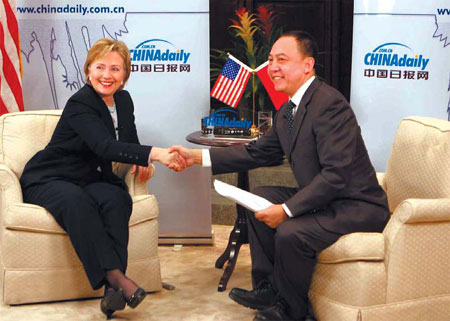
US Secretary of State Hillary Clinton's recent visit to China opened a new chapter in environmental cooperation between the world's two largest greenhouse gas emitters. Clinton admitted that both her home country and Europe "didn't know any better" about protecting the environment during their industrialization and development. She urged China not to repeat their mistakes and called for a US-China partnership on fighting global warming. The two countries have agreed to build "an important partnership" to develop clean energy technologies and speed up their transition to low-carbon economies. Some Chinese experts on climate change are delighted about the Obama administration's action on the issue, but they remain skeptical about whether the partnership could yield any substantial results. Lu Xuedu, deputy director of the global environmental affairs office at the Ministry of Science and Technology, who was also a negotiator at previous climate talks, said funding and technology transfer remained key issues to be addressed to ensure qualitative US-China cooperation. During the fourth Strategic Economic Dialogue (SED) held in Washington in June 2008, the two countries signed a 10-year energy and environmental protection cooperation framework, which covers electricity, clean water, clean transportation, clean air and the conservation of forest and wetland ecosystems. But the cooperation framework was mostly "limited to policy recommendations", according to a unnamed senior official from Ministry of Environmental Protection who took part in previous SED negotiations. Lu said that he was glad to see the US has adopted a more positive attitude toward climate change. But he also pointed out that funding and technology were the keys to ensure cooperation has a meaningful impact. Jiang Jiasi, director of Peking University Environment Fund, said that 76 percent of technology transfers still take place between developed nations. He said that technology partnerships with industrialized nations are a good place to start for developing countries, who still find it difficult to foster innovation. Todd Stern, the US special envoy on climate change, who accompanied Clinton on her Asian trip, said there are "a great number of areas" for cooperation, such as clean coal technology, carbon capture and storage, hybrid and electric vehicles, energy efficiency and renewable energies. He said the two countries could jointly set up pilot projects in these areas and work together on research and development, to "put some real content into this partnership". Yang Fuqiang, director of global climate change solutions at the WWF, proposed that closer links at provincial and state level could push forward cooperation. "The joint project on electricity demand management between China's Jiangsu province and the State of California in the US has proven very successful in recent years," Yang told China Business Weekly. There are a great many opportunities for cooperation at this level, Yang said. For example, Texas has a dry climate and natural conditions very similar to China's Ningxia Hui and Xinjiang Uygur autonomous regions, so cooperation on the development of wind energy would benefit both sides, according to Yang. The two countries should also intensify communication and exchanges between academic groups, the media and non-governmental organizations to foster better mutual understanding, Yang said. Yang's view was echoed by Stern, who applauded China's efforts in combating climate change as "very impressive", and pointed out that the steps China had been taking needed to be better understood in the US. If Sino-US cooperation on clean technologies can proceed smoothly, it will pave the way for more sensitive topics, such as the carbon emission reduction scheme, to be addressed in the lead up to the Copenhagen talks, Yang noted. A climate deal is due to be reached in December in Copenhagen to replace the Kyoto Protocol limiting the greenhouse gas emissions of 37 industrialized nations, which expires in 2012. Talking about the US position at the upcoming Copenhagen talks, Stern said that the Obama administration was committed to "a large-scale, far-reaching and mandatory plan" for climate change and clean technologies. US President Barack Obama said during his election campaign that through a carbon trade program, the US would cut its greenhouse gases by 80 percent by 2050, with a 15 percent reduction being achieved by 2020, Stern said. However, Yang pointed out this target still fell short of the 20 percent reduction by 2020 that the European Union suggested for industrialized countries, and is far lower than the 25 to 40 percent reduction recommended by United Nations Framework Convention on Climate Change. Both Clinton and Stern called on China to make significant moves as the country will continue to be one of the world's largest emitters in the near future, and worsening global warming leaves limited space for carbon emissions. Replying to this, Lu said that China, as a developing country, had always kept its promises on combating climate change and had already made tremendous achievements. During a webchat with Clinton on Feb 22, Qi Ye, a professor at Tsinghua University, said that China had doubled its energy efficiency from 1980 to 2000, and the country was determined to further reduce energy consumption by 20 percent by 2010, equal to about three times the EU's carbon emission reduction target set in the Kyoto Protocol. (China Daily 03/02/2009 page3) (For more biz stories, please visit Industries)
|
主站蜘蛛池模板: 5555国产在线观看| 日韩国产亚洲欧美成人图片| 亚洲第一狼人区在线观看| 国产成人久久精品一区二区| 国产精品成人av电影不卡| 国内精品久久人妻无码不卡| 国产精品免费中文字幕| 日韩在线观看精品亚洲| 国产成人亚洲精品狼色在线| 亚洲2区3区4区产品乱码2021| 在线视频中文字幕二区| 国产中文字幕精品免费| 最近中文字幕在线中文视频| 国产中文字幕精品免费| 精品熟女少妇av免费观看| 日本大片在线看黄a∨免费| 99在线精品免费视频九九视| 亚洲成人av免费一区| 亚洲一区二区精品另类| 国内精品一线二线三线黄| 九九热在线免费精品视频| 一区二区三区在线观看日本视频| 婷婷四虎东京热无码群交双飞视频 | 2021中文字幕亚洲精品 | 加勒比无码人妻东京热| 国产精品涩涩涩视频网站| 最近中文字幕日韩有码| 国产亚洲精品久久精品6 | 欧美成年黄网站色视频| 九九热视频在线免费观看| 日韩精品一区二区三区激情视频 | 激情亚洲内射一区二区三区 | 中文一区二区视频| 国产精品老熟女露脸视频| 日韩不卡免费视频| 国产成人精品午夜2022| 清纯唯美制服丝袜| 成人精品一区二区三区四| GV无码免费无禁网站男男| 黄色亚洲一区二区三区四区| 国产精品久久久久鬼色|