BIZCHINA> Global Markets

|
BIZCHINA> Global Markets
|
|
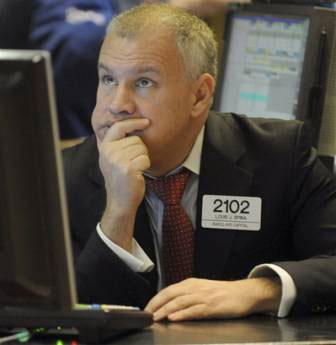
US stock market falls to 1997 levels
(Agencies)
Updated: 2009-02-24 07:26 Wall Street has turned the clock back to 1997. Investors unable to extinguish their worries about a recession that has no end in sight dumped stocks again Monday. The Dow Jones industrial average tumbled 251 points to its lowest close since Oct. 28, 1997, while the Standard & Poor's 500 index logged its lowest finish since April 11, 1997.
"People left and right are throwing in the towel," said Keith Springer, president of Capital Financial Advisory Services. Investors pounded most financial stocks even as government agencies led by the Treasury Department said they would launch a revamped bank rescue program this week. The plan includes the option of increasing government ownership in financial institutions without having to pour more taxpayer money into them. Although the US government has said it doesn't want to nationalize banks, many investors are clearly still concerned that this could be a possibility as banks continue to suffer severe losses because of the recession. They're also worried that banks' losses will keep escalating as the recession sends more borrowers into default. "The biggest thing I see here is the incredible pessimism," Springer said. "The government is doing a lousy job of alleviating fears." The Treasury and other agencies issued a statement after The Wall Street Journal reported that Citigroup is in talks for the government to boost its stake in the bank to as much as 40 percent. Analysts said the market, which initially rose on the statement, wanted more details of the government's plans. "It's only a very partial picture of what we may get," said Quincy Krosby, chief investment strategist at The Hartford. "This proverbial lack of clarity is damaging market psychology." Meanwhile, technology stocks fell after The Journal reported that Yahoo Inc.'s new chief executive plans to reorganize the company. But the selling came across the market as pessimism about the recession and its toll on companies deepened. "There's no where to hide anymore," said Jim Herrick, director of equity trading at Baird & Co. The market's decline extends massive losses from last week when the major stock indexes tumbled more than 6 percent. The major indexes plunged through the lows they reached in late November, at the height of the credit crisis. "There's no main driver of the down day," said Ryan Detrick, senior technical strategist at Schaeffer's Investment Research. "There's just so much skepticism in the overall market and (the question is) is the government doing proper things to get us out of this problem. Obviously the stock market is voting no." According to preliminary calculations, the Dow dropped 250.89, or 3.41 percent, to 7,114.78. It last closed this low on Oct. 28, 1997 when it finished at 6,971.32. The Dow hasn't traded below the 7,000 mark since October 1997. The Standard & Poor's 500 index fell 26.72, or 3.47 percent, to 743.33. It was the lowest close since April 11, 1997, when it ended at 737.65. The technology-laden Nasdaq composite index dropped 53.51, or 3.71 percent, to 1,387.72. The Russell 2000 index of smaller companies fell 16.38 or 3.99 percent, to 394.58. Declining issues outnumbered advancers by more than 6 to 1 on the New York Stock Exchange, where volume came to 1.61 billion shares compared with heavy volume of 2.12 billion shares on Friday. Among tech stocks, Hewlett-Packard Co. fell $1.96, or 6.3 percent, to $29.28, and Intel Corp. dove 70 cents, or 5.5 percent, to $12.08. Other big decliners included General Electric Co., which dropped to a 14-year low of $8.80, but ended down 53 cents, or 5.7 percent, at $8.85. Aluminum producer Alcoa Inc. tumbled 48 cents, or 7.6 percent, to $5.81. Some financial stocks managed to gain, including Citigroup, which rose 19 cents, or 9.7 percent, to $2.14, and Bank of America Corp., which gained 12 cents, or 3.2 percent, to $3.91. Bond prices were mixed. The yield on the benchmark 10-year Treasury note, which moves opposite its price, fell to 2.77 percent from 2.79 percent late Friday. The yield on the three-month T-bill, considered one of the safest investments, rose to 0.28 percent from 0.26 percent Friday. The dollar was mixed against other major currencies, while gold prices fell. Light, sweet crude fell $1.59 to settle at $38.44 per barrel on the New York Mercantile Exchange. Overseas, Britain's FTSE 100 fell 0.99 percent, Germany's DAX index fell 1.95 percent, and France's CAC-40 slipped 0.82 percent. Earlier, Japan's Nikkei stock average fell 0.54 percent. (For more biz stories, please visit Industries)
|
主站蜘蛛池模板: 中文字幕乱码熟妇五十中出| 日本道播放一区二区三区| 精品综合—国产精品综合高清| 久久夜色精品国产嚕嚕亚洲av| 亚洲国产色一区二区三区| 国产一区二区三区色噜噜| 无码无需播放器av网站| 有码中文字幕一区三区| 三年高清在线观看全集下载| 99久久亚洲综合精品成人网| 人妻另类 专区 欧美 制服| 99麻豆久久精品一区二区| 成在人线av无码免费高潮水老板 | chinese性内射高清国产| 精品一区二区三区在线播放视频 | 99er热精品视频| 精品久久综合一区二区| 国产午夜精品福利91| 国产成人精品人人| 国产剧情91精品蜜臀一区| 非会员区试看120秒6次| 成在人线av无码免费| 女主播扒开屁股给粉丝看尿口| 亚洲国产欧美日韩另类| 国产高清在线男人的天堂| 18禁免费无码无遮挡不卡网站| 日本不卡一区二区三区| 国产精品美女久久久久久麻豆| 东京热加勒比无码少妇| 亚洲成人午夜排名成人午夜| 国产精品青草久久久久福利99 | 中文字幕不卡在线播放| 五月天国产成人AV免费观看| a级毛片在线免费观看| 日本道播放一区二区三区| 亚洲日本一区二区一本一道| 国产精品成人自产拍在线| 无码伊人66久久大杳蕉网站谷歌| 麻豆精品在线| 国产资源精品中文字幕| 亚洲av无码国产在丝袜线观看|