BIZCHINA> Top Biz News

|
BIZCHINA> Top Biz News
|
|
Expensive lessons for overseas investment
By Li Xiang (China Daily)
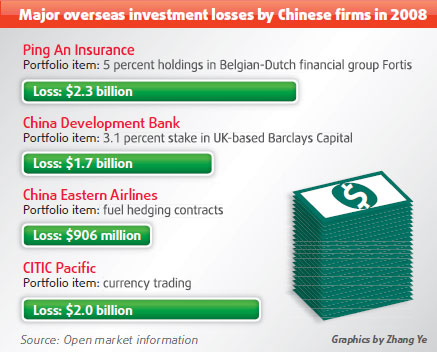
Updated: 2009-02-23 08:01 The past few months were rough for Ping An Insurance, China's second largest life insurer. Chairman Ma Mingzhe made several public apologies trying to soothe angry investors. Board members skipped meals and holidays, working night and day on damage control amid the global financial meltdown. Shareholders and the public criticized Ma's $9.7 million pay package. Ping An's troubles stem from the collapse of Belgian-Dutch financial group Fortis. The company posted a third quarter loss of $2.3 billion from its 5 percent investment in Fortis. Its Chief Investment Officer John Pearce stepped down last month amid speculation that his departure was due to the failed investment, so far the biggest overseas loss resulting from the worldwide financial turmoil by a Chinese financial institution.
The setbacks of Chinese financial firms' foreign expansion indicates the majority of these companies are still inexperienced in foreign acquisitions and face a long, possibly painful, learning process before they reach full maturity in international financial markets. CITIC Pacific, the Hong Kong arm of the China International Trust and Investment Corp, is facing a potential loss of $2 billion on its one-way bets against the US currency and the losses may continue to mount. Its chairman and managing director are now under investigation by the Hong Kong Securities and Futures Commission. China Development Bank is also feeling the pinch, having suffered an 80 percent loss on its $2.8 billion buyout of a 3.1 percent stake in Barclays Capital, the UK-based investment bank. Its holding in the British bank is now only worth $582 million. "Overseas investment, in and of itself, is not wrong. Poor decisions made at a time full of uncertainty should be blamed," said Wu Nianlu, vice-chairman of the China International Financial Society. "Companies thought they had a great opportunity to make some acquisitions at basement-bargain prices after the sub-prime mortgage crisis broke out in 2007 but they did not realize the severity of the crisis," said Wu. Chinese financial regulators have also learned the lesson the hard way. Many big international investment losses for Chinese institutions partly resulted from lack of proper government supervision and regulation. CITIC Pacific, for example, noticed huge potential losses in early September last year but did not disclose the information until October. The six-week delay turned out to be unacceptable for the company's investors. The Ministry of Commerce responded to the situation by announcing in a recent draft of rules that it may ask Chinese companies to apply for approval from the ministry if they want to invest $100 million or more overseas. The China Securities Regulatory Commission asked listed companies to detail their foreign assets holdings in their annual reports. It said listed firms should pay particular attention to devaluation of their financial assets, including derivatives, during the slump in world markets. Companies were also asked to clarify the yuan value of their foreign-currency financial assets as well as provisions they have made for losses on such holdings. Analysts say Chinese financial institutions need to set clear investment policies in their next round of overseas investment. "Companies need to indicate whether they are eyeing long-term benefits or short-term liquidity," said Sun Lijian, an economist with Fudan University. "If long-term benefits are the goal then prudence and caution are needed especially at a time of global financial uncertainty." Some banks and companies are already showing prudence by adjusting their strategies and placing their business focuses back on traditional products. Bank of China extended its deadline to complete its proposed $326.9 million purchase of a 20 percent stake in French private bank La Compagnie Financiere Edmond de Rothschild to March 31. Ma Mingzhe, chairman of Ping An Insurance said in a recent letter to his staff that the company will not seek overseas investment in the short term and will instead focus on domestic markets. Analysts agree Chinese financial institutions should continue to view overseas investment as an opportunity and some suggest that Chinese financial firms should diversify their investments by tapping into developing markets with higher returns. Most Chinese firms are investing in the European and American financial markets which currently have low yields due to the financial crisis, said Sun of Fudan University. "New economies such as Brazil, India and Russia are actually high-yielding markets for future investment," he said.
 (For more biz stories, please visit Industries)
|
主站蜘蛛池模板: 久久精品国产亚洲av热一区| 大地资源中文在线观看西瓜| 久久精品夜夜夜夜夜久久| 欧美一区二区三区在线观看| 伊人久久大香线蕉网av| 999精品全免费观看视频| 丰满少妇内射一区| 亚洲成人av在线高清| 国产成人高清亚洲一区二区| 久久人人97超碰人人澡爱香蕉| 久久波多野结衣av| 日韩在线成年视频人网站观看 | 欧美性开放免费网站| 不卡一区二区国产精品| 激情综合网五月激情五月| 中文字幕第一页亚洲精品| 国产一区二区色婬影院| 久久精品99国产精品日本| 成人午夜免费无码视频在线观看| 国产色无码专区在线观看| 国产农村妇女毛片精品久久| 日夜啪啪一区二区三区| 国产午夜精品一区理论片| 亚洲成a人片77777在线播放 | 午夜福利偷拍国语对白| 国产精一区二区黑人巨大| 国产人妻精品午夜福利免费| 乱60一70归性欧老妇| av中文无码韩国亚洲色偷偷| 国产国拍精品av在线观看| 亚洲国产成人综合熟女| 久久国产精品免费一区二区| 亚洲乱理伦片在线观看中字| 久久精品99久久久久久久久 | 久久精品人人做人人爽97| 亚洲国产成人自拍视频网| 中文无码熟妇人妻av在线| 色综合久久中文字幕综合网| h动态图男女啪啪27报gif| 久99久热精品免费视频| 中文字幕午夜福利片午夜福利片97|



