BIZCHINA> Top Biz News

|
BIZCHINA> Top Biz News
|
|
A growing hunger for foreign groceries
By Li Pan (China Daily)
Updated: 2009-02-09 07:59 Alex Roby, a 38-year-old American expat who has been living in Beijing for two years, goes to Jenny Lou's grocery store at the West Gate of Chaoyang Park every Sunday for Pepperidge Farm's Chocolate Chunk cookies. "It is exactly what I eat back home in the US," he said. There are many other expats like Roby in Beijing who enjoy shopping at Jenny Lou's. Actually, Jenny Lou's is bound to be mentioned in any conversation about where to find Western food in Beijing. The Beijing-based grocery chain catering to expats was founded by Wang Jianping, a rural woman from central China's Henan province 15 years ago. She has increasingly capitalized on the ever-increasing demand for foreign food in Beijing. Expats are not the only ones who love to purchase foreign food. With high quality, exotic flavors, and colorful package, imported food is attracting more Chinese people as well.
Cao Liping, a 62-year-old grandmother, buys Abbott's Gain Advance milk powder at France-based Carrefour for her baby granddaughter. "Abbott's is said to be the best imported milk powder for babies and I don't buy China-made milk powder, you know," Cao said, alluding to last year's toxic infant milk scandal. Zhao Lei, a young designer who has studied in France, goes to BHG market place at Xinguang Plaza to buy its fresh Suki Swiss cheese when he misses the taste. "That is the only place where I can find cheese with an original European taste," Zhao said. The market for imported food in China has been expanding at a dramatic annual growth of 15 percent in the past five years. In 1992, China's imported food amounted to $4 billion while in 2007 the number skyrocketed to $30.6 billion. Wang Wenzhe, chairman of China National Food Industry Association, said he believes that imported foods will have a greater presence in China. Though the economic crisis is tolling the bell for many industries, Wang estimated that in the next five years the market demand for foreign food will reach 1 trillion yuan annually. In addition, industrial experts predict that by 2018, China will become the largest country for imported food in the world. Dealers show great confidence in China's market for imported food. The 17th Chinese Food Exposition and Trade Fair that concluded in Wuhan, capital of central China's Hubei province in December, 2008, attracted more than 1,200 enterprises worldwide with over 10,000 kinds of foodstuffs, among which 1,000 were imported from 30 other countries. Dealers are expecting more in the Chinese market, "because in the forthcoming decade the leading consumption force in China will be the only-child generations born in 1980s and 1990s, who are more ready to embrace the consumption tide of imported food," said Zhou Xianwang, chief of Hubei Provincial Bureau of Commerce. However, "the most important thing is that we are better off than we were 30 years ago," Wang said.
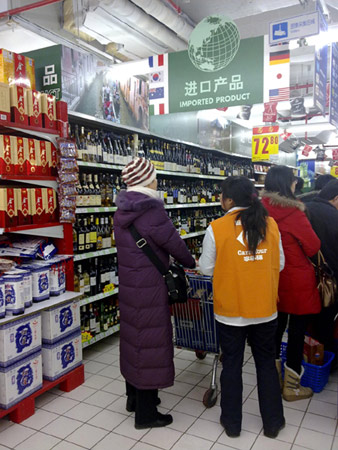
The compelling figure contrast shows that China has transformed from a nation short of food supplies into a leading food producer and consumer in the world following the 30-year old opening up. Meanwhile, people are enriching their lifestyles as they get richer. Supermarkets with imported food, are becoming more popular among young affluent Chinese urbanites. Back in 1995, Carrefour started its first hypermarket in China. In 1996, Wal-Mart entered the Chinese market with an array of mostly American food. In 1998, Ito Yokado began to enrich people's dinner tables with Japanese food. And now an increasing number of local supermarkets are also stocking their shelves with imported munchies. Homegrown supermarkets like Wu-Mart, Chaoshifa and Merry Mart that used to sell low-price necessities now have opened imported food shelves providing tens of or hundreds of imported food. Italian olive oil and Korean grapefruit honey tea are among the most popular food items. High-end supermarkets targeting foreigners and white collars such as BHG Market Place and Ole are also expanding the market. In order to best provide food and service, BHG has a warehouse set at 15 to store over 1,200 kinds of imported red wines, priced from over 10,000 yuan Bordeaux to 100 yuan house red wine. Recently, Niigata rice from Japan was promoted at the market as well. Following the opening of the first BHG Market Place at Xinguang Plaza, Beijing Hualian Group opened two other BHG Market Places in 2008 and in 2009 there are four others on the waiting list, all located in the best commercial areas in Beijing. Hotels are also providing more and more imported food. Va Piano, the flagship Italian restaurant at Intercontinental Beijing Beichen, provides original salami and pepperoni. Its vinegar and salt are also imported from Italy. (For more biz stories, please visit Industries)
|
主站蜘蛛池模板: 天天干天天射天天操| 伊在人间香蕉最新视频| 久久精品国产亚洲av热一区| 国产一区二区一卡二卡| 久久精品中文字幕极品| 国产精品高清视亚洲中文| 亚洲精品岛国片在线观看| 国产乱人伦真实精品视频| 亚洲一区二区三区久久综合| 制服丝袜亚洲欧美中文字幕| 无码人妻斩一区二区三区| 久久精品国产无限资源| 99RE8这里有精品热视频| 中文字幕亚洲制服在线看| 口爆少妇在线视频免费观看| free性开放小少妇| 国产一区二区亚洲一区二区三区| 伊人久久大香线蕉aⅴ色| 亚洲一区二区国产精品视频| 久久天天躁夜夜躁狠狠85| 少妇激情精品视频在线| 亚洲va久久久噜噜噜久久狠狠| 国产精一区二区黑人巨大| 国产成人99亚洲综合精品| 色综合天天综合天天综| 91精品国产色综合久久| 免费人成在线观看网站| 人妻教师痴汉电车波多野结衣| 8av国产精品爽爽ⅴa在线观看| 开心五月婷婷综合网站| 国产高清午夜人成在线观看,| 97久久超碰国产精品旧版| 亚洲精品国产一二三区| 国产二级一片内射视频播放| 四虎在线播放亚洲成人| 无码人妻视频一区二区三区| 国产成人一区二区三区免费| 激情成人综合网| 成av人片一区二区久久| 亚洲一级av大片在线观看| 亚洲综合网一区中文字幕|